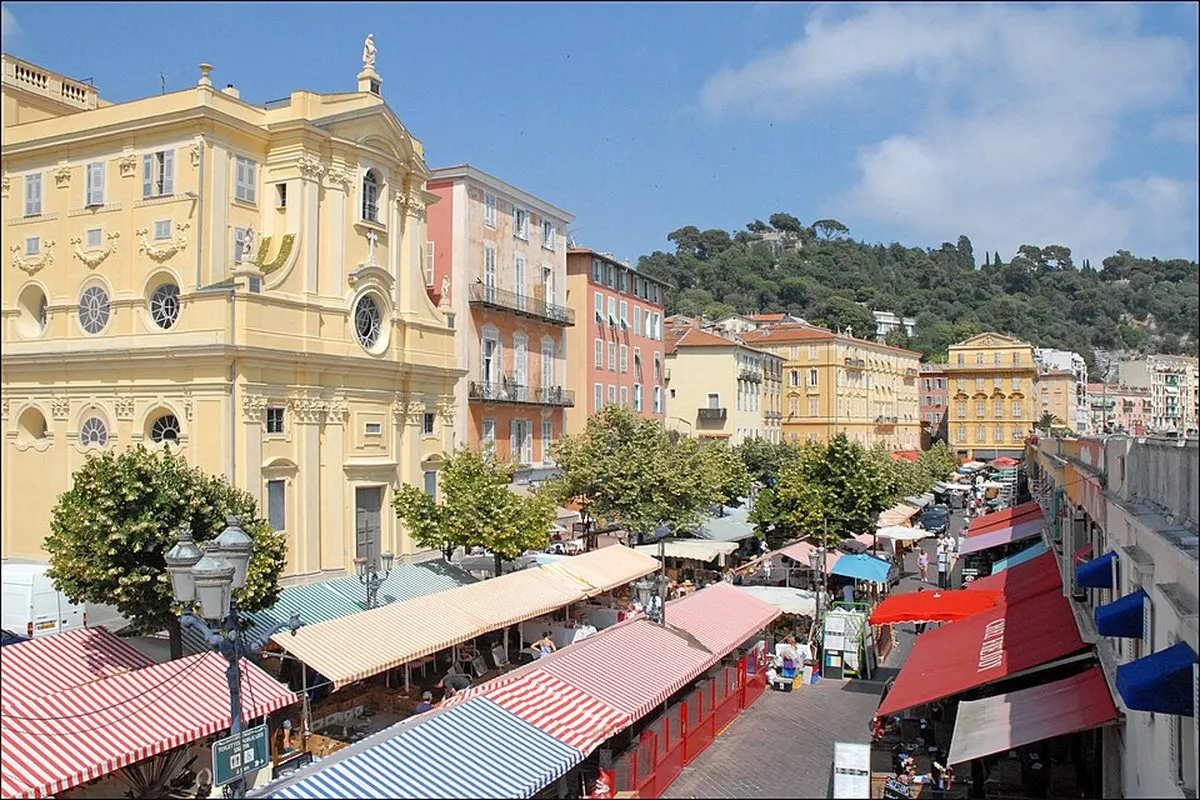
Since 1861, Nice has traded flowers, fruit and vegetables on Cours Saleya. Here's how to tackle the old town's showpiece street one morning – from the flower market to the baroque chapel and Monday's antiques market.
In this story · 5 sections
Cours Saleya is the old town's showpiece street in Nice, a wide, car-free street that runs parallel to the sea behind the row of houses on quai des États-Unis. In the morning, it fills with market stalls beneath striped awnings, and on its north side stands the baroque façade of the Chapelle de la Miséricorde. It is here that Nice has bought its flowers for over 150 years.
2 places
© OpenStreetMap contributors · OpenFreeMap
The markets on Cours Saleya- Flower, fruit and vegetable market
- Tuesday–Sunday, all year round
- Antiques and flea market
- Mondays 7am–6pm
- Craft market
- Summer evenings
From Marina to palco – the street where you needed to be seen
In old texts the place is called Marina. From 1714 the name palco took over, Italian for stage, as this was where one went to show oneself off. During the first half of the 18th century, the terraces – les Terrasses – were built along the shore, and by 1748 the street was almost completely levelled. In 1766, rows of elms were planted in place of the mulberry trees that had previously stood there.
Towards the end of the 18th century, the promenade became the wealthy foreign colony's favourite pastime, and the street and terraces became the centre of fashionable life in Nice. In 1839, Benoît Visconti opened a literary salon in one of the houses on the north side, and for half a century, Visconti was the address for visitors interested in art and literature. The Carnival procession passed through here until 1892.
The market since 1861
On 22 July 1861, the city council approved the first market for flowers, fruit and vegetables on Cours Saleya. In 1900, a metal market hall was built over the street, which was replaced in 1930 by a concrete structure. In 1950, the plane trees were cut down, and outside market hours the street became a car park. In 1980, the concrete hall was demolished, an underground car park was built, and the street became a pedestrian street again.
Today the flower market is open Tuesday to Sunday, with flowers, bouquets and potted plants, and alongside it there are stalls selling fruit, vegetables, crafts and delicatessen goods. The market is included on the Conseil National des Arts Culinaires' list of France's outstanding markets, and the Nice tourist office notes that it is ranked among the country's hundred most picturesque. In summer, a craft market is also held, running on into the evening.
Monday: the antiques market
On Mondays, the flower stalls give way to the antique dealers. Around 180 antique and flea market traders set up their stalls on Cours Saleya and Place Pierre-Gautier between 7am and 6pm, with old furniture, small decorative items, paintings and old books, according to the Côte d'Azur tourist board. On the third Saturday of the month, the flea market moves to Place Garibaldi.
Chapelle de la Miséricorde – Nice's baroque masterpiece
On the street lies the Chapelle de la Miséricorde, the chapel of the Black Penitents, which is considered the masterpiece of the Nice baroque. It was built between 1747 and 1770 on the site of the Sardinian king's old salt warehouse, designed by the architect Bernardo Antonio Vittone from Turin. Inside the elliptical nave, arches, gold and stucco dominate, and the fresco in the dome gives the impression of an open sky. The chapel has been protected as a historic monument since 1921.
The view from Ponchettes
According to the Nice tourist office, the best view of the market is from the top of the steps at Ponchettes, towards Place Pierre-Gautier. From Cours Saleya, it is then just a few steps into the alleys of Vieux-Nice, where the Palais Lascaris from the 1600s today houses the city's collection of musical instruments, with over 500 instruments. From the market it is a short walk to the sea and the Promenade des Anglais. If you want to continue along the coast, you'll find more destinations among our Riviera guides at metromode.co, and the street also features in VERA PI's guide to Cours Saleya.
Sources: Côte d'Azur France and the Nice Côte d'Azur tourist board. The tourist boards do not give exact times for the flower market – come in the morning.
Cours Saleya
The flower market in old Nice
Flowers, fruit and vegetables Tuesday–Sunday since 1861, antiques market on Mondays.
Cours Saleya, 06300 Nice
Insider tipCome in the morning.
Chapelle de la Miséricorde
The Black Penitents' chapel
Baroque chapel from 1747–1770, designed by Bernardo Antonio Vittone.
Cours Saleya, 06300 Nice