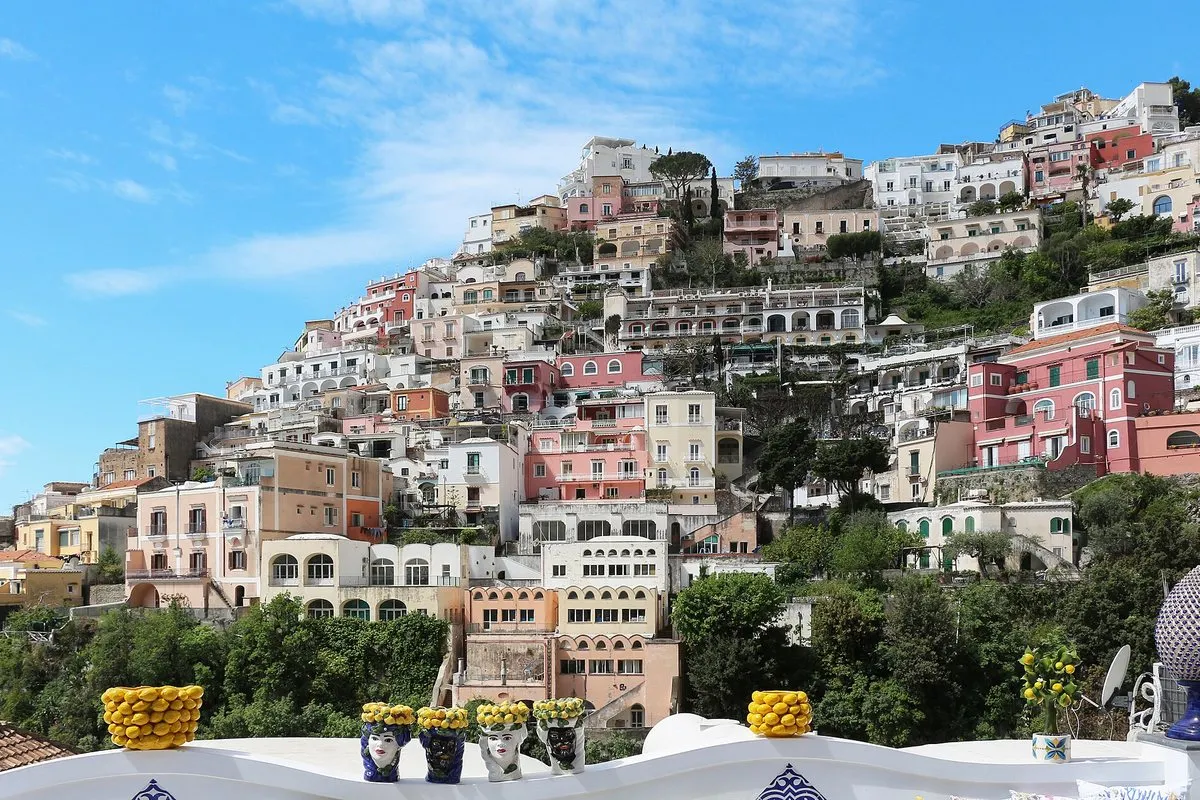
Positano climbs up the Lattari Mountains from the sea, a village of steps and terraces that John Steinbeck called a dream place. A day here goes from the Madonna in Santa Maria Assunta to the Path of the Gods high above the coast.
In this story · 8 sections
Positano is a municipality on the Amalfi Coast in the province of Salerno, with around 3,600 inhabitants. The village is built on the steep limestone slopes of the Lattari Mountains, rising from sea level to over 400 metres within a short distance. The pastel-coloured houses are stacked on top of one another, linked by narrow staircases. It is a vertical village, and it should be experienced on foot.
Modern Positano began with a piece of writing. In May 1953, John Steinbeck published the essay Positano Bites Deep in Harper's Bazaar, writing that it is a dream place that isn't quite real while you are there, but becomes beckoningly real after you have gone. Before that, Positano was a fairly poor fishing village. In the 19th century, more than half the population had emigrated, most of them to America.
6 places
© OpenStreetMap contributors · OpenFreeMap
- 01Santa Maria Assunta and MARChurch and Roman museum · Positano
- 02Spiaggia GrandeBeach · Positano
- 03Li GalliArchipelago · Positano
- 04MontepertusoVillage · Positano
- 05NocelleVillage and trail's end · Positano
- 06BomeranoTrailhead · Agerola
- Residents
- Around 3,600
- Steinbeck's essay
- May 1953, Harper's Bazaar
- Roman museum, MAR
- Opened 18 July 2018
- Path of the Gods
- About 7.8 km, Bomerano–Nocelle
- Amalfi Drive
- About 40 km, Vietri sul Mare–Positano
- UNESCO World Heritage
- Since 1997
Morning: Santa Maria Assunta
Start by the water, at the church of Santa Maria Assunta with its dome of majolica tiles. On the high altar stands a 13th-century Byzantine icon of a Black Madonna. According to legend, the icon had been stolen and was crossing the Mediterranean with pirates when a storm broke out off Positano and the sailors heard a voice say posa, posa – put it down. They carried the icon ashore, and the storm died away. The church's current appearance dates from the rebuilding of 1777–1782.
Beneath the church's oratory lies MAR, the Museo Archeologico Romano, inaugurated on 18 July 2018. Since 2003, the remains of a Roman villa have been excavated here, one of the luxury villas built on the coast of the Sorrento Peninsula in the first century BC. The villa was first described in 1758 by Karl Weber, who also led the excavations at Herculaneum and Pompeii.
Late morning: the beaches and the towers
Spiaggia Grande, or Marina Grande, lies below the church and is the village's most famous beach. To the west, a path leads to Fornillo, the second largest. More beaches – La Porta, Fiumicello, Arienzo, San Pietro, Laurito and Remmese – lie in coves beneath the cliffs, and several are best reached from the sea.
Along the coast stand the watchtowers built to defend against pirates. Torre della Sponda is the oldest, cylindrical and from the 1200s. Torre di Fornillo, out by the beach of the same name, was bought as a ruin in 1909 by the Swiss Gilbert Clavel, who rebuilt it in its pentagonal form. The Russian writer Mikhail Semyonov bought Torre di Renzo in 1915. After the First World War, Positano became a refuge for artists and writers, among them M. C. Escher and the choreographer Léonide Massine.
Midday: Li Galli from the sea
Boat trips leave Positano along the coast, and the natural destination is Li Galli, an archipelago of three islands a few kilometres to the south that belongs to Positano. Strabo described them as the home of the sirens, and they are still called Le Sirenuse. The name Li Galli may come from the fact that Greek art depicted sirens as half woman, half bird. The largest island, Gallo Lungo, has been inhabited since Roman times. In the 1920s, Massine bought the islands and had a villa built, to which Le Corbusier later contributed.
Afternoon: up to Nocelle
At the top of the municipality lies Nocelle, a small village that for a long time could only be reached by a path from Montepertuso or a long staircase from Arienzo. The name comes from the Latin nova cella, not from hazelnut as one might think. Along the way lies the cemetery at Liparlati, with 19th-century villas along the road and a view over the entire coast.
Nocelle is the end point of the Sentiero degli Dei, the Path of the Gods, which runs for about 7.8 kilometres through the Lattari Mountains from Bomerano in Agerola. The name comes from the legend that the Greek gods walked here to save Odysseus from the sirens on Li Galli. For centuries the path was the only link between the villages of the coast, before the Bourbons built the coast road. It is almost entirely downhill in the direction of Nocelle, and it is maintained by volunteers, including members of the Italian alpine club CAI. From Nocelle, the steps down to Positano take about half an hour.
Evening: flavours of the coast
The Amalfi Coast is known for limoncello, made from the sfusato amalfitano lemon grown on terraces all along the coast. From Tramonti comes concerto, a dark herbal liqueur, from Cetara its renowned anchovies, and from Vietri hand-painted ceramics. The climate is mild: winter rarely drops below six degrees, and summer is cooled by the sea breeze.
The Amalfi Coast in context
Positano is the westernmost town of the Amalfi Coast, a UNESCO World Heritage Site since 1997. The only land route is the Amalfi Drive, national road 163, about 40 kilometres long from Vietri sul Mare in the east to Positano in the west. The coast's thirteen municipalities live largely off tourism, and its nickname is the Divina costiera, the divine coast.
More to read
The Amalfi Coast is crowded in summer – go in May, June or September if you can. Across the bay lies Capri, and further up the Italian coast Portofino, Santa Margherita and Camogli. Find more destinations and all city guides at metromode.co.
Today's stops
Santa Maria Assunta and MAR
The church with the majolica dome and the Black Madonna, with the Roman museum beneath the oratory.
Spiaggia Grande
The village's main beach below the church, where the boat trips leave from.
Insider tipHead west for Fornillo
Li Galli
The sirens' islands, three islands south of Positano, bought by Léonide Massine in the 1920s.
Insider tipSeen from the boat
Nocelle
The highest village in Positano, the end point of the Path of the Gods.
Insider tipAbout half an hour down the steps to Positano
Bomerano
The starting point of the Sentiero degli Dei, about 7.8 kilometres from Nocelle.