In this story · 4 sections
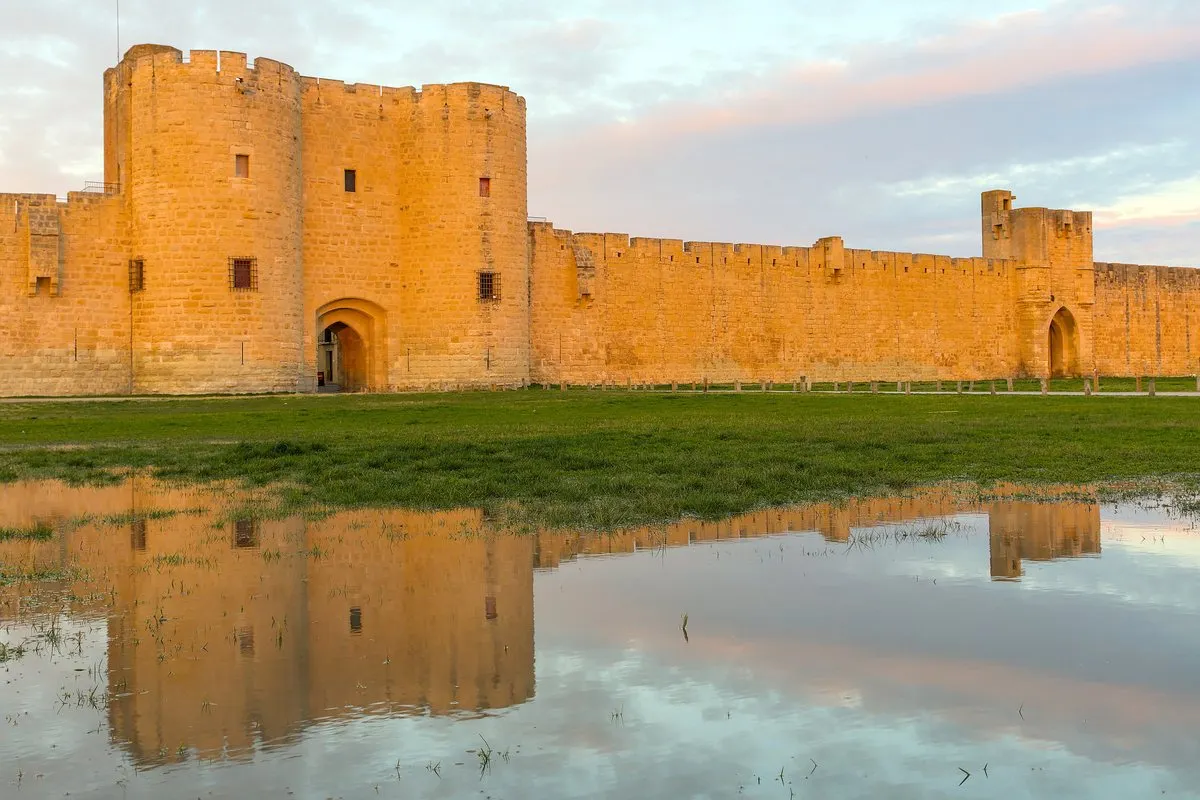
Aigues-Mortes – Aquae Mortuae, “dead waters”, in a document of 1248 – stands in the Petite Camargue at the southern tip of the Gard, among lagoons and salt marshes on the western edge of the Rhône delta. Its medieval walls are remarkably well preserved, and the town sits where the Canal du Rhône à Sète meets the channel to Le Grau-du-Roi and the sea. Our VERA PI guide to Aigues-Mortes covers the local property market.
2 places
A king's port
In 1240 Louis IX wanted a Mediterranean port of his own. Marseille belonged to his brother Charles of Anjou, Agde to the Count of Toulouse and Montpellier to the King of Aragon, so he obtained this marshy ground from the monks of the Abbey of Psalmody, exempted its residents from the salt tax and built a road through the swamps, guarded by the Carbonnière Tower. From here he sailed on the Seventh Crusade in 1248 and on the Eighth in 1270, when he died at Tunis. His son Philip III ordered the walls to be continued in 1272 to enclose the whole town; the work took another 30 years.
Contrary to legend, the sea never lapped the walls. The port lay in the Étang de la Marette and was reached by the Canal-Viel and the Grau-Louis, a channel near present-day La Grande-Motte. As the channels silted up, new ones were cut, until in 1806 the town was linked to the sea for good by the Canal du Rhône à Sète.
The Tour de Constance
The great round keep was raised from 1242 to 1254 to house the king's garrison; its rooftop turret served as a lighthouse from the 13th to the 16th century. Its later history is darker. Between 8 and 11 November 1307, under Philip the Fair, 45 Templars were interrogated, condemned and imprisoned here. After the revocation of the Edict of Nantes in 1685, the tower became a prison for Protestant women who refused to convert. The best known, Marie Durand, sister of a clandestine pastor, was locked up at 19 and released 38 years later. The tower has been a listed historic monument since 1903.
Salt
Salt was made here long before the king came: tradition credits a Roman engineer, Peccius, with the first salt marsh, which still bears his name as the Marais de Peccais. The Salins d'Aigues-Mortes, south-east of the walled town on the D46, were formed into a company in 1856 and are the historic headquarters of the Salins du Midi. Production peaks in summer, when sun and wind evaporate seawater through a chain of basins, and the site has been on France's general inventory of cultural heritage since 1995. Flamingos live along the lagoon shores.
The town today
Aigues-Mortes is a small town of about 8,700 people, with an arena known as the Plan des Théâtres for the bloodless course camarguaise. The D58 runs east through rice fields and lagoons to Saintes-Maries-de-la-Mer and Arles. The town's history also holds a grim episode: the massacre of Italian workers in August 1893.
For the beach next door, see VERA PI's Le Grau-du-Roi guide; for more of the region, our destination guides and Metro Mode Travel.
Tour de Constance
Keep, lighthouse, prison
Louis IX's garrison tower, later a prison for Templars and Huguenot women.
Salins d'Aigues-Mortes
Sea salt since antiquity
The Peccais salt marshes, worked by the Salins du Midi.