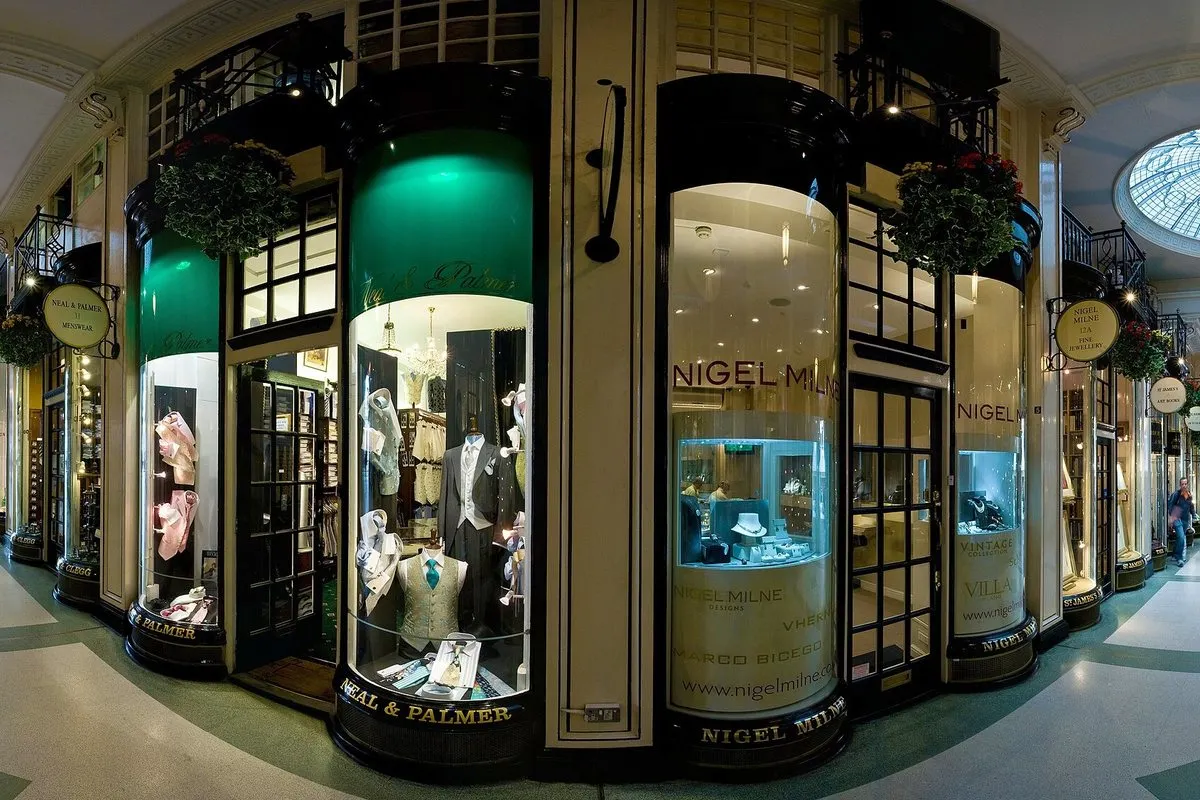
Burlington Arcade opened off Piccadilly in 1819 and is often called the world's first modern shopping mall. Across the road, Piccadilly Arcade has linked Piccadilly with Jermyn Street since 1909. Here is the story of London's covered arcades – beadles, whistling ban and all.
In this story · 5 sections
Burlington Arcade in London is a covered shopping street that runs for 179 metres alongside Bond Street, from Piccadilly to Burlington Gardens. It is often described as the world's first modern shopping mall and a forerunner of the great European shopping galleries of the 19th century. Two centuries on, it is still lined with jewellers, antique silver dealers and small luxury shops – and it still has its own rules of conduct.
2 places
© OpenStreetMap contributors · OpenFreeMap
Burlington Arcade – built in 1819 for the Earl of Burlington
The arcade was built in 1818 for George Cavendish, 1st Earl of Burlington, on what had been the side garden of Burlington House. According to Wikipedia, his brother, the 5th Duke of Devonshire, was said to want to stop passers-by throwing oyster shells and other rubbish over the garden wall. The architect was Samuel Ware, and the arcade was intended for “the sale of jewellery and fancy articles of fashionable demand”. It is also said to have been built so that genteel shoppers could browse away from the busy, dirty and crime-ridden open streets of Regency London.
Burlington Arcade opened on 20 March 1819. The original design was a single, straight, top-lit walkway lined with 72 small two-storey units. Many have since been combined, and there are now around 40 shops. The Piccadilly façade, with sculpture by Benjamin Clemens, was added in 1911.
The beadles and the ban on whistling
The arcade is patrolled by beadles in top hats and frock coats. The first beadles were all former members of Lord George Cavendish's regiment, the 10th Royal Hussars. They still enforce a Regency code of conduct: singing, humming, hurrying and “behaving boisterously” are not allowed. Whistling is banned too, because it was once used as a signal between pickpockets. Only three people are said to have been exempted, among them Sir Paul McCartney.
Fires, a smash-and-grab and two sales
The arcade has had an eventful life. Fires damaged it in 1836, 1871 and 1936, and parts were badly hit during a Second World War bombing raid. In 1964 a Jaguar Mark X was driven down the arcade; six masked men jumped out, smashed the windows of the Goldsmiths and Silversmiths Association shop and escaped with jewellery worth £35,000. They were never caught, and gates were later installed. In 2010 Thor Equities and Meyer Bergman bought the arcade for £104 million and had it restored by the architect Michael Blair, and in 2018 it was sold to David and Simon Reuben for £300 million.
Piccadilly Arcade – from Piccadilly to Jermyn Street
On the other side of Piccadilly, Piccadilly Arcade runs south to Jermyn Street. It opened in 1909 to designs by Thrale Jell and is a Grade II listed building, with 28 shops on the ground floor. The upper floor was originally offices and became the Felix Hotel in 1915. The arcade was bombed in 1941 and not fully restored until 1957. Among its tenants is the Royal Warrant holder Benson & Clegg, which moved here from Jermyn Street in 1976, and a bronze statue of Beau Brummell by Irena Sidiecka stands at the Jermyn Street end. Nearby Princes Arcade also links Piccadilly with Jermyn Street.
How to explore London's arcades
Start at the Burlington Gardens end of Burlington Arcade and walk south to Piccadilly, then cross the road to Piccadilly Arcade and continue down to Jermyn Street, the home of London's shirtmakers. The whole loop takes half an hour without stopping – which, in these arcades, nobody does. Explore the streets in VERA PI's street files for Piccadilly, Burlington Gardens and Jermyn Street, or start with VERA PI's London guide.
Burlington Arcade
London's Regency arcade since 1819
179 metres of jewellers, antique silver and luxury shops between Piccadilly and Burlington Gardens.
- Opened
- 20 March 1819
- Architect
- Samuel Ware
Piccadilly, London W1J
Piccadilly Arcade
From Piccadilly to Jermyn Street
Grade II listed arcade from 1909 with 28 shops and the Beau Brummell statue.
- Opened
- 1909
- Architect
- Thrale Jell
Piccadilly, London SW1Y
At a glance
The two arcades at a glance
| Burlington Arcade | Piccadilly Arcade | |
|---|---|---|
| Opened | 1819 | 1909 |
| Runs between | Piccadilly and Burlington Gardens | Piccadilly and Jermyn Street |
| Shops | Around 40 | 28 |