In this story · 3 sections
Cap-d'Ail sits on the western border of Monaco, touching the Monegasque districts of Fontvieille, La Colle and Les Révoires. Many people who work in the principality live here, and the Basse Corniche has a lively run of shops. But drop down towards the sea and the mood changes completely: steep gardens, grand old villas and wild coves backed by the cliffs of the Tête de Chien.
The commune had 4,482 residents in 2023. Its station, opened in 1881 on the Marseille–Ventimiglia line, is the last before the Monegasque border, which makes it the easiest seaside escape from Monte-Carlo.
4 places
© OpenStreetMap contributors · OpenFreeMap
- 01Plage de la Malasee · La Mala
- 02Pointe des Douanierssee · Cap-d'Ail
- 03Plage Marquetsee · Cap-d'Ail
- 04Villa Les Caméliassee · Cap-d'Ail
- Plage Marquet
- Start by the port, next to Fontvieille
- Pointe des Douaniers
- Rocky headland halfway along
- Plage de la Mala
- The famous cove at the western end
- Total length
- 3.6 km
La Turbie-sur-Mer becomes a town
Until 1860 Cap-d'Ail belonged to the County of Nice, as part of the commune of La Turbie. Known as La Turbie-sur-Mer, it was the hill town's seaside frontage until Monaco's rapid growth in the late 19th century gave it a life of its own. It became a separate commune on 30 December 1908, four years after Beausoleil, and in 1921 was classified as a climatic resort. A Saracen tower, once a Monegasque guard post, appears on a map of 1602.
The shore path
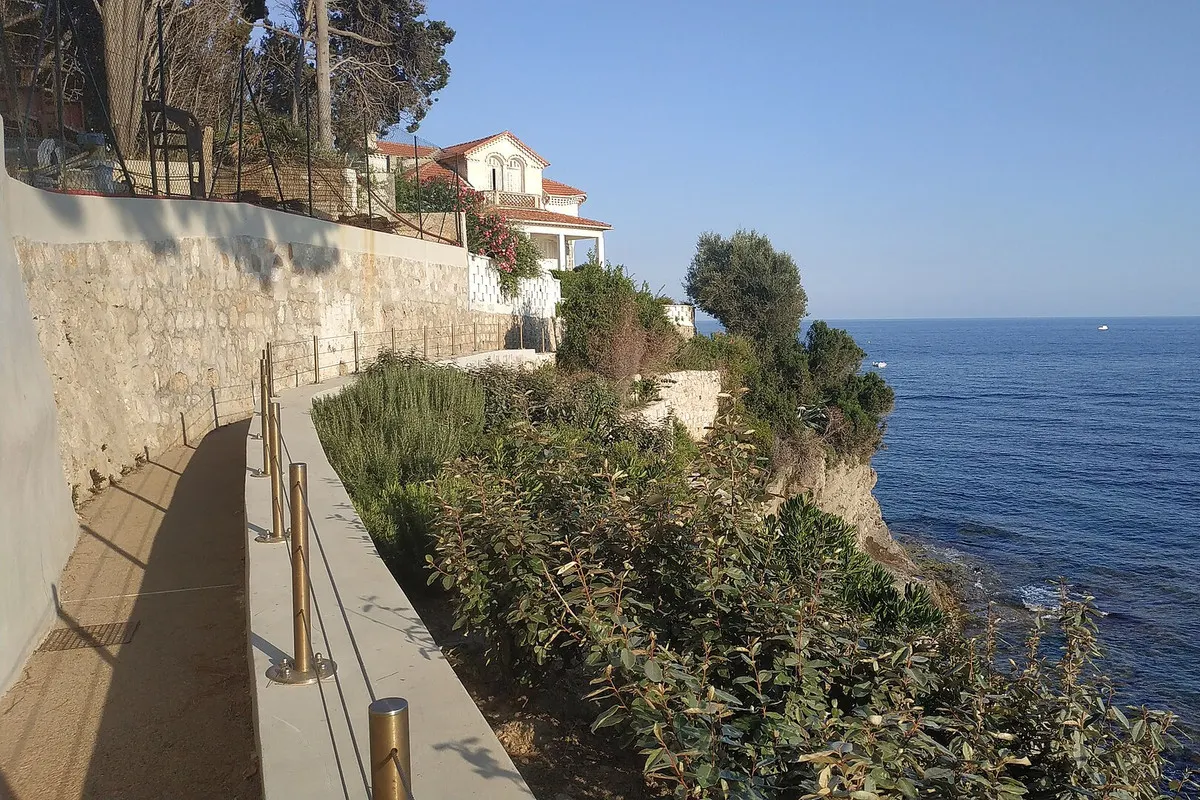
The great pleasure of Cap-d'Ail is its sentier du littoral, an old route restored as a 3,600-metre path along the rocks. It links the Plage Marquet, near the port, with the Plage de la Mala, passing the Pointe des Douaniers. Along the way, information panels describe the marine and coastal life of the protected Pointe Mala and Cap-d'Ail plateau.
The Plage de la Mala is the prize, a cove prized by day-trippers from Monaco and Nice and reached by steps from above or by the path. Go early in summer; it fills up.
Villas of the Belle Époque
In the first decades of the 20th century Cap-d'Ail filled with luxurious villas. Antoine Lumière built the Villa Lumière, or Perle Blanche, in 1902, and the Villa Hélios was built for Louis Lumière in 1901. Sacha Guitry bought the villa Les Funambules in 1911, and the public Parc Sacha Guitry now carries his name. Greta Garbo stayed many times at the Villa The Rock, built in 1910 for George Schlee.
Around 1892 the British diplomat Edward Malet commissioned the Danish architect Hans-Georg Tersling to build the Château de l'Ermitage on 5.8 hectares. The Château des Terrasses, from the late 19th century, received Prince Albert I of Monaco among its guests; the town bought it in 2001 and now hires it out. The Villa Les Camélias, where André Malraux stayed in 1941, is today a museum. Winston Churchill was an honorary mayor of the town.
Plage de la Mala
The cove at the end of the shore path
A natural cove popular with day-trippers from Monaco and Nice.
Plage de la Mala, 06320 Cap-d'Ail
Insider tipArrive early in summer.
Pointe des Douaniers
Headland on the coastal path
A rocky point halfway along the 3.6 km path.
Sentier du littoral, 06320 Cap-d'Ail
Insider tipWear proper shoes; the rocks can be slippery.
Plage Marquet
Beach by the port, next to Fontvieille
The eastern start of the coastal path.
Plage Marquet, 06320 Cap-d'Ail
Insider tipA short walk from Fontvieille in Monaco.
Villa Les Camélias
Belle Époque villa, now a museum
Where André Malraux and Josette Clotis stayed in 1941.
17 avenue Raymond-Gramaglia, 06320 Cap-d'Ail
Insider tipCheck opening days before visiting.
Neighbourhood and property data for Cap-d'Ail is on VERA PI, and more Riviera walks are on metromode.co.