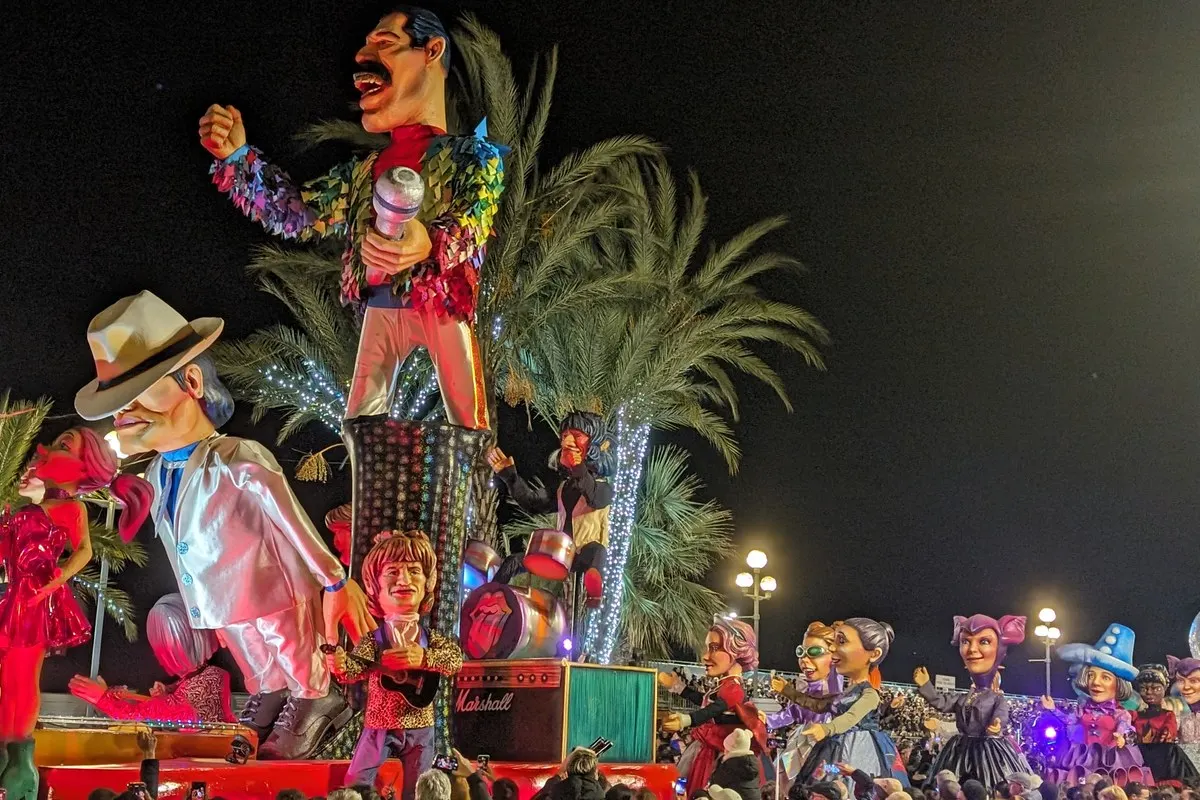
From 9 to 28 February 2027 Nice hands its streets to the King of Carnival. Here is how the oldest carnival on the Riviera works – the corsos on Place Masséna, the flower battles on the Promenade des Anglais – and how to plan a weekend around it.
In this story · 5 sections
Every February, when the rest of Europe is still in coats, Nice crowns a king made of papier-mâché, parades him through the city for a fortnight and then sets him on fire by the sea. The Carnaval de Nice is the biggest in France and one of the great carnivals of the world, and it has the advantage of a winter sun that the others can only envy.
The 2027 edition runs from 9 to 28 February under the theme Vive l'Amour – love in every sense, from poetry to the universal kind, with the Queen now fully the equal of the King. The detailed programme and prices follow nearer the date; this is how the carnival works, and how to make the most of it.
Carnaval de Nice
Event · Place Masséna and Promenade des Anglais, Nice
© OpenStreetMap contributors · OpenFreeMap
- Address
- Place Masséna, 06000 Nice
- 2027 dates
- 9–28 February 2027
- 2027 theme
- Vive l'Amour
- First recorded
- 1294
- First battle of flowers
- 1876, Promenade des Anglais
- Flowers per battle
- About 100,000
- Attendance
- More than 420,000 participants in 2026
- Grandstands (2026)
- Place Masséna €28, children 6–12 €10 · Promenade des Anglais €23, children €8
- Standing (2026)
- Illuminated corso from €7
France's largest carnival, first recorded in 1294: satirical corsos around Place Masséna, illuminated night parades and flower battles on the Promenade des Anglais, ending with the burning of the King by the sea.
01Seven centuries of carnival
The first written mention dates from 1294, when Charles II of Anjou, Count of Provence, came to spend “the days of carnival in his good town of Nice”. For centuries it was a popular street festival; in the Renaissance came masked balls in the narrow lanes of the old town, and in the eighteenth century the influence of Venice.
The modern carnival was born of tourism. In the second half of the nineteenth century Nice had become the winter capital of Europe's wealthy, and after the turmoil of the Paris Commune in 1871 the city wanted to show its calm. A festival committee was created in 1873 and turned the carnival into a staged spectacle, with parades of floats. The painter Alexis Mossa built the first float for His Majesty Carnival in 1882 and gave him a consort, Madame Carnaval, in 1893; his son Gustav-Adolf Mossa took the satirical, fantastical art of the floats to new heights. Paper confetti arrived in 1892; the old plaster kind was finally banned in 1955.
02The corsos
The carnival parades are called corsos, and their heart is Place Masséna, where grandstands are built around the square. The floats are satirical by tradition, mocking the year's news under the season's theme, and they are surrounded by street performers, bands and the grosses têtes, giant papier-mâché heads worn by walkers – nearly 300 of them paraded in 2026.
Insider tipBook a grandstand seat for a flower battle – the floats pass close and the flowers come straight to you.
The night parades are the more spectacular. In the illuminated corso, floats up to twenty metres tall are lit by thousands of LEDs, and the Promenade des Anglais becomes a moving stage along the Baie des Anges.
03The battle of flowers
The bataille de fleurs was the idea of the writer Alphonse Karr, a flower lover living in Nice, who dreamt of a spectacle in which people threw fragrant bouquets at one another. The first was held on the Promenade des Anglais in 1876. Today it is a parade of flower-covered floats from which costumed riders throw blooms into the crowd – about 100,000 of them per battle.
Around nine in ten of those flowers, mimosa, lilies and daisies among them, are grown in the hills of the region. Local growers plant the varieties in autumn, and dressing each float takes forty to fifty hours, done at the last moment so that the flowers are fresh when they pass the stands.
04How it ends
The King does not survive his reign. In 2026 the last Saturday brought a flower battle in the afternoon and the closing illuminated corso in the evening, after which the King was burned on the Quai des États-Unis and fireworks rose over the bay. On the Sunday morning the hardiest went into the sea off Opéra Plage, in water of around 13 °C.
The 2026 edition, Vive la Reine, drew more than 420,000 participants according to Nice's tourist office. Two specialities belong to the season: ganses, fried ribbons of dough dusted with sugar, and the sweet Nice tourte de blettes, made with Swiss chard.
05Planning a carnival weekend
Choose the parade first and book the rest around it. A grandstand seat on Place Masséna gives the best view of the corsos; for the flower battles, the stands along the Promenade put you closest to the floats. Book seats as soon as the programme is published, and the hotel at the same time.
Leave plenty of time for security, travel light and come back the next day for what you missed: between parades, the old town and the Cours Saleya are at their liveliest, and the light on the bay is as good in February as at any time of year.