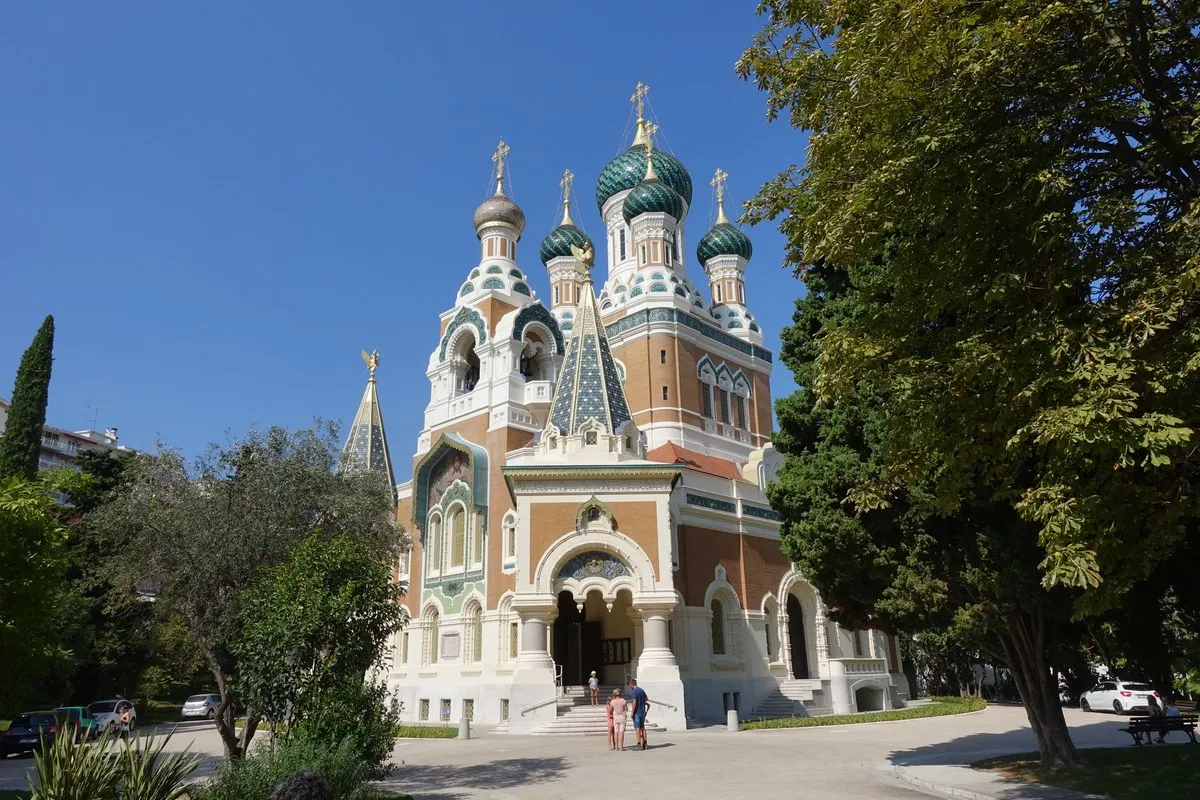
Built for the Russian colony that wintered on the Riviera and inaugurated in 1912, the Orthodox cathedral of Saint-Nicolas is a piece of sixteenth-century Moscow set down among the palms, a short walk from Nice's railway station.
In this story · 4 sections
Nice had Russians long before it had a seafront lined with hotels. From the middle of the nineteenth century the imperial family and the aristocracy of St Petersburg came south for the winter, and the city answered with villas, a boulevard named after a tsarevich and, in the end, a cathedral that is still one of the most important Russian Orthodox churches outside Russia.
Its five domes, glazed in shades of green, rise above a quiet residential quarter west of the station, and they are as startling now as they must have been in 1912. This is the story of how they came to be here, what to look at, and how to visit.
Cathédrale Saint-Nicolas
Cathedral · West of Nice-Ville station, Nice
© OpenStreetMap contributors · OpenFreeMap
- Address
- Avenue Nicolas II, 06000 Nice
- Inaugurated
- 17 December 1912
- Architect
- Mikhail Preobrazhensky
- Plan
- Greek cross around a central cube 20 metres a side
- Domes
- Five, the tallest rising to 52 metres
- Protected
- Historic monument since 11 August 1987
- Restored
- Officially reopened 19 January 2016
- Diocese
- Chersonesus, Moscow Patriarchate
Russian Orthodox cathedral inaugurated in 1912, designed by Mikhail Preobrazhensky in the manner of sixteenth-century Moscow churches, with the memorial chapel to the tsarevich Nicholas Alexandrovich in its grounds.
01A death, a chapel and a cathedral
The first Russian church in Nice came from the top. In 1856 the Empress Alexandra Feodorovna opened a subscription, and three years later the church of Saint-Nicolas-et-Sainte-Alexandra was inaugurated on rue Longchamp – the first Russian church in western Europe. The colony grew so fast that it was soon too small.
The site of the cathedral is bound up with a family tragedy. In 1865 the tsarevich Nicholas Alexandrovich, eldest son of Alexander II, died of meningitis at the age of twenty in the Villa Bermond, which his father had rented. The tsar bought the property and replaced the villa with a memorial chapel to his son, designed by the architect David Grimm. It still stands in the grounds.
In 1903 work began nearby on a far larger church, to plans by Mikhail Preobrazhensky, a professor of architecture at the Imperial Academy of Fine Arts in St Petersburg. The cathedral was inaugurated on 17 December 1912, less than five years before the revolution that would end the world it was built for.
02Moscow, with a concrete heart
Preobrazhensky looked to the churches of the Moscow region at the end of the sixteenth century. The plan is a Greek cross around a cubic central body twenty metres on each side, crowned by five onion domes: one large, reaching 52 metres, and four medium-sized, standing for Christ and the four Evangelists. Around them run tiers of kokoshniks, the rounded gables of Russian church architecture, and drums pierced by narrow windows framed in majolica. Twin porches are linked by a polygonal bell tower topped with a gilded dome.
Insider tipWalk round the outside first: the majolica and glazed tiles on the domes are best seen from the garden.
What you cannot see is the structure. When the foundations were dug, the ground proved poor, and to keep costs down the architect used reinforced concrete. The frame is dressed in around ten decorative materials: ochre industrial brick from the Rhineland, Italian marble, white limestone from La Turbie at the base, pastel-blue majolica and polychrome tiles from Florence and Blois. The effect is of a medieval building; the method is resolutely twentieth-century, which is one reason the cathedral also carries France's Patrimoine du XXe siècle label.
03Inside
Inside, the light falls on icons, frescoes and carved woodwork, and on an iconostasis of repoussé and chased metal that closes off the sanctuary. It remains a working parish church rather than a museum, and visits are paused while services are held.
04A century of ownership
For most of the twentieth century the cathedral was run by a local religious association, and from 1931 it came under the Archdiocese of Russian Orthodox Churches in Western Europe of the Ecumenical Patriarchate of Constantinople. In 2006 the Russian Federation claimed ownership, arguing that the land had belonged to the imperial family and that the 99-year lease signed in 1909 had expired. The courts in Nice, the appeal court in Aix-en-Provence and finally the Cour de cassation, in 2013, found in its favour. The keys were handed over in December 2011, and the parish now belongs to the Moscow Patriarchate's Diocese of Chersonesus.
The doors reopened to visitors on 1 July 2012, with entry now free. Restoration of the interior and exterior was planned to start on the cathedral's centenary in December 2012, and after almost two years of work the cathedral was officially reopened on 19 January 2016. The domes have rarely looked brighter.