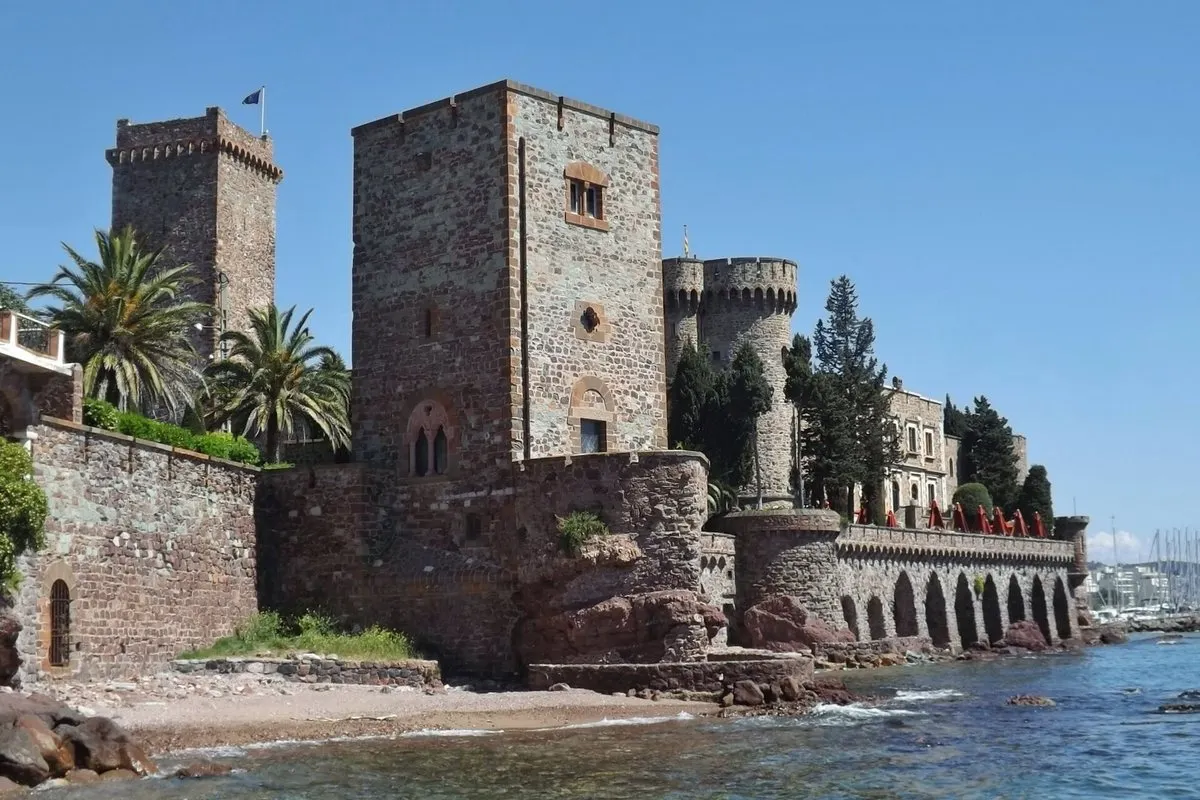
A medieval castle by the sea, a glassworks and finally a pair of artists from New York who rebuilt everything to their own ideas. Château de la Napoule is one of the Riviera's most remarkable places – and its garden is officially a Jardin remarquable.
In this story · 5 sections
By the sea in Mandelieu-la-Napoule, west of Cannes where the red Estérel mountains begin, two square stone towers stand with their feet in the water. Château de la Napoule looks like a medieval castle, and in part that is exactly what it is. But most of what you see was built in the 1920s by an American artist couple who wanted to live in a fairy tale.
Château de la Napoule
Castle and garden · La Napoule
© OpenStreetMap contributors · OpenFreeMap
- Address
- Boulevard Henry Clews, 06210 Mandelieu-la-Napoule
Medieval castle rebuilt in the 1920s, with a museum and sheltered gardens.
01The Villeneuve castle and raiders from the sea
The name La Napoule was first recorded in 1134, according to the French Wikipedia. The first castle stood on Mont San Peyre but was destroyed in 1387 by Raimond de Turenne. That same year the Countess of Provence granted the domain to Guillaume de Villeneuve, and according to tradition it was he who built the new castle by the sea. The Côte d'Azur tourist board gives 1387 as the year of construction.
The castle was meant to protect the village from attack from the sea, and it was needed. In 1530 La Napoule was plundered by corsairs under Khair ad-Din, known as Barbarossa. In 1589–1590 the Savoyard army attacked, and in 1707 and 1746 the castle was damaged again in the wars. The Villeneuve family owned it into the 1700s, after which it passed to the Montgrand family.
02A glassworks, ruins and a perfumer from Grasse
During the French Revolution the castle was abandoned and plundered. In 1837 the owner allowed a glassworks to be set up inside it, and what remained of the roof timbers was burnt as fuel. In 1876 the ruin was bought by a Grasse perfumer, Monsieur Charrier, who cleared the ruins and built a manor house by the water, completed in 1880. Around the turn of the century the house was let to wealthy summer visitors.
Insider tipCall ahead for opening hours.
03Henry and Marie Clews – "Once upon a time"
In November 1918 two Americans bought what was left. Henry Clews (1876–1937), the son of a New York banker, had inherited a large fortune and was a sculptor. His wife Marie Clews (1880–1959) was an architect. Between 1919 and 1930 they lived in the castle and rebuilt it entirely to their own ideas, with no archaeological ambitions and no known architect who might have altered their plans.
Marie designed the renovation and worked directly with the local masons Jean and César Cossano and twelve stonemasons. Henry filled the house with a fantastical bestiary of carved animals and figures, and carved mottos such as "Once upon a time" and "Myth – Mystery – Mirth" into the walls. A sculpture studio was built beside the great tower in 1919, a dining hall in the style of a knights' hall in 1924–1928, a cloister in 1925–1928 and the freestanding La Mancha tower in 1927. In 1930 the work came to a halt.
During the Second World War the castle became part of the German Südwall coastal defences, and a bunker was built in the garden. Marie Clews repaired the garden wall in 1950, and in 1951 she founded the Association d'art de La Napoule Mémorial Henry Clews, which has made the castle a venue for exhibitions, concerts and an artists' residency programme.
04Marie Clews's gardens
The gardens were designed by Marie Clews in 1919. The main garden opens with a long French-style avenue, and around it lie three smaller gardens: the garden at La Mancha, the terraces facing the sea and the secret garden. The avenue, the pool, the fountain, the well and the small buildings – the gatehouse, the chapel, the garden tower, the pergola and the bridge – are protected as historic monuments. In 2005 the garden was awarded the Ministry of Culture's Jardin remarquable label.
The castle and gardens have been protected since 6 January 1947. The museum shows Henry Clews's work, and contemporary art is exhibited in the garden. Children under ten go in free, and there is a treasure hunt in the garden.
05La Napoule, the Estérel and Cannes
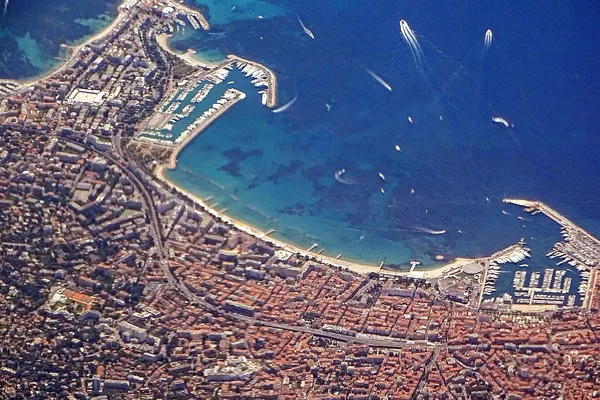
The castle stands by the harbour in La Napoule, and the coast road continues west towards Théoule-sur-Mer and the Estérel. In the other direction lies Cannes, where the Carlton's domes look out over La Croisette. More destinations can be found among our Riviera guides on metromode.co.