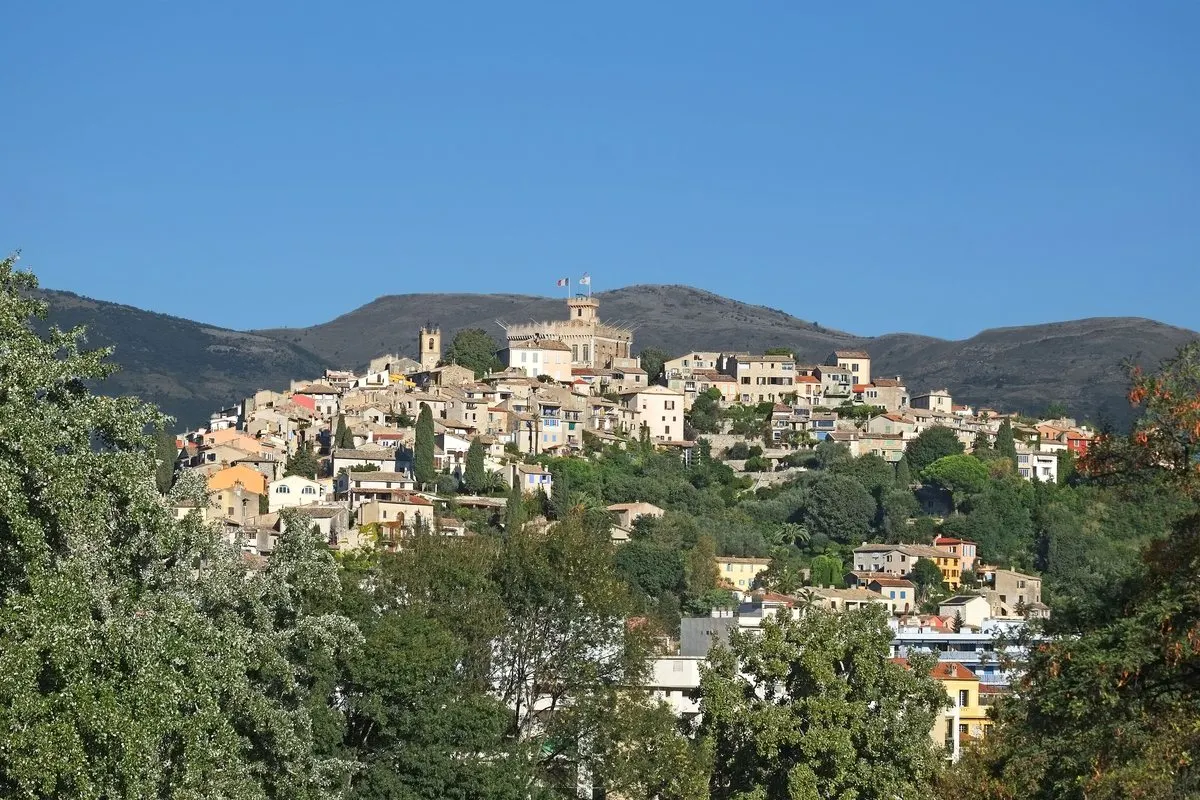
Above Cagnes-sur-Mer lies a medieval village clustered around a Grimaldi castle, and on the hill opposite, the olive grove where Auguste Renoir painted during his last eleven years. One of the Riviera's most overlooked art destinations – and one of its most moving.
In this story · 5 sections
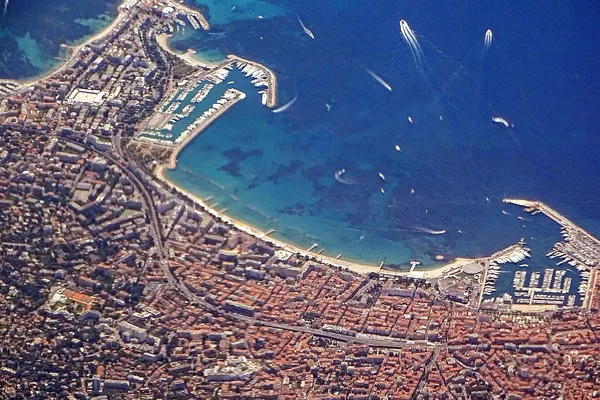
Most people who pass through Cagnes-sur-Mer see it from the motorway or the train: a modern coastal town between Nice and Antibes, with a racecourse and a long pebble beach. But look up and you'll see something entirely different. On a hill behind the town rises a medieval village of honey-coloured stone, with a crenellated castle at its summit. This is Haut-de-Cagnes. And on the hill opposite, in an olive grove several hundred years old, stands the house where Auguste Renoir spent his last eleven years.
Cagnes is essentially made up of three parts: the medieval village on the hill, the modern town below and the fishing village of Le Cros-de-Cagnes by the sea. Facts about the municipality can be found on VERA PI's page about Cagnes-sur-Mer.
5 places
© OpenStreetMap contributors · OpenFreeMap
- 01Château-Musée GrimaldiMuseum · Haut-de-Cagnes
- 02Église Saint-PierreChurch · Haut-de-Cagnes
- 03Chapelle Notre-Dame-de-ProtectionChapel · Haut-de-Cagnes
- 04Musée Renoir – Domaine des CollettesMuseum and garden · Les Collettes
- 05Le Cros-de-CagnesBeach and harbour · Cros-de-Cagnes
- 1903
- Renoir discovers Cagnes
- 1907
- Renoir buys the Domaine des Collettes (28 June)
- 1908
- The family moves into the villa with its two studios
- 1913–1918
- Renoir sculpts with Richard Guino and Louis Morel
- 1919
- Renoir dies at Les Collettes (3 December)
- 1960
- The town buys the property and turns it into a museum
Up to Haut-de-Cagnes
The village's history begins in 1309, when Rainier I Grimaldi, co-ruler of Monaco, became lord of Cagnes and had the castle built on the hill. It then belonged to the Antibes branch of the Grimaldi family right up to the French Revolution, when the family was driven out and fled to Nice. The castle stood empty until a private buyer acquired and restored it in 1875.
The lanes around the castle are steep, quiet and full of small details: archways, stone steps, climbing bougainvillea and glimpses of the sea between the houses. Below the castle stands the Église Saint-Pierre, and close by the chapel of Notre-Dame-de-Protection. Take your time and walk round the whole village – it is small, but every corner has its own view.
Château-Musée Grimaldi
The municipality bought the castle in 1939, and in 1946 it became a museum. On the ceiling of one of the halls is a 1620 fresco by Giulio Benso depicting the fall of Phaeton – the son of the sun god who lost control of the sun chariot. The castle also houses an ethnographic museum devoted to the olive tree, and the Suzy Solidor bequest: some forty portraits of the singer, painted by leading artists in the early 1900s.
It is no coincidence that a singer's portraits ended up here. Until the 1960s Cagnes was known as «the Montmartre of the Riviera». Chaïm Soutine, Raoul Dufy, Tsuguharu Foujita, Moïse Kisling and Victor Vasarely lived and worked here, and Yves Klein spent part of his childhood in the family house in Haut-de-Cagnes between 1939 and 1943.
Les Collettes – the olive grove that became a studio
Auguste Renoir discovered Cagnes in 1903. He was seriously ill and in search of warmth, and on 28 June 1907 he bought the Domaine des Collettes, a three-hectare estate with an olive grove several hundred years old, orange trees and a 19th-century farmhouse. He would have preferred to live in the old farmhouse himself, but his wife Aline wanted a spacious house. The Nice architect Jules Febvre therefore designed a villa in neo-Provençal style with two studios, and in the autumn of 1908 the family moved in.
Here Renoir painted for eleven years, with Aline and his three sons Pierre, Jean and Claude around him, until he died on 3 December 1919, aged 78. It was also here, between 1913 and 1918, that he took up sculpture, first with Richard Guino and later with Louis Morel. Matisse, Maillol, Modigliani, Rodin, Picasso and Monet all visited the villa.
After Renoir's death his son Claude went on living there until 1960. The year before, Jean Renoir filmed Le Déjeuner sur l'herbe in the house where he grew up. In 1960 the town bought the property and turned it into a museum, with a dozen rooms "where everything was left as it was".
What you see at the Musée Renoir
The rooms show works from Renoir's late period, when he found his subjects in his own garden, among them La Ferme des Collettes, Paysage aux Collettes and Les Grandes Baigneuses. Over the years the state museums have added works by Pierre Bonnard, Raoul Dufy and Aristide Maillol, among others. The villa has been a historic monument since 2001 and carries the Maisons des Illustres label.
But perhaps the most moving thing is the garden. The olive trees Renoir painted still stand, gnarled and silvery green, with views down to the sea and up to Haut-de-Cagnes. Sit for a while on the grass before you leave. In September 2026 two paintings were stolen from the museum, both on loan from the Musée d'Orsay; check which works are on display before your visit.
Down to Cros-de-Cagnes
Finish by the sea. Towards the end of the 18th century, fishermen from Menton came here twice a year to fish, and the waters were so rich that they eventually stayed. The fishing village of Le Cros-de-Cagnes grew up, with its little chapel of Saint-Pierre-des-Pêcheurs on the promenade. If you want to see more art on the coast, Saint-Paul-de-Vence and Antibes are only a few kilometres away. You can find more places along the coast under Destinations at metromode.co.
Château-Musée Grimaldi
The Grimaldi fortress from 1309
Castle with the 1620 fresco "The Fall of Phaeton", an olive museum and Suzy Solidor's portrait collection.
Place Grimaldi, Cagnes-sur-Mer
Église Saint-Pierre
The village church
The church on Place Grimaldi, just below the castle.
Chapelle Notre-Dame-de-Protection
The village chapel
Small chapel on the edge of the medieval village.
Musée Renoir – Domaine des Collettes
Renoir's house, studio and olive grove
The villa where Renoir lived and worked from 1908 to 1919, with the studio preserved and the old olive grove open to visitors.
Chemin des Collettes, Cagnes-sur-Mer
Insider tipHistoric monument since 2001.
Le Cros-de-Cagnes
Fishing village by the sea
The fishing village founded by fishermen from Menton, with the chapel of Saint-Pierre-des-Pêcheurs on the seafront.