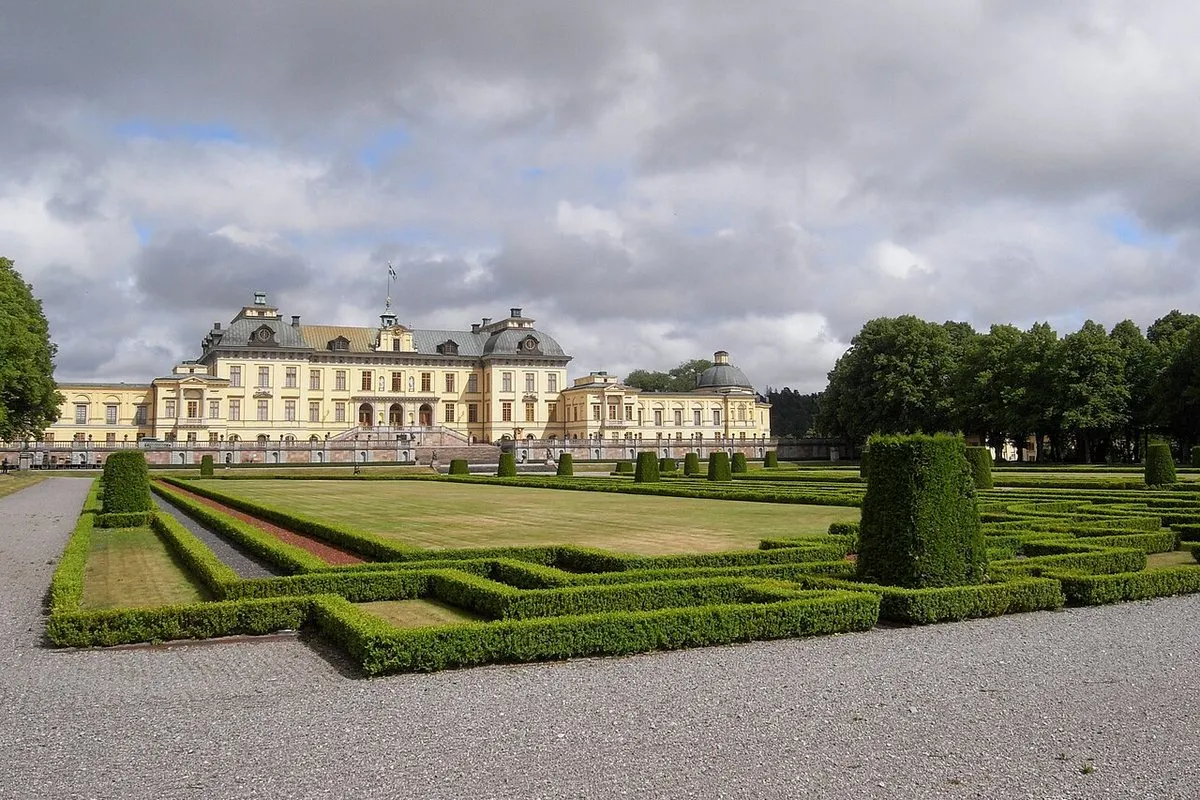
A baroque palace on an island in Lake Mälaren, a Chinese pavilion that was a birthday present and the world's best-preserved 18th-century theatre. Drottningholm is the royal family's home and Sweden's first World Heritage Site – and one of the most beautiful day trips from Stockholm.
In this story · 6 sections
Drottningholm Palace is located on Lovön in Lake Mälaren, west of central Stockholm, and one understands why the kings chose this location. The pale palace façade is reflected in the water, and behind it stretches a baroque garden with box hedges, fountains and lime tree avenues extending over seven hundred metres. Since 1981, it has been the official residence of King Carl XVI Gustaf and Queen Silvia – but large parts of the palace and park are open to visitors. According to Wikipedia, around 700,000 people visit every year.
2 places
© OpenStreetMap contributors · OpenFreeMap
Drottningholm in brief- Island
- Lovön, Ekerö Municipality
- Built
- 1662–around 1750
- Architects
- Tessin the Elder, Tessin the Younger, Carl Hårleman
- World Heritage Site
- 1991 (Sweden's first)
- Palace Theatre inaugurated
- 9 July 1766
- Chinese Pavilion
- 1763–1769 (Carl Fredrik Adelcrantz)
From the queen's stone house to pleasure palace
The place got its name in 1579, when John III had a stone house built here for his queen, Catherine Jagiellon – hence Drottningholm, the Queen's Islet. The palace we see today was planned and built on the initiative of the Dowager Queen Hedvig Eleonora from 1662 to around 1750, as a pleasure palace to designs by Nicodemus Tessin the Elder, his son Nicodemus Tessin the Younger and Carl Hårleman. In 1777 the state bought the property from Queen Lovisa Ulrika, and the royal family has had the right of use ever since.
John III's palace burned down on 30 December 1661, the same year that Hedvig Eleonora had bought it. Already in the spring of 1662, the queen approved Tessin the Elder's drawings for a new palace on the old walls and cellar vaults, built according to the then modern principle of entre cour et jardin – with the representative façade facing a courtyard and the garden behind. At most, 400 men worked simultaneously on the construction, and by Midsummer 1664 the main building was complete. The complex is approximately 160 metres long. The façade was not originally light-coloured as it is today, but painted red.
In 1744, Lovisa Ulrika received the palace as a wedding gift when she married the heir to the throne, Adolf Fredrik, and she had Carl Hårleman add a storey to the side wings for living quarters, a library and a portrait gallery – so carefully done that today it is barely visible that it is a later addition.
Drottningholm is considered one of the finest palace buildings from Sweden's Age of Greatness and is Sweden's best-preserved royal palace. In 1991, the palace grounds – the palace, the theatre, the Chinese Pavilion, Kantongatan, the gardens and the Malmen area – became Sweden's first site on Unesco's World Heritage List.
The baroque garden and the English park
The oldest part of the park was laid out in the late 17th century. It was Nicodemus Tessin the Younger who completed his father's work, with a powerful central axis running out from the palace and models such as Vaux-le-Vicomte and Versailles. Closest to the palace lies the Embroidery Parterre, followed by the Water Parterre with twelve smaller fountains around the Hercules Fountain and, to the west, the Cascades with fourteen small waterfalls. Many of the statues were made by Adrian de Vries. The entire layout is 720 metres long and 180 metres wide, and it was restored in the 1950s and 1960s on the initiative of Gustaf VI Adolf.
North of the baroque garden lies the English park, Gustav III's creation, with ponds, canals, bridges and open lawns. The king liked to draw himself, and of the buildings he dreamed of here – a temple of love, a Chinese tower, a small Gothic castle – only the Gothic Tower became reality. The park's architect, Fredrik Magnus Piper, presented his general plan in 1797, five years after the king's death.
The Chinese Pavilion – a birthday surprise
Further into the park lies the Chinese Pavilion, and the story behind it is one of the most charming in Swedish palace history. The first pavilion, in Chinese style, was prefabricated in timber on Arsenalsgatan in Stockholm and rafted in sections to Drottningholm. On 24 July 1753, King Adolf Fredrik surprised Queen Lovisa Ulrika with it as a birthday gift. The present Chinese Pavilion was designed by Carl Fredrik Adelcrantz and built 1763–1769 – fundamentally French rococo, but with the Chinese and oriental elements that were then the height of fashion.
In the nearby pavilion Confidencen, the dining tables could be hoisted up through the floor, so that the royals could eat without the servants being present.
The Palace Theatre – the 18th century still in operation
The Drottningholm Palace Theatre is described as the best-preserved 18th-century theatre in the world. It was built on the initiative of Lovisa Ulrika after a previous theatre burnt down in 1762, was designed by Carl Fredrik Adelcrantz and was inaugurated on 9 July 1766. The stage machinery by Donato Stopani still makes it possible to change scenery in front of an open curtain, with trapdoors, moving waves and wind and thunder machines. The stage is 20 metres deep, still one of the deepest in the country.
Every summer, opera and ballet from the 1600s and 1700s are performed, nowadays usually with period instruments. It is one of the major cultural experiences in the Stockholm area – and the tickets sell out. Since 2025, the theatre has been part of Sweden's cultural canon.
Inside the palace
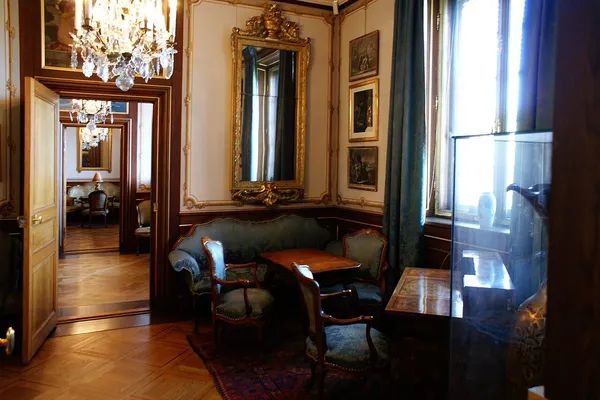
The staircase, created 1665–1687 by Tessin the Elder with the Italian stucco artists Giovanni and Carlo Carove and the sculptor Nicolaes Millich from Antwerp, was described even by contemporaries as something that could scarcely be matched in Europe. Hedvig Eleonora's state bedchamber was completed in 1683 and is considered unsurpassed in the country, and in the adjoining Ehrenstrahl Salon the court painter David Klöcker Ehrenstrahl painted allegories of the royal family's history in the 1690s. Lovisa Ulrika's library, furnished according to designs by Jean Eric Rehn, was the place where the queen gathered learned friends. The Stone Hall, with tapestries woven in Delft for Queen Christina's coronation in 1650, is today the royal family's festive living room and is part of the private section of the palace, which is closed to the public.
How to plan your day
In summer, the most beautiful way to get here is by boat from Stockholm; the palace park has its own steamboat jetty to the east. You can also get here by car or public transport via Drottningholmsvägen. Allow a full day if you want to see the palace, the Chinese Pavilion and the park, and book the theatre performance well in advance if you come during the opera season. On the second Sunday of Advent, a Christmas market is held on Teaterplanen in front of the Palace Theatre.
Before or after the excursion: plan the rest of your Stockholm day with Metro Mode's Stockholm map, read our guide for first time in Stockholm and see the districts in VERA PI's Stockholm guide.
Drottningholm Palace
The royal couple's residence and Sweden's first World Heritage Site
Baroque palace with a baroque garden, English park, the Chinese Pavilion and the 18th-century theatre.
Drottningholm, Ekerö
Insider tipParts of the palace are closed because the royal family lives there.
Drottningholm Palace Theatre
The world's best-preserved 18th-century theatre
Inaugurated in 1766, with Donato Stopani's original stage machinery. Opera and ballet every summer.
Drottningholm, Ekerö
Insider tipPerformances sell out – book early.