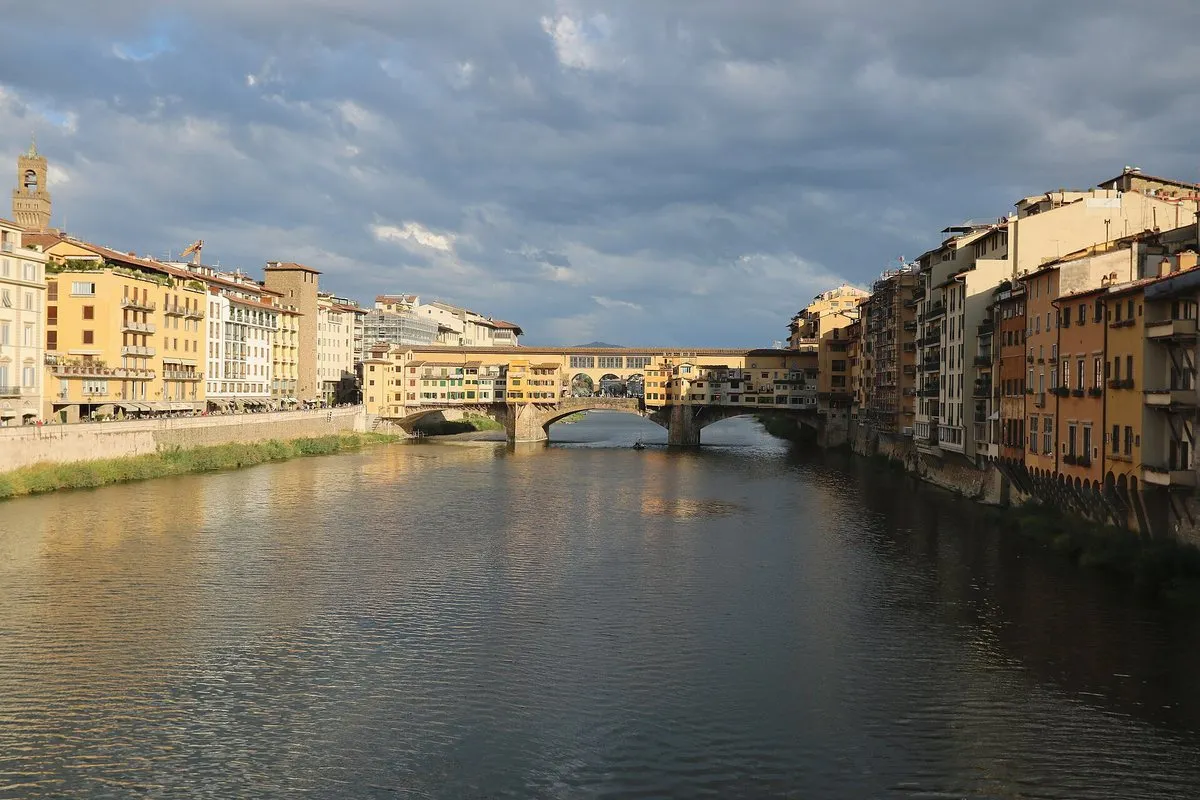
In 1564, Cosimo I de' Medici commissioned a kilometre-long passage over the rooftops of Florence so as to avoid the streets. Follow his route – from the Uffizi over the Ponte Vecchio to the Palazzo Pitti, Boboli and the church on the hill – and you'll see the Renaissance city from above.
In this story · 8 sections
Florence, Tuscany's capital with around 360,000 inhabitants, lies around 270 kilometres north-west of Rome. The historic city centre became a World Heritage Site in 1982, and most of what visitors come for – the Duomo, the Uffizi, the Ponte Vecchio – is within a few hundred metres on the northern side of the Arno. But the city has a second half. The Oltrarno, beyond the Arno, south of the river, is the district with Palazzo Pitti, Santo Spirito, Belvedere and Piazzale Michelangelo.
The best way to link them is to follow the route that the Medici themselves took. In 1564, Duke Cosimo I de' Medici commissioned the architect Giorgio Vasari to build an elevated, covered passageway from the government palace, the Palazzo Vecchio, to the family's residence at Palazzo Pitti. It was to be completed within five months, in time for the wedding between Cosimo's son Francesco and Joanna of Austria in 1565. Cosimo ruled in an uncertain political climate and wanted to be able to move about without showing himself on the street.
6 places
© OpenStreetMap contributors · OpenFreeMap
- 01Santa Maria del FioreCathedral · Piazza del Duomo
- 02Galleria degli UffiziArt museum · Piazza della Signoria
- 03Ponte VecchioBridge · Arno
- 04Palazzo Pitti and Giardino di BoboliPalace and garden · Oltrarno
- 05Giardino BardiniGarden · Oltrarno
- 06San Miniato al MonteChurch and monastery · Oltrarno
- 1013
- Construction of San Miniato al Monte begins
- 1339–1345
- The current Ponte Vecchio
- 1436
- Brunelleschi's dome completed, the cathedral consecrated
- 1560–1581
- The Uffizi is built
- 1564–1565
- The Vasari Corridor is built
- 1769
- The Uffizi opens to the public
- 2024
- The Vasari Corridor reopens in December
Morning: the Duomo from outside
Start at Santa Maria del Fiore before the queues form. The cathedral was begun in 1296 to designs by Arnolfo di Cambio. Work on the dome, designed by Filippo Brunelleschi, began in 1420 and was completed in 1436, and it remains the largest dome ever built in masonry. The cathedral was consecrated by Pope Eugenius IV on 25 March 1436, New Year's Day according to the Florentine calendar. The polychrome marble façade in green, pink and white dates from the 19th century. Together with the baptistery and Giotto's bell tower, the cathedral forms part of the World Heritage Site.
Morning: the Uffizi
At Piazza della Signoria stands the Uffizi. Vasari began building the complex in 1560 for Cosimo I, to bring together the state's magistracies and guilds under one roof – hence the name, uffizi, offices. The construction was completed in 1581 by Alfonso Parigi and Bernardo Buontalenti, and the top floor became a gallery for the family's collections. The courtyard is so long and narrow, open towards the Arno at its end, that architectural historians call it Europe's first regular street vista.
When the House of Medici died out, the last heiress, Anna Maria Luisa, gave the collections to the city through the so-called Family Pact. The gallery could be visited on request from the 16th century, was officially opened to the public in 1769, and formally became a museum in 1865 – one of the first modern museums.
Midday: the Vasari Corridor
From the Uffizi, the corridor runs out above Lungarno degli Archibusieri, follows the northern bank of the Arno and crosses the river above the Ponte Vecchio. It curves around the Torre dei Mannelli, concealing part of the façade of the church of Santa Felicita, and then winds, ever narrower, over the houses of the Oltrarno to the eastern side of Palazzo Pitti. The entire stretch is approximately one kilometre.
The corridor was closed for security reasons in 2016 and did not reopen to the public until December 2024. It can be visited Tuesday to Sunday for a supplementary charge on the Uffizi ticket, and anyone who has entered the corridor cannot return to the gallery. The section closest to the Uffizi was badly damaged by the Mafia car bomb in Via dei Georgofili on the night of 27 May 1993, when five people died.
Ponte Vecchio: the goldsmiths' bridge
Those who do not take the corridor cross over at street level. The Ponte Vecchio spans the Arno where the river is at its narrowest, where a bridge probably already existed in Roman times. The current bridge has stood since around 1339–1345, and it was the only bridge in Florence that was not destroyed during the Second World War. It was badly damaged in the 1966 flood.
The shops belonged to the butchers from 1442. In 1565, the same year the corridor was built, a decree was issued that excluded the butchers and only allowed goldsmiths and jewellers. This is still the case. In the middle of the bridge stands a bust of the goldsmith Benvenuto Cellini, which the bridge's goldsmiths commissioned from Raffaello Romanelli in 1900.
Afternoon: Palazzo Pitti and Boboli
The corridor ends at Palazzo Pitti, the grand dukes' main residence. Behind the palace lies the Giardino di Boboli, laid out for Cosimo's wife Eleonora of Toledo. Niccolò Tribolo had barely begun before he died in 1550, and the work was continued by Bartolomeo Ammanati, with contributions from Vasari and Buontalenti, who also created the grotto in the courtyard between the palace and the garden.
The Boboli Gardens are one of the first formal Italian gardens from the 16th century, and they influenced aristocratic gardens throughout Europe: long axes, wide gravel avenues, statues, fountains and grottoes. The open view over the city was unusual for its time. The garden was reserved for the immediate family.
Late afternoon: Bardini and San Miniato
From Via de' Bardi, the entrance leads to the Giardino Bardini, a garden in three parts from different eras: a large 17th-century staircase in the middle, an Anglo-Chinese garden from the 1800s on one side, and an agricultural section on the other. It has wide views over the city and opens onto Costa di San Giorgio, towards Forte di Belvedere and Boboli.
End at one of the city's highest points, at San Miniato al Monte. The church was begun in 1013 and is regarded as one of Tuscany's finest Romanesque buildings. The patterned floor dates from 1207, and the Cappella del Crocefisso in the nave was designed by Michelozzo in 1448, with ceiling decoration by Luca della Robbia. The Olivetan monks, who have run the monastery since 1373, sell liqueurs, honey and herbal teas in a shop next to the church. Just below lies Piazzale Michelangelo.
More to read
Continue to Rome's grand hotels or north to Milan's Quadrilatero della moda, and find all city guides at metromode.co.
Stops on the walk
Santa Maria del Fiore
The cathedral with Brunelleschi's dome from 1436.
Insider tipArrive early in the morning
Galleria degli Uffizi
The Medici collections in Vasari's office building from 1560–1581.
Insider tipThe Vasari Corridor requires a supplementary ticket
Ponte Vecchio
The goldsmiths' bridge, the only one spared during the Second World War.
Palazzo Pitti and Giardino di Boboli
The grand dukes' palace and the garden that became a model for Europe's gardens.
Giardino Bardini
Garden in three parts with a view over the city, entrance from Via de' Bardi.
San Miniato al Monte
Romanesque church from 1013 on one of the city's highest points. The monks sell liqueur and honey.