In this story · 3 sections
Fréjus lies at the eastern edge of the Var, on the alluvial plain of the Argens and the Reyran, between the Massif des Maures and the Esterel. It merges almost seamlessly with neighbouring Saint-Raphaël, and with 59,719 residents in 2023 it is the third-largest town in the department. Unlike the rocky coves on either side, its shore is flat: an almost continuous beach of golden sand running six kilometres from Saint-Aygulf to Saint-Raphaël.
Behind the beach lies something the rest of the Riviera cannot match: a Roman city whose walls, arches and arena still shape the old town.
4 places
© OpenStreetMap contributors · OpenFreeMap
- 01Amphithéâtre romainsee · Centre
- 02Cathédrale Saint-LéonceSee · Old town
- 03Lanterne d'Augustesee · Port antique
- 04Chapelle Notre-Dame-de-Jérusalemsee · La Tour de Mare
- Amphitheatre
- Arena still used for shows
- Aqueduct
- 42 km from Mons, with 1.8 km on bridges
- Theatre
- Open-air venue named after Philippe Léotard
- Harbour
- Quay remains and the Lanterne d'Auguste
- Walls and gates
- Porte des Gaules, gates of Rome and Reyran
Forum Julii: Caesar's market, Augustus's navy
The name comes from Forum Julii, the forum of Julius Caesar, founded to rival the power of Greek Massalia. The exact date is uncertain, but the town existed by 43 BC, when it appears in the letters between Plancus and Cicero, and 49 BC is the date usually given. After the battle of Actium in 31 BC, Octavian brought the galleys captured from Mark Antony here.
Between 29 and 27 BC it became a colony for veterans of the Eighth Legion, and its harbour became the only naval base of the Roman fleet in Gaul. Walls 3.7 kilometres long enclosed 35 hectares and some 6,000 inhabitants. Under Tiberius came most of the monuments still visible today: the amphitheatre, the aqueduct, the lighthouse, the baths and the theatre. In AD 40 Gnaeus Julius Agricola, who completed the Roman conquest of Britain, was born here; his son-in-law Tacitus called Forum Julii "an ancient and illustrious colony".
Walking the Roman town
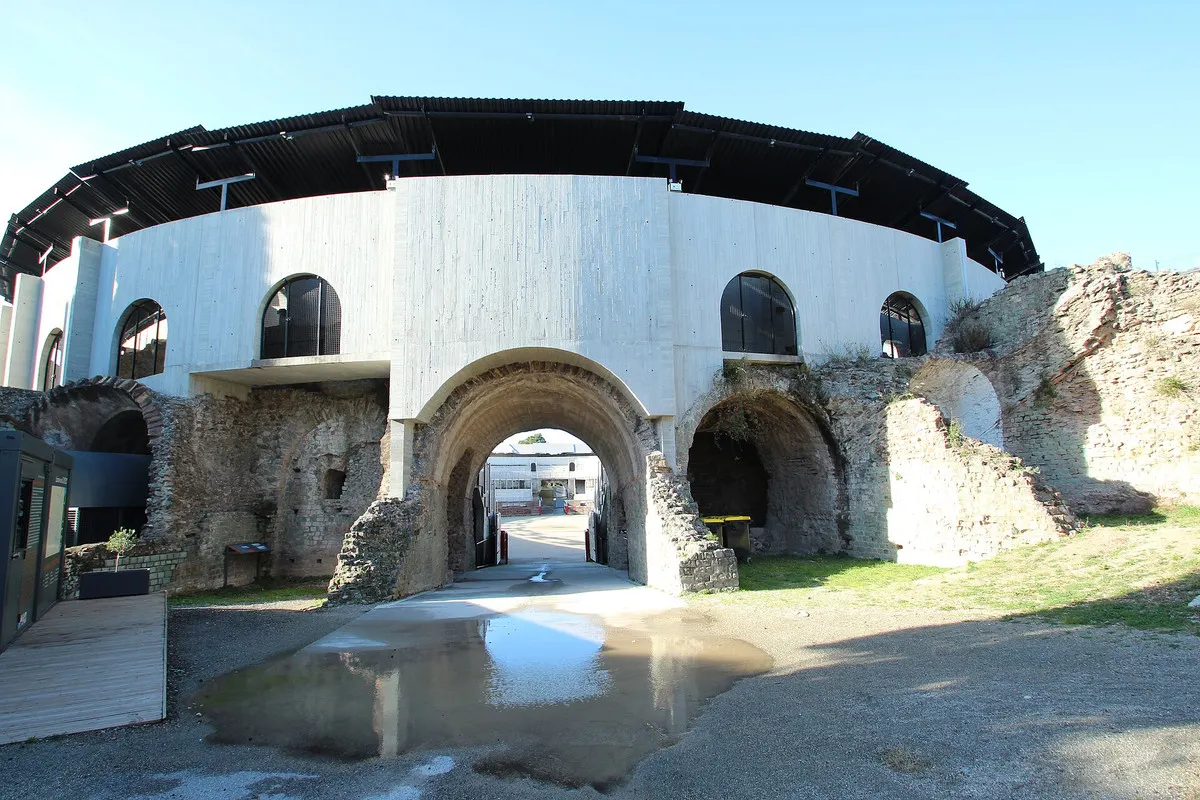
Start at the amphitheatre on the western edge of the old town, where modern seating now sits on the Roman arches and the arena still stages events. The theatre, renamed after the actor Philippe Léotard, is used as an open-air venue. Inside the old town, look for the Porte des Gaules on the Place Agricola, the paving of the Via Aurelia and the cistern on the Butte Saint-Antoine.
Then follow the line of the vanished harbour. Excavations in 2005 showed that the ancient shore lay almost a kilometre further inland than had been thought. On the old south quay stands the Lanterne d'Auguste, part of the harbour's system of lighthouses. North of town, stretches of the 42-kilometre aqueduct from Mons stride across the countryside.
Bishops, bulls and a pilot
A bishop was appointed in 374, and Saint Léonce, bishop from 433, gave his name to the cathedral at the centre of the episcopal group. As the harbour silted up, the town declined; by 1789 it had only two wells and 2,500 people. Since 1905 Fréjus has been the easternmost bullfighting town beyond the Rhône, with events in the amphitheatre. On 23 September 1913 Roland Garros took off from here to make the first flight across the Mediterranean.
The town's darkest night came on 2 December 1959, when the Malpasset dam on the Reyran gave way after 24 hours of torrential rain. A wave some ten metres high swept into Fréjus, killing 423 people.
Amphithéâtre romain
The Roman arena of Forum Julii
Roman arches beneath a modern seating structure; still used for shows.
Rue Henri-Vadon, 83600 Fréjus
Insider tipStart here, then walk east into the old town.
Cathédrale Saint-Léonce
The heart of the episcopal group
The cathedral of one of France's oldest dioceses, at the centre of the old town.
Place Jean-Camille-Formigé, 83600 Fréjus
Insider tipAllow time for the cloister and baptistery.
Lanterne d'Auguste
Roman harbour beacon on the old quay
Part of the lighthouse system of Rome's naval harbour.
Avenue de Provence, 83600 Fréjus
Insider tipShows how far inland the Roman shore lay.
Chapelle Notre-Dame-de-Jérusalem
Chapel in the hills north of town
One of Fréjus's notable religious buildings, on the road into the Esterel.
RN7, 83600 Fréjus
Insider tipCheck opening times before driving out.
Neighbourhood and property data for Fréjus is on VERA PI, and more from the Var coast is on metromode.co.