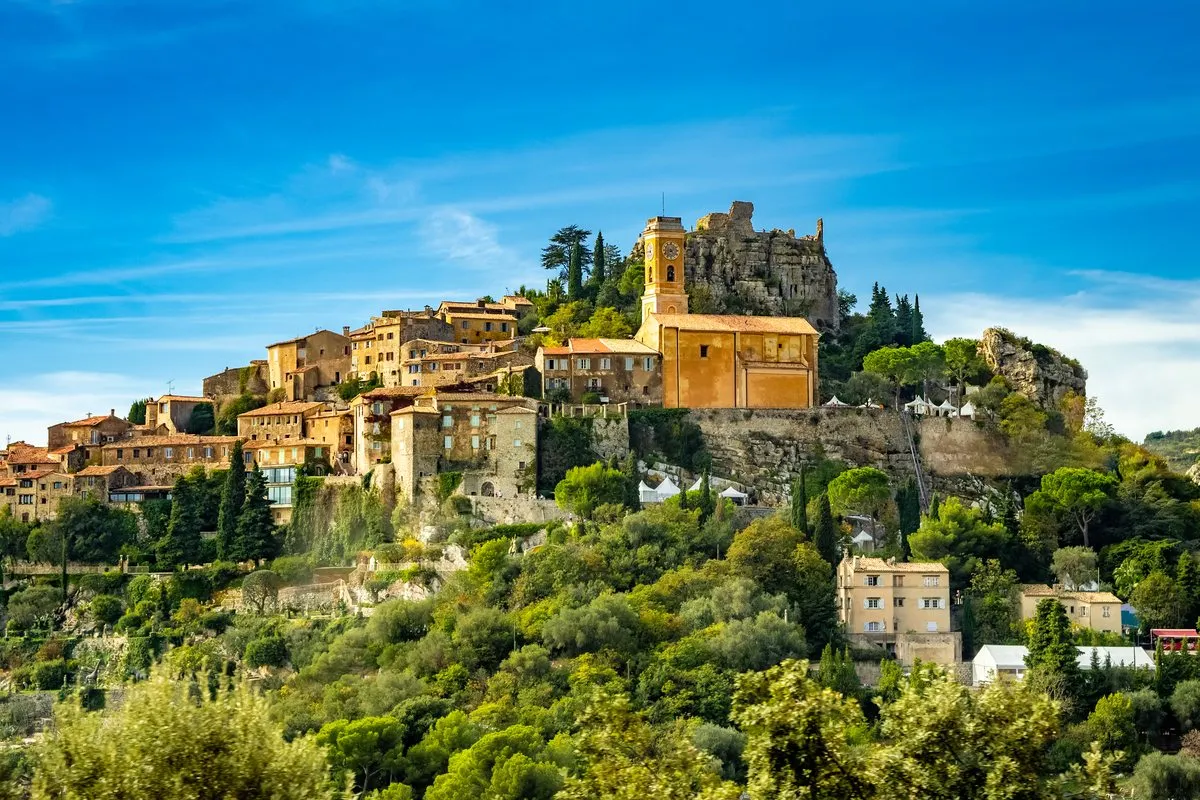
Four hundred and twenty-nine metres straight above the Mediterranean, a medieval village clings to the cliff face. Èze is the Riviera's most dramatic viewpoint – and those who make their way up on foot from the beach understand why it has fascinated philosophers, princes and chefs.
In this story · 5 sections
Èze is actually two places. Down by the water lies Èze-sur-Mer, or Èze-Bord-de-Mer as the road sign says, with a railway station, a pebble beach and villas hidden among the pines. And 429 metres directly above, on a rocky outcrop that looks as though it is balancing over the sea, lies Èze-Village: a maze of stone houses, archways and steps around the remains of a castle. Between them winds a path that has become a legend.
The village lies about 8.5 kilometres north-east of Nice and 4.5 kilometres west of Monaco, and it can be seen from afar thanks to its bright ochre church tower. It is one of sixteen villages that the Nice Côte d'Azur tourist office has gathered on its Route des Villages Perchés, the road through the perched villages – but none of the others has Èze's view. Facts about the commune can be found on VERA PI's page about Èze.
5 places
© OpenStreetMap contributors · OpenFreeMap
- 01Jardin d’ÈzeGarden · Èze-Village
- 02Église Notre-Dame-de-l’AssomptionChurch · Èze-Village
- 03Château EzaHotel and restaurant · Èze-Village
- 04Parfumerie GalimardShop · Èze-Village
- 05Cap EstelHotel and restaurant · Èze-Bord-de-Mer
- October 2026
- 9am–6.30pm (last admission 6pm)
- November–December 2026
- 9am–4.30pm (last admission 4pm), closed 25 December
- Admission, adult
- 10 euros (free for under-12s)
The Nietzsche Path – uphill from the beach
The most rewarding way to reach the village is on foot from the sea. The Chemin de Nietzsche begins near the station in Èze-sur-Mer and winds steeply upwards through pine forest, olive groves and bare limestone outcrops. The path is named after Friedrich Nietzsche, who spent winters in Nice in the late 19th century. According to tradition, he often walked here and drew inspiration for the third part of Thus Spoke Zarathustra. Whether this is exactly true cannot be verified, but it is easy to understand why the story has endured.
The path isn't long, but it is extremely steep: almost the entire height difference is covered over a short distance. Go early in the morning, before the heat sets in, with proper shoes and plenty of water. Those who want to spare their legs can take the bus up and walk the path down instead – with the sea ahead of them the whole way.
A village built to be defended
Èze's location is no coincidence. The bay below is already mentioned in the Roman Antonine Itinerary as Avisionis portus, and a hoard of Greek silver bowls from the 2nd century BC found here is now held at the British Museum. The Moors held the area for decades until William of Provence drove them out in 973. From 1388, Èze belonged to the House of Savoy, which built the village up into a fortress near Nice.
The history that followed was turbulent. Franco-Ottoman troops under Hayreddin Barbarossa took the village in 1543, and in 1706, during the War of the Spanish Succession, Louis XIV had the castle and walls demolished. In April 1860, the inhabitants voted unanimously to become French. The village's motto, Isis Moriendo Renascor – "In dying I am reborn" – and its coat of arms, a phoenix on a pyre, say something about how the village sees its own history.
The exotic garden in the castle ruins
The village's highest point is also its greatest attraction. Within the ruins of the medieval fortress lies the Jardin d'Èze, a botanical garden of succulents from several continents, particularly Central America: cacti, aloes, agaves and the black-rosetted Aeonium arboreum. Along grey-green paths stand Jean-Philippe Richard's sculptures, and in the northern section there is a Mediterranean garden with grottoes, waterfalls and Provençal garrigue. The garden holds the "Jardin remarquable" distinction.
The view from the top is hard to beat. The coastline stretches westwards past Saint-Jean-Cap-Ferrat and all the way towards Saint-Tropez, and on a really clear day Corsica can be seen on the horizon, according to the tourist office. A visit takes about an hour.
The church, the chapel and the lanes
Below the garden stands the Église Notre-Dame-de-l'Assomption from 1764, the church with the ochre tower. Inside there is an Egyptian cross, usually read as a reminder of the village's oldest history. The village's oldest building, however, is the Chapelle de la Sainte-Croix from 1306, where the lay brotherhood of the White Penitents met – those who looked after the victims of the plague. The shape of the bell tower shows that the village once belonged to the Republic of Genoa.
The lanes in between are car-free, cobbled and full of galleries, studios and small shops. As few residents with local roots still live in the village itself, it is sometimes called a village-musée. Just below the gate lies the perfume house Galimard, and at the foot of the village stand several of the grand villas, among them Château Balsan, where Marie-Gabrielle of Savoy lived until 1990.
The prince, Disney and Michelin-starred restaurants
Èze has an unusual concentration of fine dining for a village of its size. Château Eza, built into the houses on the cliff edge, was the private residence of Prince Wilhelm of Sweden from 1923 to 1953. Today it is a small hotel, and its restaurant has one star in the Michelin Guide 2026.
A stone's throw away stands the Château de la Chèvre d'Or. The hotelier Robert Wolf bought the house in 1953 and turned it into a restaurant, and after Walt Disney's visit in 1956 the place became famous worldwide. Wolf then bought house after house in the village and converted them into hotel rooms. The restaurant has two stars in the Michelin Guide 2026. Down by the sea, in Èze-Bord-de-Mer, La Table du Cap Estel also has one star.
From Èze it is close to both Beaulieu-sur-Mer and Monaco. More destinations along the coast can be found at metromode.co.
Source: Nice Côte d’Azur tourist board, October 2026. Always check current information before your visit.
Jardin d’Èze
Succulents and views in the castle ruins
Botanical garden at 429 metres with cacti, agaves and Jean-Philippe Richard's sculptures – and views along the entire coast.
20 rue du Château, Èze
Insider tipJardin remarquable. Allow an hour.
Église Notre-Dame-de-l’Assomption
The church with the ochre tower
Built in 1764 and visible from far away. Inside there is an Egyptian cross.
Château Eza
Prince Wilhelm's house on the cliff edge
The private residence of Prince Wilhelm of Sweden from 1923 to 1953, today a small hotel whose restaurant has one star in the Michelin Guide 2026.
Rue de la Pise, Èze
Parfumerie Galimard
The perfume house at the foot of the village
Perfume house and museum just below the village gate.
Boulevard du Maréchal Leclerc, Èze
Cap Estel
The hotel by the sea in Èze-Bord-de-Mer
Hotel on a headland by the water. The restaurant La Table du Cap Estel has one star in the Michelin Guide 2026.
Avenue Raymond Poincaré, Èze