A lane 90 centimetres wide, a rune stone built into a house, a cannon barrel guarding a corner and a tavern that has served since 1722. Gamla stan rewards those who leave the main streets – here is the walk to take.
In this story · 6 sections
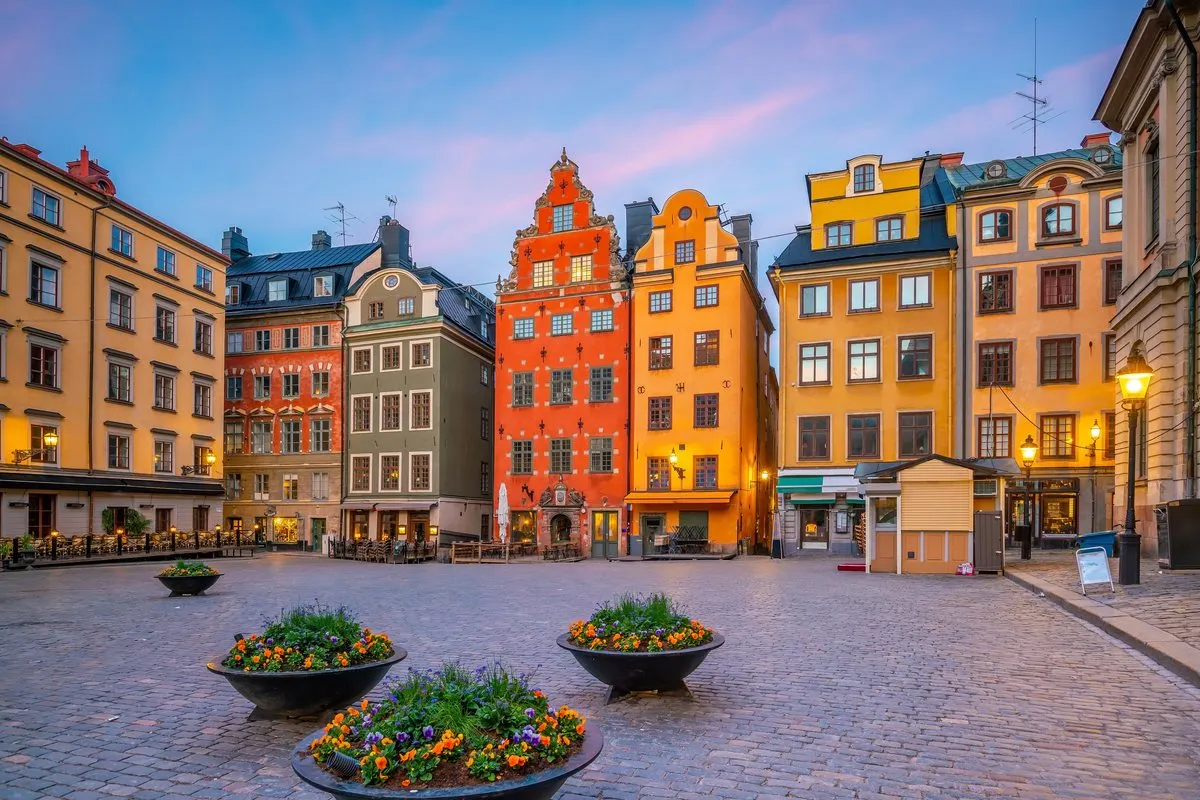
Most visitors to Gamla stan walk the same line: over the bridge, along Västerlånggatan, up to Stortorget and on to the palace. It is a fine route, but the old town on Stadsholmen keeps its best secrets in the lanes on either side – the steep stairways, the quiet street that follows the old town wall, and the eastern main street where the shops are fewer and the pace slower. This walk takes an unhurried hour or two, longer with a lunch, and covers the heart of Stockholm's medieval town.
2 places
© OpenStreetMap contributors · OpenFreeMap
The walk at a glance- Järntorget
- Start of the walk, southern end of Västerlånggatan
- Mårten Trotzigs gränd
- 90 cm wide, 36 steps – Stockholm's narrowest lane
- Prästgatan
- The street inside the old wall; rune stone U 53 at Kåkbrinken
- German Church
- Highest point in Gamla stan, 96 metres above the water
- Österlånggatan 37
- Seventeenth-century portal with Dutch inscription
- Den Gyldene Freden
- Österlånggatan 51, a tavern since 1722
Start at Järntorget and climb Mårten Trotzigs gränd
Begin at Järntorget, at the southern end of Västerlånggatan. A few steps north, a gap opens between the houses: Mårten Trotzigs gränd, just 90 centimetres wide and the narrowest lane in Stockholm. It climbs in 36 steps from Västerlånggatan up to Prästgatan. The lane is named after Mårten Trotzig, a German merchant and burgher who came to Sweden in 1581 and bought property here in 1597, 1599 and 1600. It has had other names – in 1544 it was "the narrow stair lane" – and by 1733 a map already called it Trotz gränd. In the mid-nineteenth century it was closed off with planks at both ends; it reopened in 1945, and its present name was fixed in 1949.
Prästgatan – the street inside the wall
At the top, turn left onto Prästgatan. It runs inside the line of the old town wall that once encircled the high ground of Stadsholmen, and it keeps its original course. It is named after the homes of the city's chaplains: in 1586 it was already Prästegathen, the Priests' Street. The four small houses where the chaplains lived were demolished in 1708, when the clergy house that still stands was built.
Look out for the corner of Kåkbrinken and Prästgatan. Built into the foundations of the house is a rune stone, U 53, which reads: "Torsten and Frögunn had the stone raised in memory of their son." It is thought to date from the eleventh century and probably came here as building material; no one knows where it originally stood. Above it, a cannon barrel was set into the corner in the seventeenth century to protect the house from the large wagons that had begun to use the narrow streets. Further along, at Prästgatan 78, a relief of 1920 marks the house where the painter Carl Larsson was born on 28 May 1853.
For a short detour, cross Stora Nygatan's side of the island to Vera Siöcronas torg by Sven Vintappares gränd – a square of just 50 square metres, laid out in the late eighteenth century as a turning place for the fire brigade's horse-drawn wagons.
The German Church
Prästgatan brings you to the German Church, St Gertrude's, on Svartmangatan. Its tower carries the highest point in Gamla stan: the weathercock, 96 metres above the water. The church stands on the site of the guildhall of St Gertrude, where the medieval town's German merchants met from the fourteenth century. It was rebuilt as a church in the late sixteenth century to designs by Willem Boy, John III's court architect, gained its tower in 1613–1618 and was then remodelled as a hall church by Hans Jacob Kristler of Strasbourg, the same master builder who worked on Ulriksdal and Makalös. The south portal, with sculptures of the 1640s by Joest Henne of Westphalia, echoes the burghers' houses of the old town. The tower burned in 1878. Most services are still held in German.
Österlånggatan – the quieter main street
From the church, walk down to Österlånggatan, which runs north to south from Slottsbacken to Järntorget. Like Västerlånggatan, it once ran just outside the town's defensive wall, and it is mentioned as early as the fifteenth century as "the Long Street". When Skeppsbron was built in the seventeenth century and became the easternmost main street, Österlånggatan lost its importance – and gained, in its place, a calmer character, with fewer souvenir shops than its western twin.
At Österlånggatan 37, stop at the seventeenth-century portal, probably made by the German stonemason Johan Wendelstam. Its inscription is in Dutch and translates roughly as: "When things go well, you have many friends; when luck turns, where can you find them?" – suggesting that whoever commissioned it came from Holland. The blocks along the street carry names from classical mythology: Orpheus, Diana, Bacchus, Castor and Pollux, Apollo, Callisto.
Lunch at Den Gyldene Freden
End at Österlånggatan 51 with Den Gyldene Freden, which opened at this address in 1722 and is Stockholm's oldest surviving city tavern. Which peace the name refers to is uncertain: its first keeper, Petter Hellberg, took the name from an older cellar. The tavern closed in 1891, apparently for good, but was revived in 1895 by Sofia Eklund of the rival Källaren Remmaren across the street, whose house was to be demolished to widen Österlånggatan. In 1919 the painter Anders Zorn bought the building, had it restored and bequeathed it to the Swedish Academy, which still owns it.
Before you go
Wear shoes with a good grip: the lanes are cobbled and Mårten Trotzigs gränd is steep. Mornings are quieter, and the eastern side of the island is calmer than Västerlånggatan all day. Read more about the streets in VERA PI's guides to Prästgatan, Österlånggatan and Järntorget, and follow our plan for a day in Gamla stan. In the lanes, point your phone at any house with Metro Mode Camera to learn when it was built.
Mårten Trotzigs gränd
Stockholm's narrowest lane
A 90-centimetre-wide stairway of 36 steps between Västerlånggatan and Prästgatan.
Mårten Trotzigs gränd, Stockholm
Insider tipSteep and cobbled – take care when wet.
Den Gyldene Freden
Stockholm's oldest surviving city tavern
Serving at this address since 1722; owned by the Swedish Academy since Anders Zorn's bequest.
Österlånggatan 51, Stockholm
Insider tipBook ahead for dinner.