Copper tents that are really a stage set, a pavilion the king moved into before it was finished, and the foundations of a palace that was never built. Haga Park, on the edge of Stockholm, is Gustav III's dream of an English landscape – and the home of the Crown Princess.
In this story · 6 sections
Just north of Stockholm's inner city, where the grid of Vasastaden gives way to water and woodland, lies Haga Park, stretching along the western shore of Brunnsviken from Stallmästaregården in the south to Frösundavik in the north. It is an English-style landscape park, laid out for Gustav III and still known as the Gustavian Park, and its 144 hectares lie wholly within the Royal National City Park. Among its lawns and groves stand a Turkish kiosk, a Chinese pavilion, an Echo Temple, the Copper Tents, Haga Palace and the foundations of a palace that was never finished.
2 places
© OpenStreetMap contributors · OpenFreeMap
Haga Park at a glance- Location
- Western shore of Brunnsviken, Solna
- Size
- 144 hectares, within the Royal National City Park
- Laid out
- 1780–1797, plan by Fredrik Magnus Piper
- Gustav III's Pavilion
- 1787–1792, Olof Tempelman and Louis Masreliez
- Copper Tents
- 1787–1790, Louis Jean Desprez
- Haga Palace
- 1802–1805; home of the Crown Princess since 2010
A king's retreat
The area was once a rural landscape of inns and farms – Kräftriket, Stallmästaregården, Norrbacka and Hagalund – and the future pleasure park had an inn of its own at Gamla Haga. Gustav III had been raised on the ideals of the Enlightenment, and living close to nature was in fashion; he particularly treasured a meeting with Jean-Jacques Rousseau in Paris in 1771. As crown prince he rented Haga farm for the summer of 1767, and four years later, newly king, he bought it. In 1785 he added the neighbouring Brahelund estate, more than doubling the park's size.
Haga became the place where the king withdrew to work undisturbed. He retreated here for several days before his coronation in 1771, the coup of 1772, the outbreak of war in 1788 and the parliaments of 1786, 1789 and 1792. On his travels abroad he called himself the Count of Haga.
Piper's English park
The present park was laid out in 1780–1797. Its architects included Fredrik Magnus Piper, Louis Jean Desprez, Olof Tempelman and Carl Christoffer Gjörwell the Younger, with interiors by Louis Masreliez, and the king himself contributed many sketches. Piper, the English-trained park architect, presented his general plan in 1781, with buildings placed along carefully planned sightlines – one of them running almost five kilometres to the Royal Palace. After the leaves fall, you can still see the Chinese Pavilion from the Turkish Kiosk and from Gamla Haga.
What looks natural is the result of extensive earthworks that softened the transitions between meadow, grove and the great sloping lawns, the pelouses. Canals and islets were dug in 1787–1790, and by 1800 some 26,000 trees had been planted. After a journey to Italy in 1783–1784, the king dreamed of turning the whole Brunnsviken area into a Swedish Campagna Romana – hence the Italian-sounding names around the water, such as Albano, Frescati and Tivoli. After his murder in 1792 the grand plans were shelved.
Gustav III's Pavilion
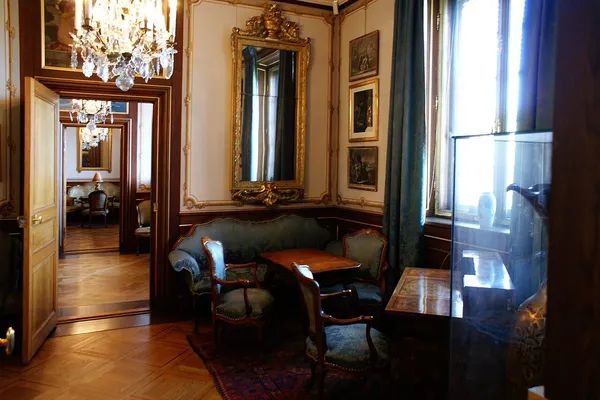
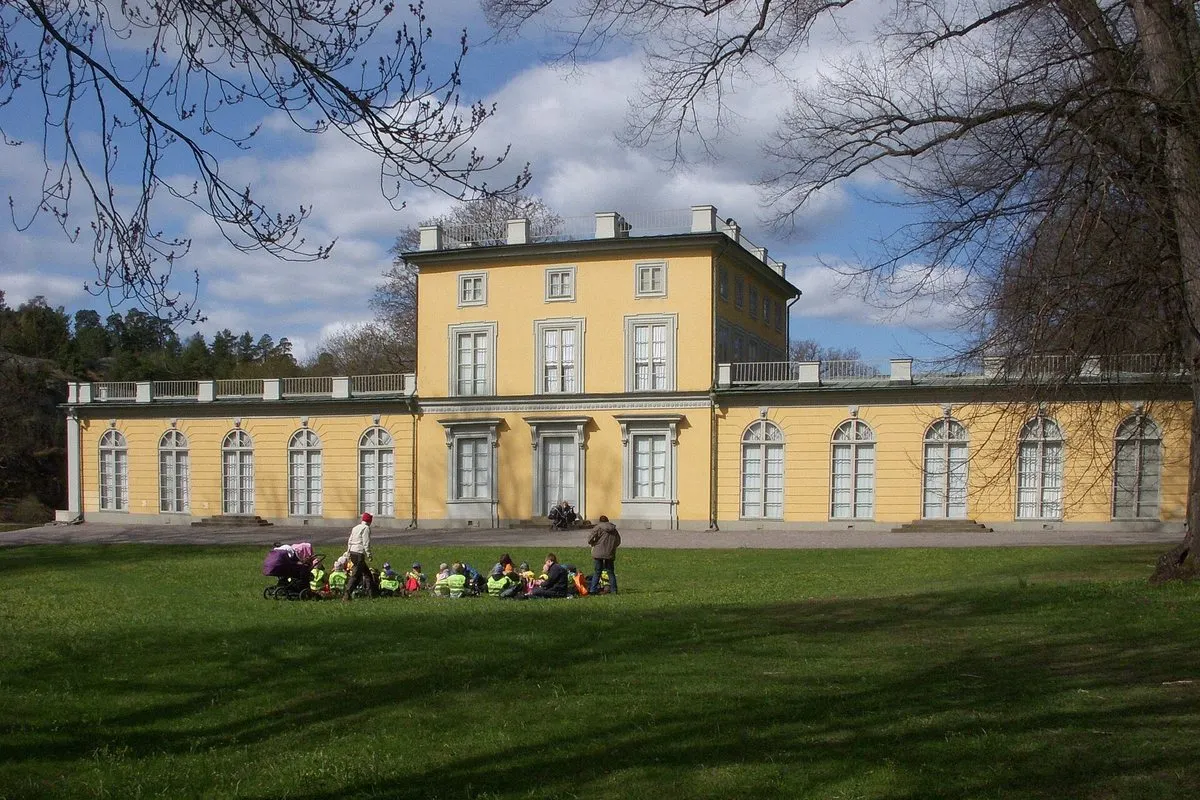
The heart of the park is Gustav III's Pavilion, the king's "little palace", built in 1787–1792 to designs by Olof Tempelman around an older stone house of the Brahelund estate. Its interiors and much of its furniture were created by Louis Masreliez, his first great commission in the late Gustavian style; for a time he lived in the suite at the top of the building to supervise the work. The king moved in on 10 December 1790, before it was finished, and held his first dinner in the dining room as the great marble-topped table arrived at the last moment.
The Great Salon keeps its original decoration, painted with the gods of antiquity – Jupiter, Apollo, Juno and Minerva. The king's dining room was conceived as a classical temple, with painted marble pilasters and reliefs honouring Bacchus. The Mirror Salon in the south wing, with tall windows on three sides overlooking the park and Brunnsviken, was described by the art historian Nils G. Wollin as "something of the most enchanting created in Swedish architecture". Much of Gustav III's Haga library has been reassembled in the building, and the pavilion has been a listed state monument since 1934.
The Copper Tents
At the north-west edge of the great lawn, the Copper Tents look like a Roman military camp, rendered in painted copper sheet. Designed by Louis Jean Desprez and built in 1787–1790 as quarters for the mounted guard, they are in fact a stage set – from behind, they are ordinary rendered and timber buildings. The central tent burned in 1953 and was rebuilt in 1962–1964; in 2009 the tents were repainted in their original cobalt blue. The east tent holds an inn that visitors could already find here in 1912, and the Haga Park Museum opened in the central tent in 1983.
Haga Palace and the palace that never was
Haga Palace, built in 1802–1805 for Gustav IV Adolf by Carl Christoffer Gjörwell the Younger as a "children's palace", was where King Carl XVI Gustaf and his sisters, the "Haga princesses", were born. Since 2010 it has been the home of Crown Princess Victoria and Prince Daniel, a wedding gift from the government; a public path runs along the water. Nearby lie the foundations of Stora Haga, the vast palace Gustav III commissioned from Desprez and never lived to see.
Walking Haga
The park is a classic walk for Stockholmers, and the path around Brunnsviken makes a fine circuit. Start at Stallmästaregården, follow the shore to Gustav III's Pavilion and the Copper Tents, and climb Frösundatoppen at the northern end for the view. Check the pavilion's opening times before you go. Plan the route with Metro Mode's Stockholm map, start from Vasastan with our plan for a day in Vasastan, explore Solna with VERA PI and point your phone at the pavilion with Metro Mode Camera.
Gustav III's Pavilion
The king's little palace in Haga Park
Gustavian masterpiece of 1787–1792 with interiors by Louis Masreliez.
Hagaparken, Solna
Insider tipCheck opening times before visiting.
The Copper Tents
Desprez's painted copper camp of 1787–1790
Former guard quarters, now an inn and the Haga Park Museum.
Hagaparken, Solna
Insider tipBest seen across the great lawn.