Greenwich gave the world its Prime Meridian and Greenwich Mean Time. On the Thames in south-east London, Wren's naval hospital, Inigo Jones's Queen's House, the Royal Observatory and the Cutty Sark form the World Heritage Site of Maritime Greenwich. Here is the guide.
In this story · 5 sections
Greenwich lies on the River Thames in south-east London, around nine kilometres east-south-east of Charing Cross. It is best known for the Greenwich Meridian and Greenwich Mean Time, and its riverside contains the UNESCO World Heritage Site of Maritime Greenwich: the Old Royal Naval College, the Queen's House, the Royal Observatory on its hill and, by the water, the clipper ship Cutty Sark. It makes one of the finest days out from central London.
3 places
© OpenStreetMap contributors · OpenFreeMap
- 01Royal Observatory GreenwichMuseum · Greenwich
- 02Cutty SarkMuseum ship · Greenwich
- 03Old Royal Naval CollegeHistoric site · Greenwich
- 1616–1635
- Queen's House built
- 1675
- Royal Observatory founded
- 1696–1712
- Royal Hospital for Seamen built
- 1884
- Greenwich chosen as the Prime Meridian
- 1954
- Cutty Sark arrives in dry dock
From Tudor palace to Wren's naval hospital
Greenwich was the site of a royal palace from the 15th century – the Palace of Placentia, later known as Greenwich Palace – and the birthplace of Henry VIII, Mary I and Elizabeth I. The palace fell into disrepair during the Civil War and was demolished in 1694. In its place Sir Christopher Wren designed the Royal Hospital for Seamen, built between 1696 and 1712 on the instructions of Mary II. From 1873 to 1998 the buildings served as the Royal Naval College. Today they are managed by the Greenwich Foundation, and the Painted Hall, painted by Sir James Thornhill between 1707 and 1726, and the chapel are open to visitors. UNESCO has described the site as the "finest and most dramatically sited architectural and landscape ensemble in the British Isles".
The Queen's House – England's first classical building
Behind the college stands the Queen's House, built between 1616 and 1635 by Inigo Jones for Anne of Denmark and then Henrietta Maria. It was the first consciously classical building in England, designed after Jones's tour of Italy, and its Great Hall is a perfect cube. The Tulip Stairs are a wrought-iron staircase that supports itself. Wren kept the long view from the house to the river when he laid out the hospital, and that 35-metre-wide vista is protected today. The house is part of the National Maritime Museum and shows maritime paintings and portraits.
The Royal Observatory and the Prime Meridian
On the hill in Greenwich Park stands the Royal Observatory, commissioned by Charles II in 1675 on a site chosen by Wren. John Flamsteed became the first Astronomer Royal, charged with improving navigation by finding longitude at sea. A time ball has marked daily time signals since 1833, and in 1884 the International Meridian Conference in Washington chose the Greenwich meridian as the Prime Meridian for the world. Together with the National Maritime Museum, the Queen's House and Cutty Sark, the observatory forms Royal Museums Greenwich.
Cutty Sark – one of the last tea clippers
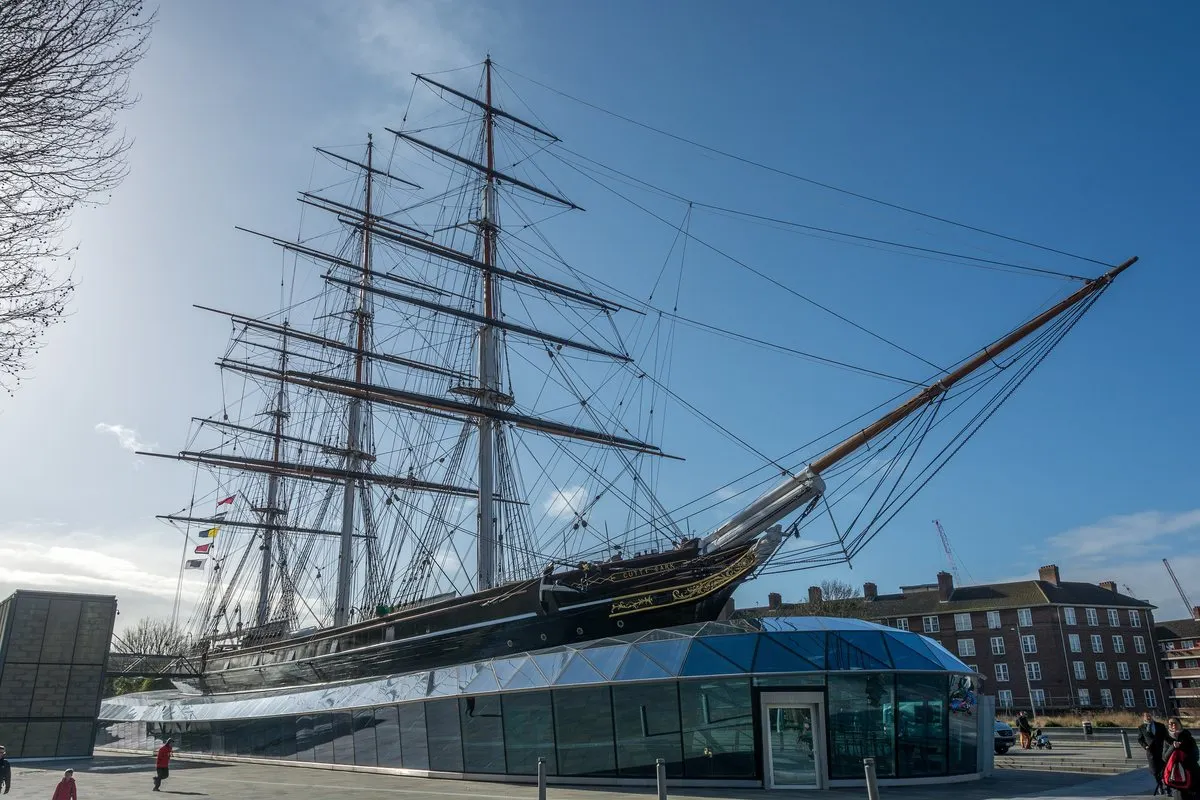
Cutty Sark was built at Dumbarton in Scotland in 1869 and was one of the last and fastest tea clippers. She is named after the witch in Robert Burns's poem Tam o' Shanter. Steamships and the Suez Canal soon took over the tea route, and she carried wool from Australia before being sold to Portugal in 1895. She came to permanent dry dock at Greenwich in 1954. After a fire in 2007 she was restored and reopened in 2012. She is one of only three surviving intact composite ships – a wooden hull on an iron frame – from the 19th century.
How to spend a day in Greenwich
Start at Cutty Sark by the river, walk through the Old Royal Naval College to the Painted Hall, continue to the Queen's House and climb through Greenwich Park to the Royal Observatory for the view back over the Thames. Explore the area in VERA PI's street file for King William Walk, see all of Greenwich in VERA PI, or start with VERA PI's London guide.
Royal Observatory Greenwich
Home of the Prime Meridian
Founded 1675, with Flamsteed House and the time ball.
Greenwich Park, London SE10
Cutty Sark
Tea clipper from 1869
In dry dock at Greenwich since 1954.
King William Walk, London SE10
Old Royal Naval College
Wren's riverside masterpiece
The Painted Hall and chapel are open to visitors.
King William Walk, London SE10