A royal hop garden of 1619, a park of theatres and toboggan runs, statues from Linnaeus to Hjalmar Söderberg – and in the middle, Sweden's national library, with its cast-iron reading room and book vaults 40 metres underground. Humlegården is where Östermalm comes to breathe.
In this story · 6 sections
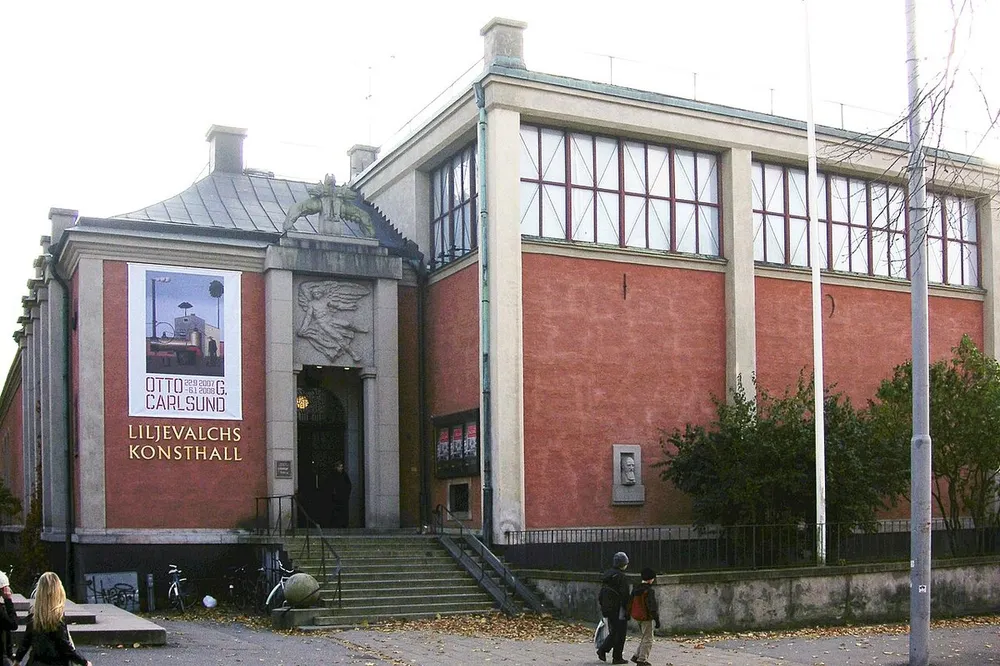
Four streets frame it – Karlavägen to the north, Sturegatan to the east, Humlegårdsgatan to the south and Engelbrektsgatan to the west – and inside them lies Östermalm's great green room: lawns, lime avenues, a hill and a scattering of statues, a few steps from the bars and boutiques of Stureplan. Humlegården has been a royal kitchen garden, a pleasure ground, a theatre district and a public park, and since 1878 it has been home to the Royal Library, Kungliga biblioteket, Sweden's national library.
The Royal Library
Library · Östermalm
© OpenStreetMap contributors · OpenFreeMap
- Address
- Humlegården, Stockholm
- Location
- Östermalm, between Karlavägen, Sturegatan, Humlegårdsgatan and Engelbrektsgatan
- Royal garden
- Laid out 1619 for Gustav II Adolf
- Public park
- Partly from 1764, fully from 1869
- Royal Library
- Opened in the park on 2 January 1878
- Architect
- Gustaf Dahl; wings by Axel Anderberg, 1926–1927
- Underground vaults
- Two, five storeys each, 40 metres below ground
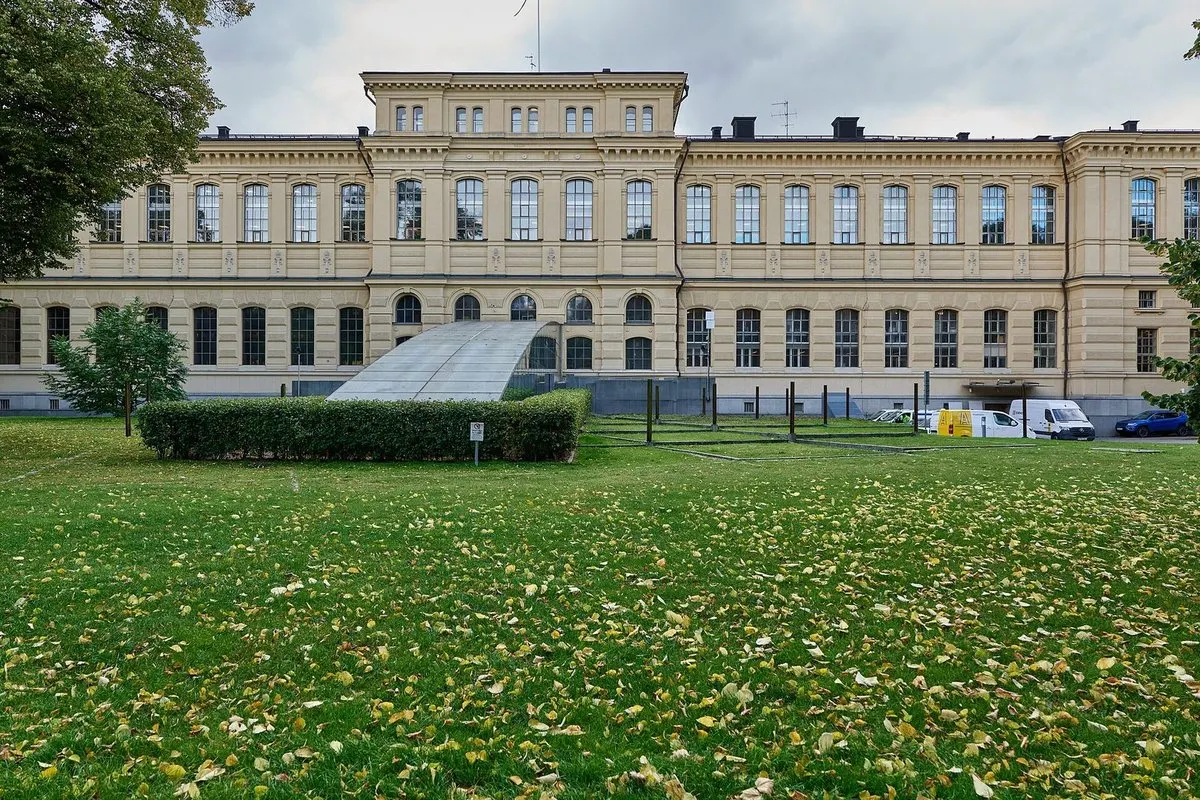
Gustaf Dahl's building of 1878 with its cast-iron reading room and underground vaults.
01A king's hop garden
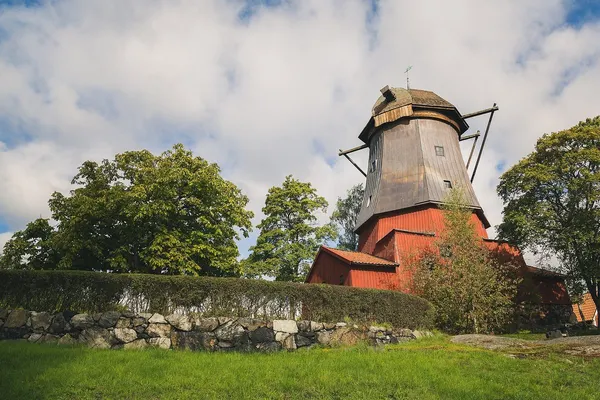
In the Middle Ages the area was probably farmland belonging to the estate of Ekeby, which Magnus Ladulås gave to the convent of St Clare in 1288. Humlegården itself was laid out as a royal garden in 1619 at the command of Gustav II Adolf. Fruit and herbs were grown here, and later hops – humle, which gave the park its name. Queen Ulrika Eleonora had a pavilion built, the Rotunda, where she stayed with her children.
After some years of decay the park was bought at public auction by King Adolf Fredrik in the mid-eighteenth century, and he had it restored. It was partly opened to the public in 1764, and over the following century Humlegården served as a theatre, a zoo, a pleasure garden and an inn. In 1773 the Humlegård Theatre opened in the old pavilion, and between 1851 and 1878 the Nya Theatern performed here.
02Linnaeus and Flora's Hill
From 1835 to 1842 the Linnaean Society leased the park and transformed it: ponds were dug, greenhouses and aviaries built, and the whole area north of the east–west avenue was reshaped in the English landscape style. Statues of Carl Linnaeus and Flora were set up at the foot of the hill, which became known as Flora's Hill. In winter it became a popular toboggan run – in the 1850s a sledge could be hired by the hour for twelve skilling – and artists such as Gustaf Axel Broding drew the winter scenes for the daily papers. Since 1869 Humlegården has been a fully public park.
Insider tipCheck opening hours before visiting.
03A park of statues
Humlegården is an open-air gallery of Swedish sculpture. The Linnaeus monument by Frithiof Kjellberg was raised in 1885, followed by John Börjeson's statue of the chemist Carl Wilhelm Scheele in 1892 and Per Hasselberg's "The Grandfather" by the library in 1896. Sigrid Fridman's statue of the writer and reformer Fredrika Bremer arrived in 1927, Peter Linde's statue of the novelist Hjalmar Söderberg in 2010, and Francisco Gazitúa's "Cordillera de Los Andes" in 2000. The most recent addition, "Standing Waves" by Adéle Essle Zeiss and Liva Isakson Lundin, was raised in 2022.
04The Royal Library
The royal collections go back to the days of Gustav Vasa, who acquired books on history, science, theology and maps; Eric XIV, John III and Charles IX added to them, and they were kept in the old Tre Kronor palace. During the Thirty Years' War the library grew through spoils of war, among them the episcopal library of Würzburg in 1631 and the royal library in Prague in 1649 – from where the thirteenth-century Codex Gigas, the "Devil's Bible", was brought to Stockholm.
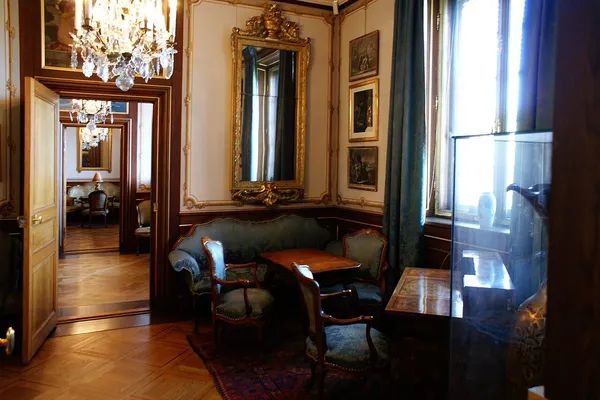
In 1661 a new law required every printer in Sweden to send two copies of everything it printed, one of them to the royal library – a rule born more of the great power's wish for control and censorship than of a love of literature, but one that still underpins the library's mission: today it collects and preserves everything printed in Sweden. When Tre Kronor burned in May 1697, some 17,286 volumes and 1,103 manuscripts were lost. After decades in various noble palaces, the collections moved into the new Royal Palace in 1768, and Gustav III gave his private library of 14,500 works in 1792. August Strindberg worked at the library as an extraordinary amanuensis between 1874 and 1882.
05Gustaf Dahl's building
The library moved into its present home in Humlegården at the turn of 1877–1878 and opened on 2 January 1878. The building, designed by Gustaf Dahl, was originally 80 metres long and built with a pioneering frame of brick walls, cast-iron columns and iron beams, its Renaissance-inspired façade marked by a raised central section. The two wings were added in 1926–1927 to designs by Axel Anderberg, and the building has been a listed state monument since 1935. Of the original interior, the vestibule and the great reading room survive, with their tall cast-iron columns in double rows and galleries.
In the 1980s, to expand without touching the protected building or the park, two great rock vaults of five storeys each were blasted out 40 metres below ground. The rebuilt library reopened in 1997, and the underground "KB Annexet" now holds most of the collections, beneath a large vaulted glass roof that meets the main building's north façade. In one of the vaults stands an exact copy of the poet Nelly Sachs's Stockholm apartment, complete with all her belongings. The collections – more than 18 million items, plus over 7 million hours of recorded radio, television and music – are open to everyone, although material from the Swedish collection must be studied on site and most items are ordered in advance.
06Visiting
Humlegården is a natural pause between Stureplan and the quieter streets of upper Östermalm. Check the library's opening hours before you go. Read about the streets around the park in VERA PI's guides to Humlegårdsgatan, Sturegatan and Karlavägen, explore Östermalm with VERA PI, follow our plan for a day on Östermalm and point your phone at the library with Metro Mode Camera.