A reinforced-concrete temple of daylight from 1916, Carl Milles's Archer on a 12-metre column, a garden restaurant and a new wing glittering with 6,860 glass bottle bottoms. Liljevalchs is Stockholm's public art hall – and home of the much-loved Spring Salon.
In this story · 6 sections
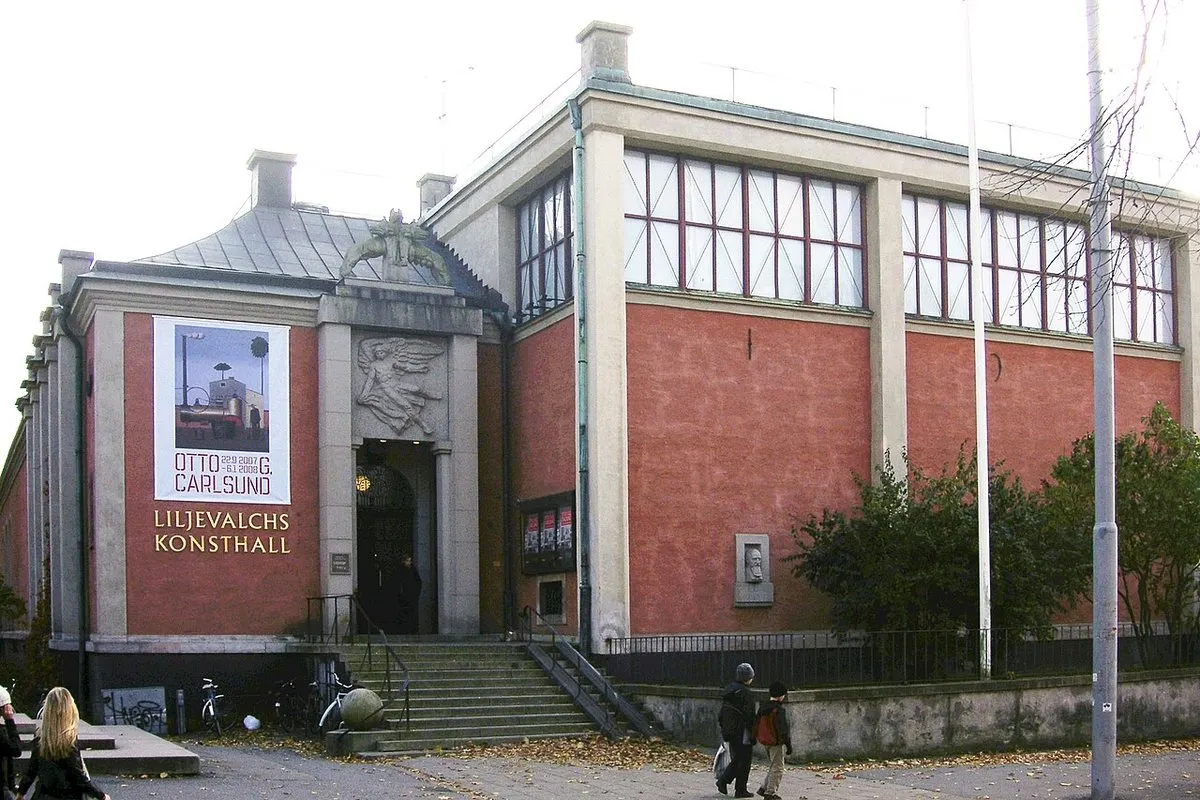
On Djurgårdsvägen, on southern Djurgården, a long, low building in soft red render stands behind a granite column topped by a bronze archer drawing his bow. This is Liljevalchs, the art hall that opened in 1916 with the aim of making art more accessible to everyone, and it has been showing modern and contemporary art – along with crafts and design – ever since. The architectural historian Fredric Bedoire counts it among the breakthrough works of modern architecture in Sweden.
Liljevalchs
Art gallery · Djurgården
© OpenStreetMap contributors · OpenFreeMap
- Address
- Djurgårdsvägen 60, Stockholm
- Address
- Djurgårdsvägen 60, Djurgården
- Opened
- March 1916
- Architect
- Carl Bergsten
- Sculpture outside
- "The Archer" by Carl Milles, 1919
- Spring Salon
- Every year since 1921
- Liljevalchs+
- Wingårdh and Ingegerd Råman, opened 12 August 2021
Carl Bergsten's daylit art hall with Milles's Archer, the Spring Salon and the Liljevalchs+ extension.
01A bequest and a competition
The art hall was paid for by the estate of the industrialist Carl Fredrik Liljevalch the Younger, a patron of the arts, philanthropist and benefactor of museums. Those who administered his bequest decided that a public art hall was what he would have wanted. A committee led by Prince Eugen secured a site from the City of Stockholm on Djurgården, which the city provided free of charge on condition that the finished building passed to the city.
An architectural competition in 1913 drew 32 entries, judged by a jury that included Prince Eugen, the painter Karl Nordström and the architects Carl Westman and Gustaf Wickman. The first prize was shared between Carl Bergsten and Cyrillus Johansson, but the commission went to Bergsten, whose design was cheaper to build and, in the jury's view, fitted admirably with the traditional buildings of Djurgården. The jury even sent him to Hamburg to study the new Kunsthalle there. His competition design had pale green façades; they became pale red with details in white render. Building began in June 1914, and the first exhibition, at the opening in March 1916, showed works by Carl Larsson, Anders Zorn and Bruno Liljefors.
02A building made of light
Liljevalchs draws on contemporary German gallery design, the palaces and villas of southern Europe and the new technique of reinforced concrete, and its spare interior and slender construction make it a representative of Swedish Grace, the style that bridged National Romanticism and the classicism of the 1920s. Bergsten had imagined an obelisk in front of the building – in fact an artfully designed chimney – but it was dropped for lack of money. Instead, in May 1919, Carl Milles's sculpture "The Archer" was raised on a 12-metre granite column outside. Milles also made the portal relief and the Cerberus above the entrance, and Christian Eriksson the granite bust of Liljevalch.
Insider tipLunch at Blå Porten in the garden.
The entrance floor holds some 13 galleries. The largest, the Sculpture Hall, rises 8.5 metres to a coffered ceiling of reinforced concrete, with a band of windows running almost all the way round beneath the roof and a stair of dark grey steps against the white walls. Most of the rooms are lit from above, several through glass roofs or lanterns, others from side windows – a variety of natural light that made Liljevalchs a unique gallery for its time. From the second-largest hall, glass doors open through an airy portico onto an enclosed garden.
03The Spring Salon
Since 1921 Liljevalchs has held the annual Spring Salon, Vårsalongen, often made up of works by members of the public and little-known artists, selected by a jury. It is a popular chance for unknown artists to show – and sell – their work, and one of the fixtures of the Stockholm art year. Another landmark exhibition was the Home Exhibition of 1917, organised by the Swedish Society of Crafts and Design. Since 1974 the art hall has belonged to the City of Stockholm, and the Stockholm City Museum has classified the building as being of exceptionally high cultural-historical value.
04Liljevalchs+
In 2013 five practices competed to design an extension: Lundgaard & Tranberg, Snøhetta, Petra Gipp Arkitektur, Wingårdh Arkitektkontor and Kengo Kuma & Associates. Wingårdh won, working with the glass artist Ingegerd Råman, with a three-storey concrete building of around 2,400 square metres of exhibition space on a former car park. During the excavations in 2018 a centuries-old shipwreck and well-preserved wooden chests were found on the site.
Liljevalchs+ opened on 12 August 2021. Its three galleries, which can be divided into smaller rooms, are lit indirectly through a grid of 166 roof lanterns, which from outside are meant to resemble battlements. The façades and inner walls are cast in concrete with 6,860 inset "bottle bottoms" of clear glass designed by Råman – "a successful interplay between artist and architect", in the jury's words. It divided opinion: Gert Wingårdh called it his finest creation, while a campaign group named it the ugliest new building of 2020; it was also nominated for Stockholm Building of the Year 2022. The extension has its own entrance on Falkenbergsgatan, with a museum shop.
05Lunch in the garden
On the far side of the garden lies the restaurant Blå Porten, where you can eat indoors or in the garden itself; the restaurant and garden also have their own entrance from Djurgårdsvägen.
06Visiting
Liljevalchs shows several exhibitions a year, mostly contemporary, and has charged admission for most of its history – check current exhibitions and opening times before you go. Read about the setting in VERA PI's guides to Djurgårdsvägen, Falkenbergsgatan and Djurgården, combine it with our plan for a day on Djurgården and point your phone at the Archer with Metro Mode Camera.