A façade modelled on a palace on the Grand Canal, an Art Nouveau and Moorish-style swimming hall, and a fire that almost wiped out the whole thing. Sturebadet at Stureplan is Stockholm's oldest preserved bathhouse – and still the city's most elegant way to take a dip.
In this story · 6 sections
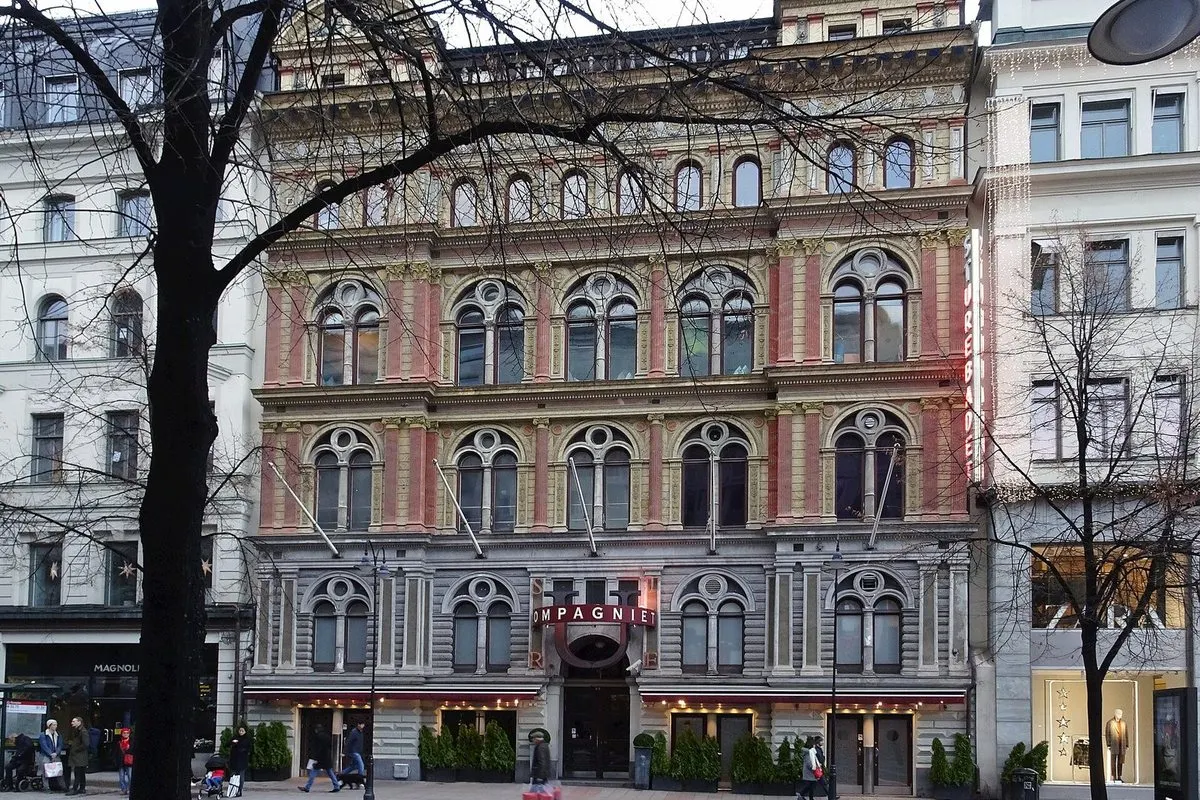
In the midst of Östermalm's most elegantly dressed quarter, a stone's throw from Stureplan, stands a narrow five-storey façade in warm red marbling that gives no hint of what it conceals. Within lies Sturebadet, Stockholm's oldest surviving bathhouse, inaugurated in May 1885 and protected as a listed building since 1986. The swimming hall, with its richly detailed wooden interiors in Art Nouveau and Moorish style, is one of the most beautiful interiors in the city – and one of the most improbable survival stories.
Sturebadet
Spa · Östermalm
© OpenStreetMap contributors · OpenFreeMap
- Address
- Sturegatan 4, Stockholm
- Opened
- May 1885
- Initiator
- Carl Curman, the bathing physician
- Façade
- Isæus & Sandahl, after Palazzo Vendramin-Calergi in Venice
- Swimming hall
- 1902, Sigge Cronstedt; interior design Hjalmar Molin
- Pool
- 14 × 7 metres, around 20 bathers at a time
- Listed building
- Since 1986
Venetian façade, Moorish swimming hall from 1902 and a reconstruction following the fire in 1985.
01A bathing lover's dream
Behind the construction was the bathing physician Professor Carl Curman, who had long dreamed of giving the people of Stockholm better health. In 1867, he founded Stockholms Badhusaktiebolag and subsequently opened Stora badhuset on Malmtorgsgatan. It became a success, and after fifteen years the company wanted to open a branch in Östermalm. Curman found a plot in the block of Sperlingens backe on Sturegatan.
Then he travelled to Venice to find inspiration – and found it in the 16th-century Palazzo Vendramin-Calergi on the Grand Canal. Back in Stockholm, he engaged the architectural firm Isæus & Sandahl, where a young Gustaf Wickman also worked. Where the palace in Venice has façades in genuine white marble, Sturebadet was given painted marbling in warm red shades. The idea was that the building should not look like a bathing establishment, but should fittingly blend into the new urban environment that was emerging around Stureplan.
When the baths opened, Ny Illustrerad Tidning wrote that the new bathhouse made an "excellent showing" next to the dominant Bångska palace, and that the façade "in taste, elegance and genuine artistic arrangement" surpassed most things in Stockholm. Behind the elegant front, only a tall brick factory chimney revealed what was going on inside the building.
02A Roman bath in Stockholm
The new baths were a modern hot-air bath modelled on the ancient Roman baths. The heart of the building was the tall, glass-covered atrium hall, designed after ancient models with pilasters between the windows, where bathers waited before proceeding to the ladies' or gentlemen's baths, both divided into three classes. In the windows facing the atrium, the nine muses were etched, and the floor of patterned cement mosaic, with inset glass blocks that let light down to the floor below, is still preserved today. There were hot rooms, tub baths, a cold-water pool and around a hundred cubicles. Two floors up was the Medico-Mechanical Institute, the city's first gym, where the physician Gustaf Zander kept his exercise machines.
Insider tipEntrance to the baths via Sturegallerian.
03The swimming baths from 1902
In 1902, the baths were extended with the swimming hall that today is Sturebadet's hallmark, designed by Sigge Cronstedt on the inner part of the property. The interior, in Art Nouveau style with Old Norse and Moorish features, was designed by the architect Hjalmar Molin. The water came from the building's own water tower adjacent to the swimming hall. The pool measures 14 by 7 metres and accommodates around 20 bathers at a time – an intimate space rather than a fitness facility.
04The demolition threat and the fire
In the late 1970s, the upkeep became increasingly expensive, and in 1982 the owner applied for permission to demolish the pool building in order to build offices. In 1984, the baths were closed. After lengthy discussions with the city's heritage authorities, it was saved through a listed building designation covering the street-facing building with its entrance and atrium, the men's sauna, the pool, the warm rooms, the swimming hall and the façade facing Sturegatan. As part of the agreement, a shopping centre, Sturegallerian, was built through the ground floors of the property.
In the middle of the renovation, on 30 May 1985, the building was ravaged by fire. The swimming hall was largely destroyed. There were no drawings, but there were photographs from when the baths were new, as well as photographic documentation made just a few weeks before the fire. Using these as a basis, master carpenter Anders Wickman and his team recreated the detailed wooden interiors, and the architectural firm Malmquist & Skoogh was responsible, among others, for the reconstruction of the swimming hall. It was the first time in Sweden that such an extensive and meticulous reconstruction had been carried out.
05Sturebadet today
After the conversion, the original connection between the atrium and the swimming hall was broken. Today, the atrium and entrance building house the nightclub Sturecompagniet, while Sturebadet has its own entrance and reception inside Sturegallerian. Both parts have been given a blue rating by the Stockholm City Museum, the classification that denotes exceptionally high cultural-historical values. Skandia owned and ran the baths after the fire, and in 2008 they were bought by the financier Anders Wall together with three other parties. Today Sturebadet is owned and operated by Sturebadet Holding AB.
Sturebadet is today a wellness facility with a swimming pool, gym, group training and spa treatments, and regular guests have access via various memberships. The terms and conditions for visits and admission change, so check directly with Sturebadet before planning your visit.
06Round the corner
Sturebadet is located right in Stockholm's luxury district. Combine your visit with our plan for a day on Östermalm and the architecture of Östermalm's stone city, read about the streets in VERA PI's street guide to Sturegatan and Birger Jarlsgatan, and explore the rest of Östermalm at VERA PI. And if you want to know more about the façade in front of you: point your phone at it with Metro Mode Camera.