1,430 rooms, two bronze lions cast from spoils of war, and a guard that has stood watch since 1523. The Royal Palace in Gamla Stan is the monarch's residence, a working court and one of Stockholm's great experiences.
In this story · 5 sections
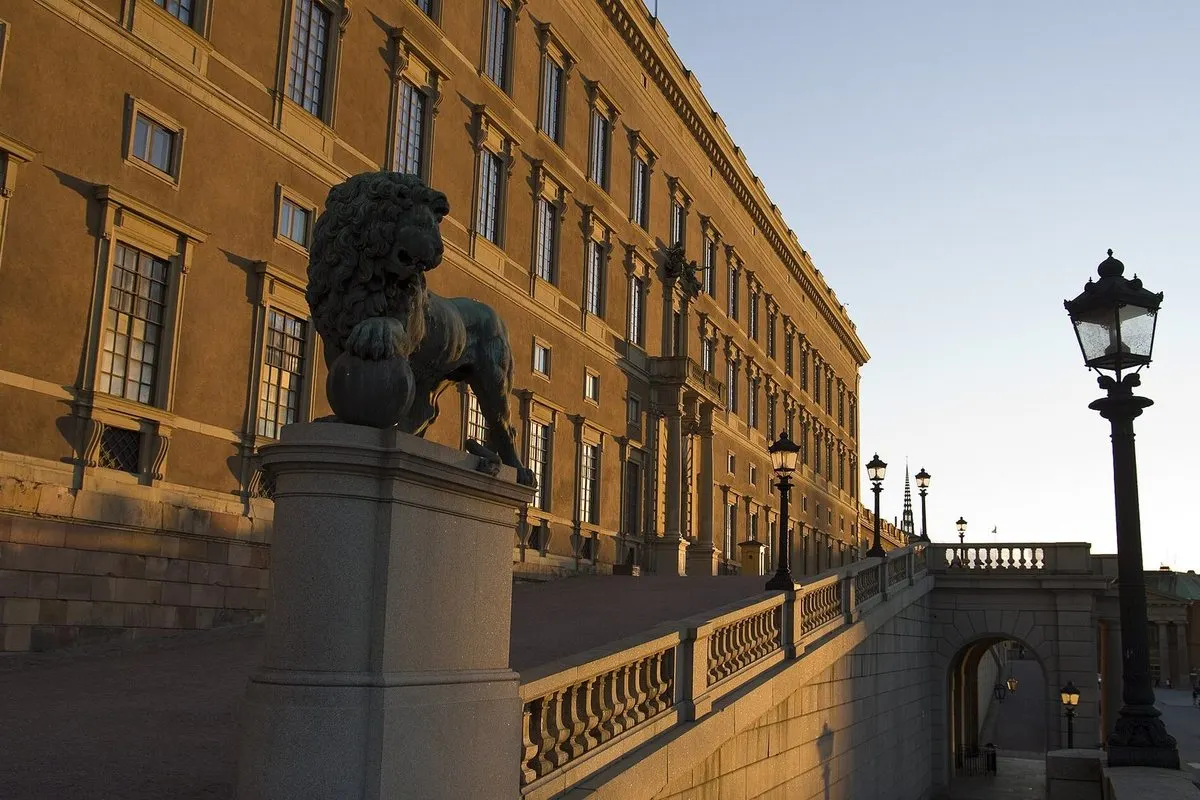
From Norrbro and Strömmen you can see the Royal Palace in its full length: a closed, almost square baroque building on the northern tip of Stadsholmen, with Lejonbacken and the two bronze lions facing the water. It is the official residence of the Swedish monarch. The current palace has stood here since the 1700s, and fortifications have existed on the site since the Middle Ages. The palace has 1,430 rooms, of which 660 have windows, covering 42,000 square metres – and large parts of it are open to visitors.
2 places
© OpenStreetMap contributors · OpenFreeMap
- 01The Royal Palace (Kungliga slottet)Sight · Gamla Stan
- 02The outer courtyard (Yttre borggården)Experience · Gamla Stan
- Architect
- Nicodemus Tessin the Younger, completed by Carl Hårleman and others
- Built
- 1697–1754, completed 1771
- Rooms
- 1,430, of which 660 with windows (2009)
- Area
- 42,000 square metres
- Royal Guard
- Continuously since 1523
- Spectators at the Changing of the Guard
- At least 800,000 per year
From Tre Kronor to Tessin's palace
For a long time the castle Tre Kronor stood here, named after the three golden crowns that were put up on its largest tower in 1588. As early as 1690, the architect Nicodemus Tessin the Younger began rebuilding the northern wing in strict Roman baroque style, modelled on the Palazzo Farnese in Rome. The wing was roofed in just five months. But on 7 May 1697, a fire destroyed almost the entire old castle. Only the newly rebuilt walls in the north survived – and they largely remain standing to this day.
That same year, Tessin presented the drawings for an entirely new palace. The demolition of the ruins took three years, and the remains of the old keep were used as filling for Lejonbacken. The work was carried out intensively, and a colony of French artists and craftsmen, many with experience from Louis XIV's construction at Versailles, came to Stockholm to adorn the palace. But the Great Northern War emptied the state coffers, and after the defeat at Poltava in 1709, construction came to a complete halt. For almost twenty years, the palace stood half-finished in the middle of the city.
When work resumed in 1727, Tessin had only one year left to live. Carl Hårleman took over and designed many of the original interiors in the new Rococo style. On the first Sunday of Advent 1754, King Adolf Fredrik and Queen Lovisa Ulrika were able to move in, and the palace is considered fully completed in 1771. Since then, the palace has not been rebuilt to any great extent – only adapted, furnished and modernised for new monarchs.
Four façades, four messages
Tessin gave each façade its own meaning. The stern northern façade facing Strömmen was to radiate royal power. The western façade represents the king: here there are ten caryatids, female figures of about 4.5 metres by the French sculptor Charles Guillaume Cousin, and medallions with nine Swedish monarchs, from Gustav Vasa to Karl XI. In the central window above the portico, the royal family usually appears on the king's birthday. The eastern façade facing the Logården garden represents the queen, and the southern façade, designed as a triumphal arch facing Slottsbacken, represents the nation. In its niches stand statues of famous Swedes such as Carl von Linné, Erik Dahlbergh and Tessin himself.
The lions on Lejonbacken were approved by Karl XII in 1700 and cast in 1702 and 1704. The bronze came from a fountain taken as spoils of war from Kronborg Castle at Helsingør.
The palace has been undergoing the largest façade renovation in its history since 2011, as the Gotland sandstone in the façades and sculptures has weathered. The work is being carried out stage by stage over several decades, and parts of the façade may be covered by scaffolding.
The halls
Inside the southern arch, the Hall of State and the Royal Chapel lie on either side – secular and spiritual power gathered in the same place. The Hall of State was brought into use for the Riksdag in 1755 and houses Queen Kristina's silver throne. The Royal Chapel is the church of the Royal Court Parish, and services are held there every Sunday and public holiday.
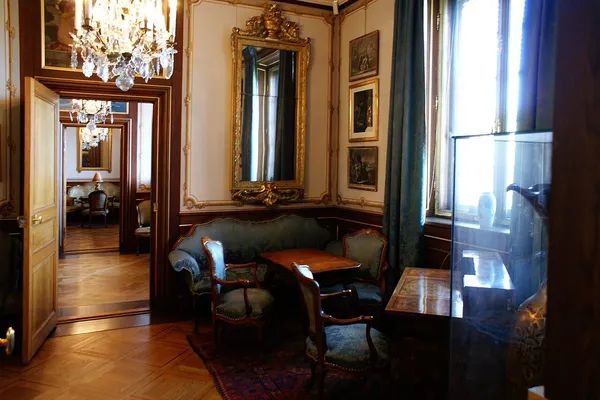
Two floors up in the north wing lie the State Apartments. In Karl XI's Gallery, official dinners are held, among other things during state visits and for the Nobel laureates, and in the corner lies the White Sea, which is furnished as a drawing room before and after the dinners. The Bernadotte Apartments, one floor up, take their name from the portraits of the royal dynasty in the Bernadotte Gallery. Adolf Fredrik and Lovisa Ulrika moved in here in 1754, and the last to live here were Oscar II and Sofia. In the west wing are the Guest Apartments, where visiting heads of state have stayed during state visits since the 1870s, and the Halls of the Orders of Chivalry with an exhibition on the royal orders.
The palace is also a museum in several layers. The Treasury displays the Royal Regalia, the Royal Armoury royal costumes and weapons, Gustav III's Museum of Antiquities the king's antique sculptures, and in the Tre Kronor Museum you can see the cellar vaults of the old castle that burned down in 1697.
The Changing of the Guard
The Royal Guard has guarded the palace and the royal family since 1523. It consists of around 35 soldiers, and the duty is shared between units of the Swedish Armed Forces – the Life Guards provide the most days of guard duty – and the Home Guard. The Changing of the Guard takes place in the outer courtyard, between the palace's curved wings, and is estimated to draw at least 800,000 spectators a year.
In summer, from June to August, and in connection with Christmas, New Year and other major holidays, the new guard marches with a military band through the city, usually from the Army Museum (Armémuseum). During the rest of the year, the guard usually marches on Wednesdays and Saturdays with drummers or trumpeters. On selected days between April and August, the guard rides up to the palace from the Life Guards' cavalry barracks (Livgardets kavallerikasern) on Östermalm, accompanied by the Life Guards' Dragoon Band (Livgardets Dragonmusikkår) on horseback. Check the day's schedule before you go, and arrive in good time to secure a place close to the palace courtyard.
How to visit the palace
The palace's public areas and museums have their own opening hours and tickets that vary throughout the year, and the halls may be closed during state visits and official ceremonies – check before your visit. Allow half a day if you want to see both the halls and the museums. In the evening, the façades are illuminated, and the walk around the palace – from Lejonbacken via Skeppsbron and Logården to Slottsbacken – is one of the most beautiful in Gamla Stan.
Combine the visit with our plan for a day in Gamla Stan or a night at the Grand Hôtel opposite the palace, read about the streets around the palace in VERA PI's street guide to Slottsbacken, Lejonbacken and Skeppsbron, and explore the rest of Gamla Stan at VERA PI. And if you're standing in front of a façade you want to know more about: point your phone at it with Metro Mode Camera.
The Royal Palace (Kungliga slottet)
The monarch's official residence with 1,430 rooms
Tessin's baroque palace with the Hall of State, the State Apartments, the Treasury, the Royal Armoury and the Tre Kronor Museum.
Slottsbacken 1, Stockholm
Insider tipThe halls may be closed during state visits – please check in advance.
The outer courtyard (Yttre borggården)
The venue for the Changing of the Guard
The Royal Guard has been guarding the palace since 1523. The Changing of the Guard draws at least 800,000 spectators a year.
Slottsbacken, Stockholm
Insider tipChanging of the Guard with a military band in summer, otherwise usually Wednesdays and Saturdays.