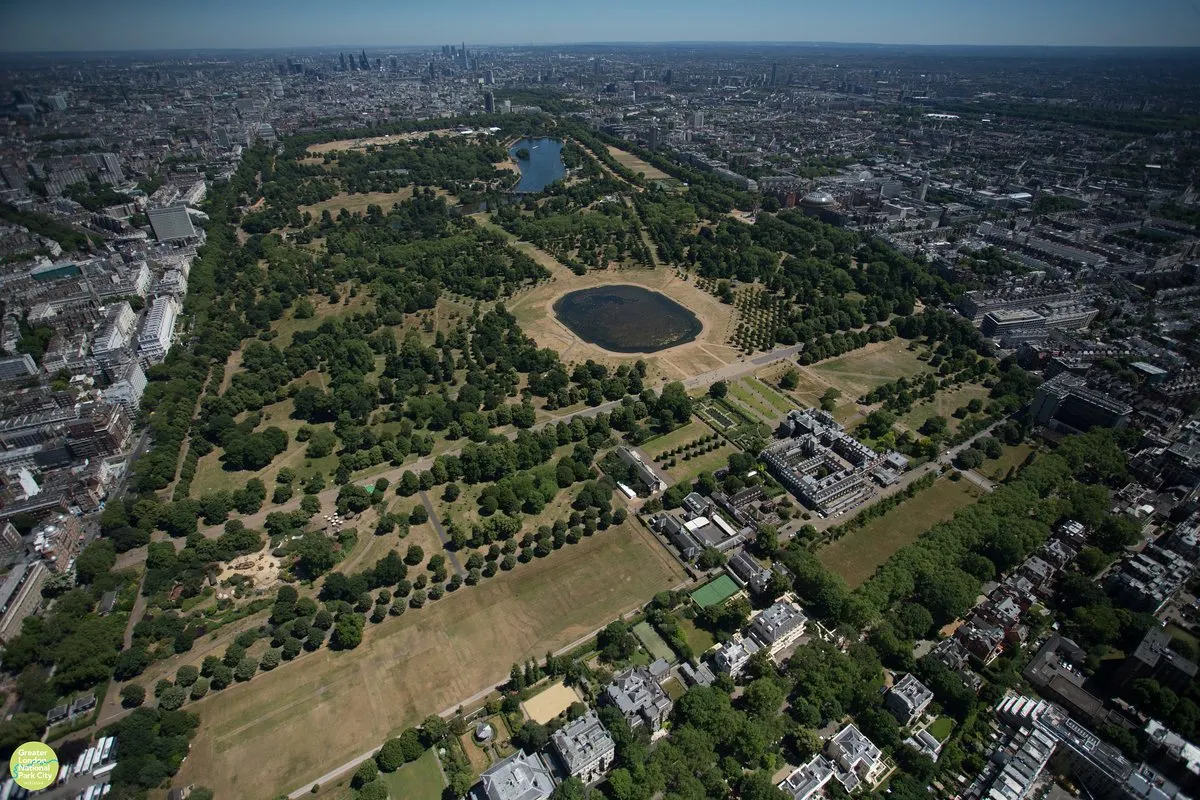
Henry VIII enclosed Hyde Park as a hunting ground in 1536; Charles I opened it to the public a century later. Together with Kensington Gardens it forms 253 hectares of royal parkland in the middle of London – the Serpentine, Rotten Row, Speakers' Corner and Peter Pan included.
In this story · 5 sections
Hyde Park is the largest of central London's Royal Parks, covering around 142 hectares between Park Lane, Knightsbridge and Bayswater Road. To the west, Kensington Gardens adds a further 107 hectares around Kensington Palace. Together they make 253 hectares of lawns, lakes and avenues, both managed by The Royal Parks and both Grade I listed. The Serpentine lake runs through the middle and divides the two.
2 places
Hyde Park in dates- 1536
- Henry VIII creates a hunting park
- 1637
- Opened to the public
- 1728
- Kensington Gardens separated
- 1851
- Great Exhibition in the Crystal Palace
- 1872
- Speakers' Corner established
From Henry VIII's deer park to a public park
In 1536 Henry VIII took the manor of Hyde from Westminster Abbey and enclosed it as a deer park and hunting ground. Charles I opened the park to the general public in 1637, and it soon became popular for May Day celebrations. In 1689 William III laid out the King's Private Road along the southern edge – the wide, gravelled ride now known as Rotten Row, which runs from Hyde Park Corner towards Kensington Palace. In 1851 the Great Exhibition was held in Joseph Paxton's Crystal Palace on the south side of the park.
The Serpentine and the Long Water
The Serpentine was created for Queen Caroline by damming the River Westbourne, with landscaping between 1726 and the early 1730s by Charles Bridgeman. The section inside Kensington Gardens is called the Long Water. On the south bank, the Serpentine Lido opened in 1930 and is still used for swimming in summer, and south of the lake is the Diana, Princess of Wales Memorial Fountain, opened on 6 July 2004.
Speakers' Corner, the gates and the concerts
In the north-east corner, near Marble Arch, Speakers' Corner has been a place of free speech and debate since 1872. At Hyde Park Corner, the screen of the Apsley Gate was built in 1825 to designs by Decimus Burton, and the Wellington Arch opened in 1828. The park has a long history as a concert venue – from its first rock concert in 1968 and Queen's free concert in 1976 to Live 8 in 2005 and today's BST Hyde Park festival – and Winter Wonderland has run here every winter since 2007.
Kensington Gardens – the Italian Garden and Peter Pan
Kensington Gardens was originally the western part of Hyde Park and was separated from it in 1728 at Queen Caroline's request. Henry Wise and Charles Bridgeman laid it out as a landscape garden with the Round Pond, formal avenues and a sunken Dutch garden, and it opened to the public in 1841. Queen Victoria commissioned the Italian Garden, with its four fountains at the head of the Long Water, and the Albert Memorial in the south-east corner, opposite the Royal Albert Hall. George Frampton's bronze statue of Peter Pan honours J. M. Barrie's Peter Pan in Kensington Gardens, and there is a Diana Memorial Playground for children. The Serpentine Gallery stands in the gardens too.
How to walk Hyde Park and Kensington Gardens
Enter at Hyde Park Corner, walk west along Rotten Row and the south bank of the Serpentine, cross into Kensington Gardens past the Serpentine Gallery and the Peter Pan statue, and end at the Italian Garden or the Round Pond in front of Kensington Palace. Note that Kensington Gardens closes at dusk, while Hyde Park is open from 5am until midnight. Explore the edges of the park in VERA PI's street files for Park Lane, Bayswater Road, Knightsbridge and Kensington Palace Gardens, or start with VERA PI's London guide.
Hyde Park
Royal Park since 1536
The Serpentine, Rotten Row, Speakers' Corner and the Diana Memorial Fountain.
- Size
- About 142 hectares
- Open
- 5am to midnight
Hyde Park, London W2
Kensington Gardens
Queen Caroline's gardens
The Italian Garden, the Round Pond, the Albert Memorial and Peter Pan.
- Size
- 107 hectares
- Open
- Daylight hours
Kensington Gardens, London W2