In this story · 5 sections
Hyères lies 16 kilometres east of Toulon, and its old quarters cling to the south side of the Castéou hill, 204 metres high, looking over the modern town to the bay between Cap Bénat and the Giens peninsula. Its reputation as a place to winter goes back to the 18th century, which makes it the oldest of the Riviera's climatic resorts. The town still likes to call itself Hyères-les-Palmiers, after the 7,000 palms grown in its streets and nurseries; Alexandre Dumas once teased it for making so much of "a few little palms".
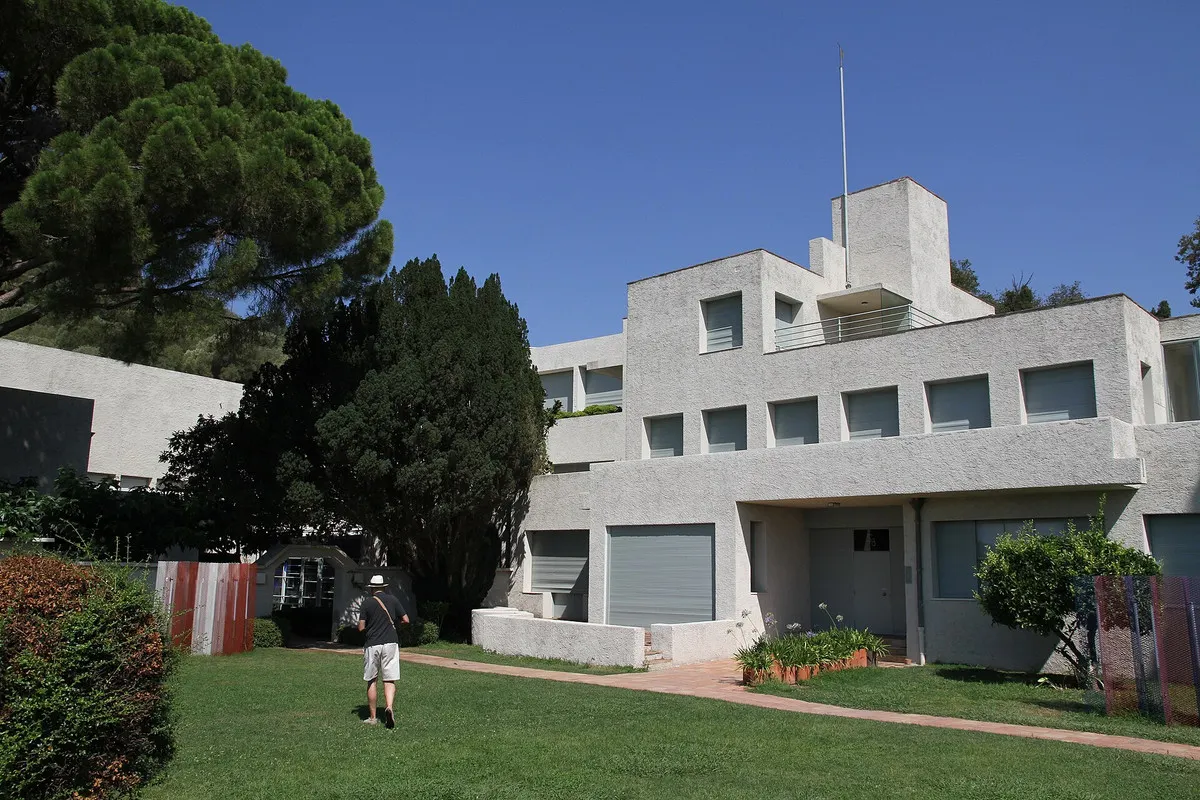
For design lovers, though, Hyères means one address above all: the Villa Noailles, a white cubist house on the castle hill where the avant-garde of the 1920s came to work and play.
5 places
© OpenStreetMap contributors · OpenFreeMap
- 01Villa Noaillessee · Le Château
- 02Castel Sainte-Clairesee · Le Château
- 03Jardin Olbius Riquiersee · Hyères
- 04Olbiasee · L'Almanarre
- 05Vieux Salins d'Hyèressee · Les Salins
- 1923
- Mallet-Stevens begins the house
- 1925
- Guevrekian's cubist garden
- 1929
- Man Ray films Les Mystères du château de Dé
- 1933
- Final extensions: 2,000 m² and some 60 rooms
- 1973
- Sold to the town of Hyères
- 1989
- Opens to the public
The Villa Noailles: a house for the avant-garde
In 1922 Vicomte Charles de Noailles and his wife Marie-Laure, patrons and friends of the great names of modern art, commissioned a house on the Clos Saint-Bernard, a plot of 1.5 hectares on the Castéou hill that Charles had received from his mother as a wedding present. They had been turned down by Ludwig Mies van der Rohe and had disagreed with Le Corbusier, so the job went to Robert Mallet-Stevens, working with the local architect Léon David. Building began in 1923.
Charles knew what he wanted: "a house infinitely practical and simple", with morning sun in the bedrooms and afternoon sun in the salon. The result is a loose stacking of sharp-edged cubes with large glass openings and no decoration at all. It grew in stages until 1933, from 500 square metres to 2,000 and some 60 rooms, with a squash court, a gymnasium and an indoor pool beneath a glass roof with retractable windows, the first covered private pool in France.
The interiors gathered the most promising designers of the day: Mallet-Stevens's own Transat chair by the pool, Marcel Breuer's Wassily chair on the terrace, colourful furniture by Sybold van Ravesteyn, clocks by Francis Jourdain, lamps by Jean Perzel, stained glass by Louis Barillet, and sculpture by the Martel brothers, Henri Laurens, Brancusi, Giacometti and Lipchitz.
Man Ray, Buñuel and the costume balls
The villa became a meeting point for Giacometti, Gide, Cocteau, Picasso, Dalí and Buñuel. In 1929 Man Ray shot his surrealist film Les Mystères du château de Dé here, and Buñuel wrote the screenplay of L'Âge d'or in the second-floor guest room; the Noailles financed the film. Óscar Domínguez painted the fresco on the pool terrace, and the couple threw great costume balls for the artists who came to stay.
In 1925 Gabriel Guevrekian added a cubist garden, a triangular composition that once held Lipchitz's bronze La Joie de vivre, now in the Israel Museum in Jerusalem. The garden of the villa is today the public Parc Saint-Bernard, labelled a Jardin remarquable.
The villa today
Sold to the town in 1973 after years of neglect, the villa was listed as a historic monument in 1975 and 1987, restored in stages and opened to the public in 1989. Since 1996 it has been an art and architecture centre with a national label, known for its programme of architecture, fashion and photography, including the International Festival of Fashion and Photography, and design, with the Design Parade in Hyères and Toulon. In 2025 its management came under scrutiny and the director was replaced; Hugo Lucchino was appointed in August 2025.
The old town on the hill
Walk down from the villa into the medieval town. The collegiate church of Saint-Paul has a 12th-century nave, partly rebuilt in late Gothic style in the 16th century, and a permanent collection of ex-votos. The Chapelle Saint-Blaise, known as the Templars' tower, stands on the Place Massillon and is used for exhibitions. The church of Saint-Louis, from the 13th century, was once the church of the Franciscan friars.
Just below the villa stands the Castel Sainte-Claire, a fanciful neo-Romanesque villa built by Olivier Voutier, the man who discovered the Venus de Milo. The American novelist Edith Wharton lived there from 1927 to 1937, at the same time as the Noailles were entertaining up the hill.
Olbia, salt and flamingos
In the fourth century BC Greek sailors from Massalia built a fortified trading post at L'Almanarre and called it Olbia, "the happy one". To the east, the salt marshes of the Salins-d'Hyères shelter more than 250 bird species, flamingos above all, and the double tombolo, two strips of sand tying the Giens peninsula to the mainland, is one of only five in the world. From the Tour Fondue at the end of the peninsula, boats cross to Porquerolles.
Villa Noailles
Mallet-Stevens's modernist house and art centre
One of France's first modern houses, with the cubist garden and the Parc Saint-Bernard.
Rue Saint-Pierre, 83400 Hyères
Insider tipCheck the exhibition calendar; the festivals draw crowds.
Castel Sainte-Claire
Edith Wharton's home from 1927 to 1937
A neo-Romanesque villa with a garden, just below the Villa Noailles.
Allée du Castel Sainte-Claire, 83400 Hyères
Insider tipCombine with the walk down into the old town.
Jardin Olbius Riquier
The town's main park and palm collection
Hyères's principal public park, labelled a Jardin remarquable.
Jardin Olbius Riquier, 83400 Hyères
Insider tipThe place to understand why the town calls itself Hyères-les-Palmiers.
Olbia
The Greek and Roman site at L'Almanarre
The fortified trading post founded by Greeks from Massalia in the fourth century BC.
L'Almanarre, 83400 Hyères
Insider tipPair it with the beach and the tombolo road.
Vieux Salins d'Hyères
Salt marshes and flamingos
More than 250 bird species, with flamingos the star.
Les Salins, 83400 Hyères
Insider tipBring binoculars and go early or late in the day.
Property and neighbourhood data for Hyères and nearby Bormes-les-Mimosas is on VERA PI.