In this story · 5 sections
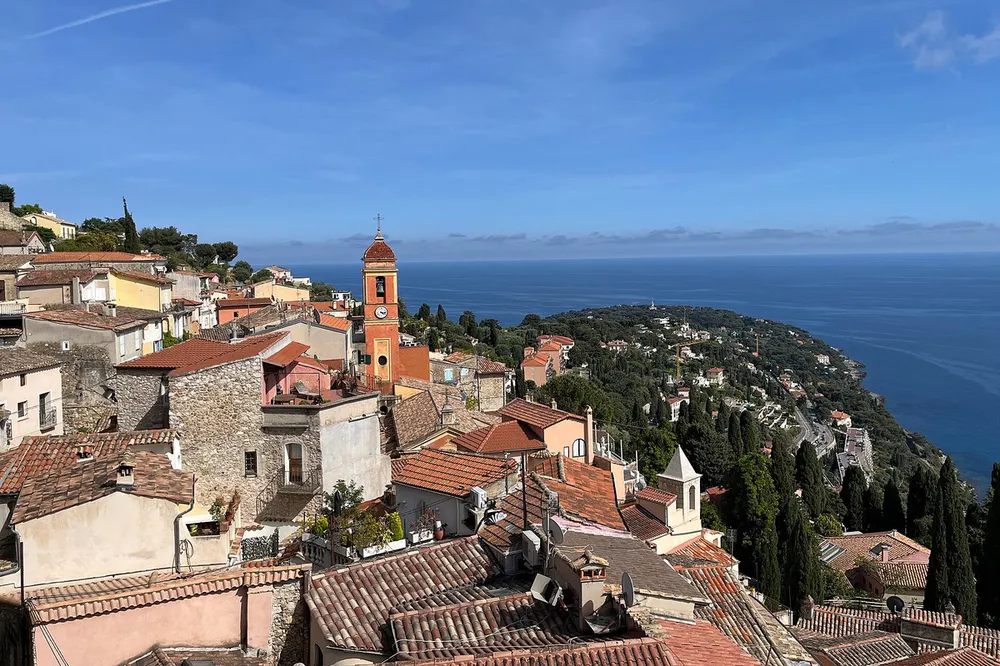
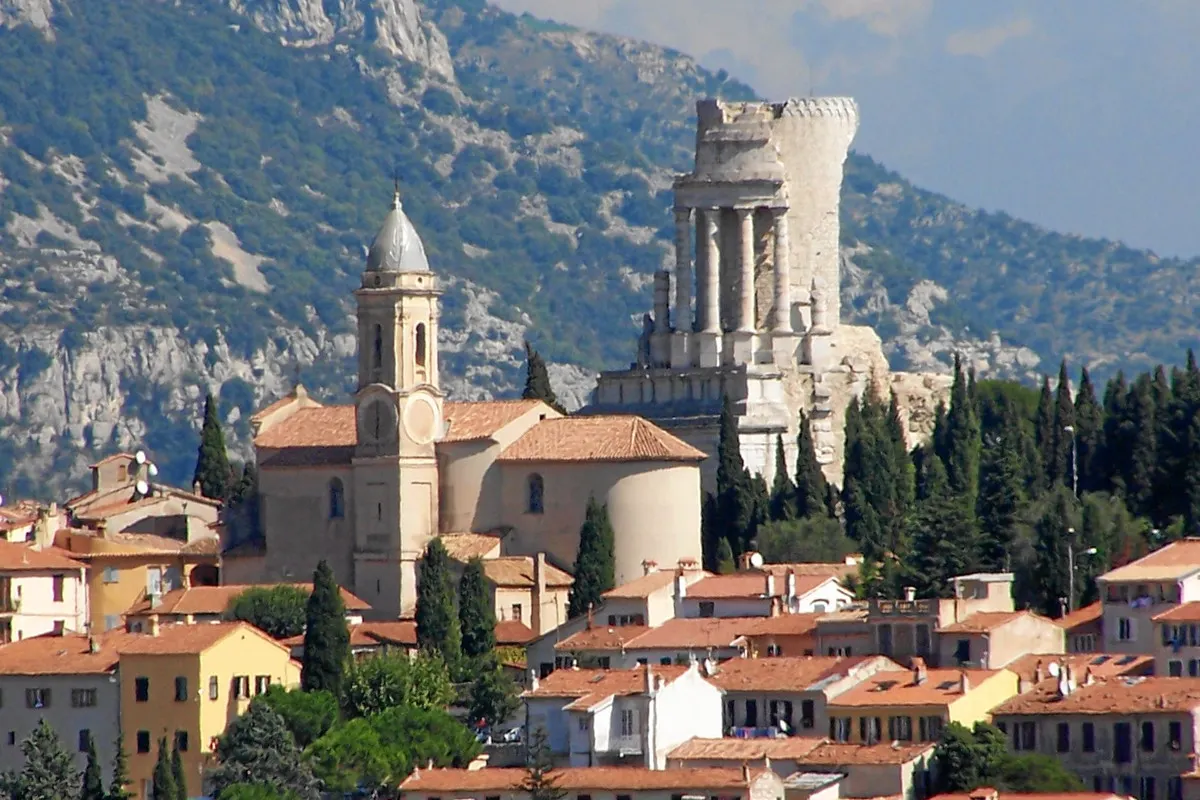
La Turbie is the village you see from Monaco without quite noticing: a cluster of ochre houses on the skyline, and above them a pale stone drum with a ring of columns. That drum is the Trophy of Augustus, or Tropaeum Alpium, and it has stood on this ridge since the reign of Rome's first emperor. The commune borders the Principality, and the view runs straight down the slope to the harbour.
It is a short climb from the coast, either up from Cap-d'Ail or along the Grande Corniche, yet it feels a world away from the yachts below. Come for the monument, stay for the lanes, and time your visit for the late afternoon, when the light turns the stone gold.
3 places
© OpenStreetMap contributors · OpenFreeMap
- 01Trophée d'Augustesee · La Turbie
- 02Église Saint-Michelsee · La Turbie
- 03Tête de Chiensee · La Turbie
- 7–6 BC
- Trophy dedicated to Augustus by the Senate and people of Rome
- 1705
- Partly destroyed by mining, then used as a quarry
- 1865
- Classified as a monument historique
- 1905–1908
- Site cleared and excavated under Philippe Casimir
- 1920–1934
- Partial reconstruction by Jules Formigé, funded by Edward Tuck
Augustus and the conquest of the Alps
The trophy stood at the highest point of the Via Julia Augusta as the Roman road crossed the Alps, at the meeting of Italy and Gaul. It celebrated the campaigns, probably fought between 25 and 14 BC, that brought the Alpine tribes under Roman rule. Its dedication, preserved by Pliny the Elder in his Natural History, dates it to 7–6 BC.
The inscription was built to impress. It ran 17 metres long and 3.66 metres high in nine lines, and named the defeated peoples of the mountains one by one. Around 140 original fragments have since been set into a modern marble panel on the rebuilt west face, where the text has been engraved again so that it can be read in full. It was one fragment naming the Trumpilini, a people of the Val Trompia, that allowed scholars to identify these ruins with the monument Pliny described.
From ruin to restoration
The monument has had a hard two millennia. It was fortified and damaged repeatedly, partly destroyed by mining in 1705 and then used as a quarry, and much of the old village of La Turbie is built with stones taken from it. The Sardinian government shored up the surviving tower between 1857 and 1859. After the County of Nice became French in 1860, the trophy was classified as a monument historique in 1865.
Serious excavation began in 1905, led locally by the scholar Philippe Casimir, and uncovered hundreds of dressed blocks. The architect Jean-Camille Formigé re-erected two columns and their entablature between 1913 and 1915. His son Jules Formigé then rebuilt far more between 1920 and 1934: 32 houses were bought and demolished to free the site, a Mediterranean garden was laid out and a museum was created. The work was financed by the American patron Edward Tuck, whose name the museum carries.
What you see today is therefore part original, part interpretation. Specialists stress that the exact heights and the sculptural programme remain uncertain, which makes the visit more interesting rather than less: walk round to the side deliberately left unrestored and compare it with the rebuilt face.
The village: Genoa, Dante and Monaco
In the Middle Ages Turbia, as it was then called, lay mostly under the Republic of Genoa, and Dante named it in the Divine Comedy as the western limit of Liguria. It later passed between Savoy and Monaco, and the old local speech absorbed much of the Monegasque dialect before fading after 1860. Until the early 20th century the commune was much larger and included what are now Beausoleil and Cap-d'Ail. Today it covers just 7.42 square kilometres around the old town and the trophy, and had 3,045 residents in 2023.
Walk up from the main square through the vaulted lanes towards the monument and you pass the church of Saint-Michel, whose bell tower and dome frame the trophy in almost every photograph of the village. Prince Albert II of Monaco keeps a secondary residence nearby, the 56-acre Roc Agel estate on the slopes of Mont Agel, and Rudolf Nureyev had a house here until 1993.
Where motor racing climbed the hill
La Turbie calls itself the cradle of the motor hillclimb, with some justification. On 31 January 1897 the final stage of the Marseille–Nice race was a 17-kilometre climb from Nice to La Turbie, won by André Michelin in a steam-powered De Dion at an average of 31.8 km/h. The course claimed its first fatality in 1900, and in 1903 the French interior minister had it closed; the Nice Automobile Club won its reopening in 1909.
The cyclists followed. From 1968 to 1995, with the exception of 1977, nearly the same road served as the closing time trial of Paris–Nice, often deciding the race. Raymond Poulidor beat Eddy Merckx here in 1972, and Sean Kelly won the La Turbie climb five times. The hairpins also appear in the 1998 film Ronin, and AS Monaco has trained in a former quarry in the commune since 1981.
The view from Tête de Chien
Above the village rises the limestone outcrop of Tête de Chien, the dog's head. The name is a folk misreading of the older Testa de camp, the head of the camp. From its edge the whole of Monaco lies below like a model: the Rock, the harbour, the towers of Monte-Carlo. Combine it with Èze further along the Grande Corniche for a half-day of perched villages and Roman stone.
Trophée d'Auguste
The Roman victory monument and its museum
The Tropaeum Alpium of 7–6 BC, partly rebuilt in the 1920s and 1930s, with a garden and a museum named after its patron Edward Tuck.
Ruelle Saint-Jean, 06320 La Turbie
Insider tipWalk round to the unrestored side to see how much was rebuilt.
Église Saint-Michel
The village church beside the trophy
The bell tower and dome that frame the trophy in the classic view of the village.
Rue Edward Tuck, 06320 La Turbie
Insider tipBest seen from the lanes below the monument.
Tête de Chien
The headland viewpoint over Monaco
A limestone outcrop with an unbroken view down over the Principality.
Route de la Tête de Chien, 06320 La Turbie
Insider tipGo late in the day for the light on the Rock.
More from the coast below on metromode.co, and property and neighbourhood data for La Turbie at VERA PI.