In this story · 5 sections
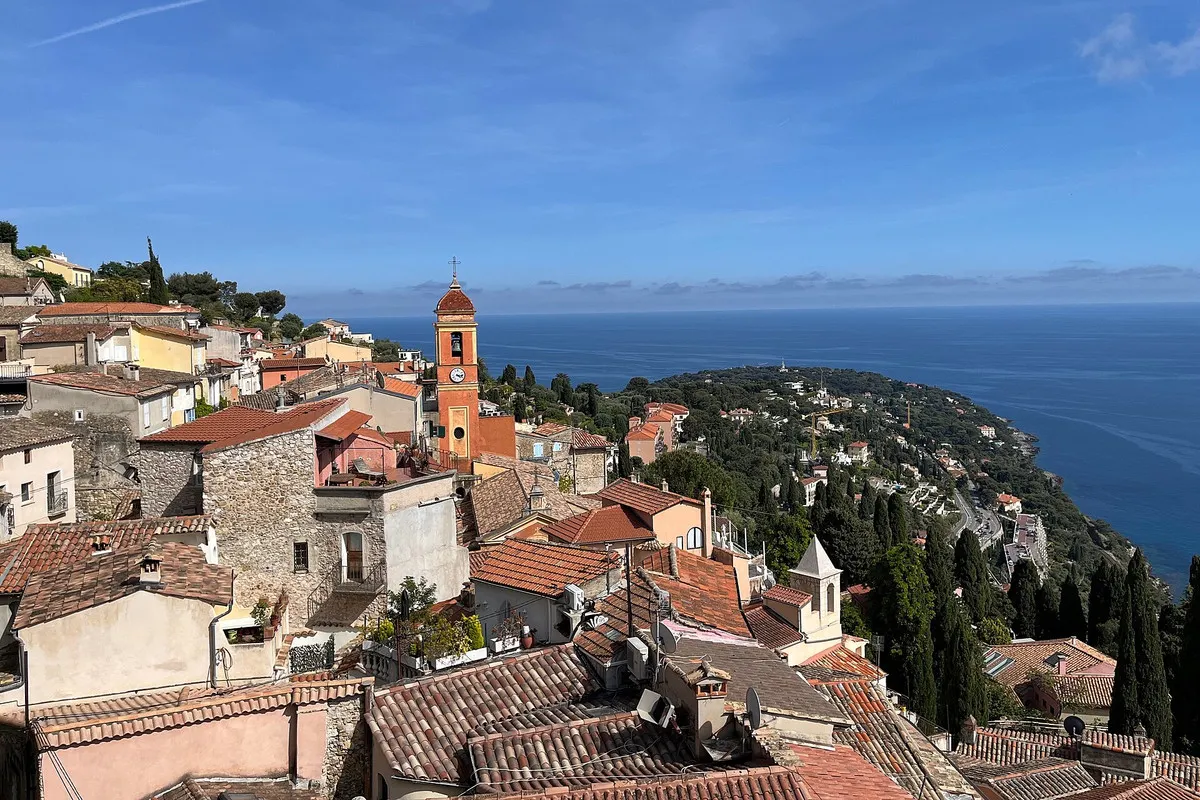
Roquebrune-Cap-Martin, simply Roquebrune until 1921, is a commune of several faces: the leafy peninsula of Cap Martin, the pebble beach of Carnolès running into Menton, and Saint-Roman, practically a suburb of Monaco. Its heart, though, is the old village, stacked up the hillside around a stone keep at 225 metres, in an amphitheatre of mountains overlooked by Mont Agel.
It takes minutes to reach from Monaco or Menton, and the contrast is total. Cars stay below; above, the lanes are stepped, vaulted and cool even in August.
4 places
© OpenStreetMap contributors · OpenFreeMap
- 01Château de Roquebrunesee · Vieux village
- 02Église Sainte-Margueritesee · Vieux village
- 03Olivier millénairesee · Vieux village
- 04Chapelle de la Pausasee · Vieux village
- 971
- Founded by Conrad I, Count of Ventimiglia
- 1355
- Passes to the Grimaldis for five centuries
- 1467
- Plague vow that gave rise to the Passion procession
- 1848
- Free City with Menton, under Savoy protection
- 1861
- Ceded to France by plebiscite
- 1921
- Renamed Roquebrune-Cap-Martin
A fortress older than the feudal age
The village, first called Roccabruna, was founded in 971 by Conrad I, Count of Ventimiglia, to guard his western border. The fortress was raised at the end of the tenth century and at first enclosed the whole village. French sources describe the ensemble as the only surviving example in France of the so-called Carolingian castles, the forerunners of the great keeps built two centuries later, and its donjon as the oldest in the country.
In 1355 the Vento family sold Roquebrune and Menton, and both passed to the Grimaldis of Monaco, who held them for five centuries and strengthened the keep. Roquebrune became French in 1793, returned to Monaco in 1814, then broke away with Menton in 1848 as the Free Cities under the protection of Savoy. A plebiscite finally made it French in 1861.
Walking the old village
Start at the Place des Deux-Frères, at the foot of the keep, and climb into the castle for the view over the rooftops to Cap Martin. The old and newer parts of the village are divided by the main street, and the difference in building periods shows in the houses either side.
The church of Sainte-Marguerite dates from the 12th century and has been restored several times, notably in the 19th. Inside are an altarpiece of the Crucifixion and a Rosary altarpiece with fifteen panels of the Mysteries. Lower down, on the road towards Menton, the Chapelle de la Pausa was built in the 15th century after the plague vow; its name probably comes from the pause, as it sits at the foot of the steep climb to the village.
The olive tree that predates the castle
Just east of the village, on the road to the Pausa chapel, grows the olivier millénaire. It is less a single trunk than a cluster of huge shoots whose roots are slowly swallowing the stones of the wall it grows on. It measures 16 metres round and 13 metres high, and the tree specialist Robert Bourdu put its age at more than 2,000 years. It is regularly described as the oldest tree in France.
A vow kept since 1467
During a plague epidemic in 1467 the villagers made a vow, and for close to 500 years they have kept it. On the afternoon of 5 August a procession presents the main scenes of the Passion in six tableaux, moving between the church and the Chapelle de la Pausa. The day is usually a holiday for the commune's own services. On the night of Good Friday there is a second procession, of the dead Christ.
Empresses, poets and an architect
The railway brought the famous. Empress Elisabeth of Austria spent months at the Hôtel du Cap-Martin between 1894 and 1897, and the Empress Eugénie owned a villa here. In the 1920s and 1930s Coco Chanel built La Pausa on Cap Martin. Rodin stayed at the villa Angélica between 1906 and 1914, and the writers Romain Gary and Lesley Blanch lived in Roquebrune from 1950 to 1957.
Two graves add a melancholy footnote. W. B. Yeats, who died in Menton in 1939, was buried at Roquebrune on the understanding that he would be moved to Drumcliff in Ireland; by 1948 his remains could no longer be identified with certainty. Le Corbusier, who built his tiny cabanon on the shore below, drowned there on 27 August 1965 and lies in the local cemetery.
Château de Roquebrune
The tenth-century keep of the Grimaldis
The fortress raised at the end of the tenth century, with views across the rooftops to Cap Martin.
Rue Moncollet, 06190 Roquebrune-Cap-Martin
Insider tipStart from the Place des Deux-Frères just below.
Église Sainte-Marguerite
The 12th-century village church
Restored over the centuries, with a Crucifixion altarpiece and a Rosary altarpiece of fifteen panels.
Chemin de Souta Riba, 06190 Roquebrune-Cap-Martin
Insider tipThe 5 August Passion procession leaves from here.
Olivier millénaire
An olive tree put at over 2,000 years old
Sixteen metres round and 13 metres tall, growing into an old stone wall.
Rue Grimaldi, 06190 Roquebrune-Cap-Martin
Insider tipA short walk east of the village centre.
Chapelle de la Pausa
The plague-vow chapel of the 15th century
Built after the vow of 1467, with interior frescoes, at the foot of the climb to the village.
Rue Grimaldi, 06190 Roquebrune-Cap-Martin
Insider tipEnd point of the Passion procession.
Neighbourhood and property data for Roquebrune-Cap-Martin is on VERA PI, and more Riviera stories are on metromode.co.