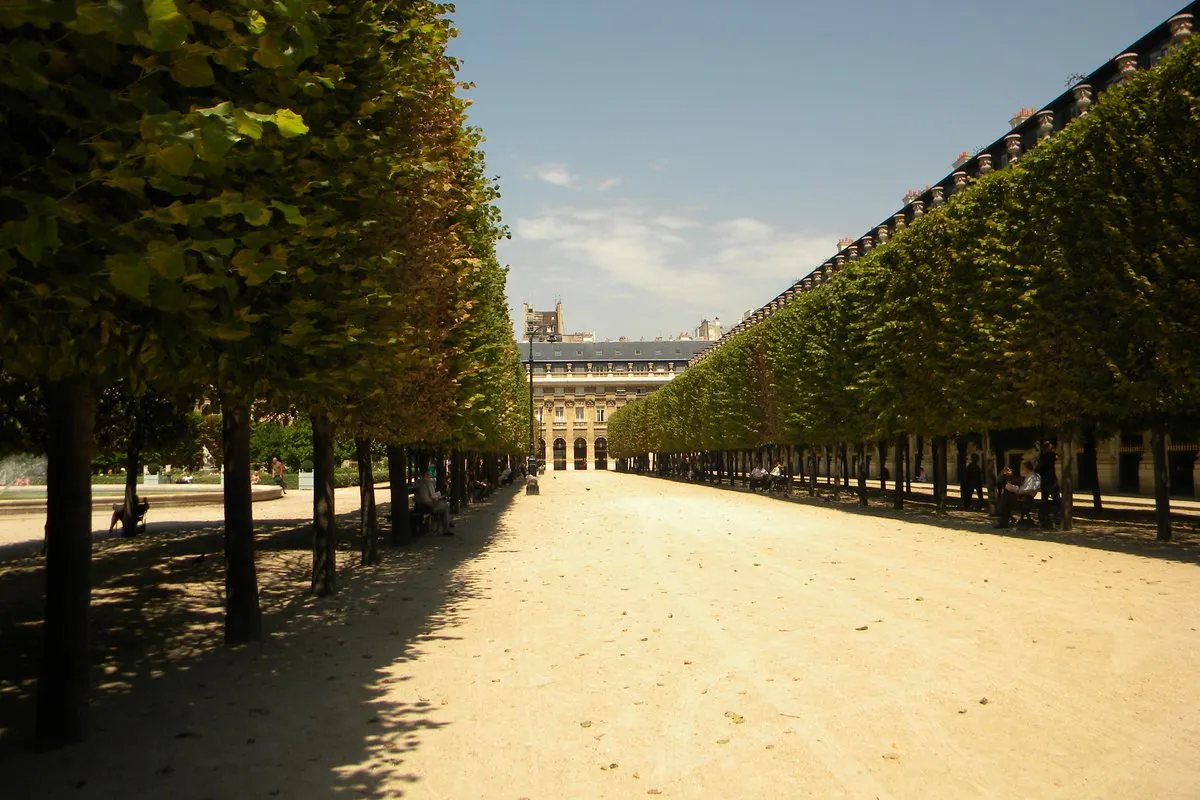
A cardinal's palace, arcades from the 1780s, a midday cannon and 260 striped columns. Jardin du Palais-Royal is Paris's most elegant garden – and one of the most historic.
In this story · 6 sections
Behind an unassuming gate opposite the Louvre in Paris's 1st arrondissement lies one of the city's most beloved spots. The Jardin du Palais-Royal is a long rectangular garden with neatly trimmed tree-lined avenues, a colourful flowerbed around a fountain and arcades on three sides. Cardinals, revolutionaries and writers have walked here – and today it is the city's most elegant spot for a pause between the Louvre and the Opéra.
2 places
© OpenStreetMap contributors · OpenFreeMap
Palais-Royal- Palace built
- 1633–1639, architect Jacques Lemercier
- Garden laid out
- Winter 1635–1636
- Arcades
- 1781–1784, architect Victor Louis
- Noon cannon
- 1786
- Buren's columns
- 260, chosen in 1985
- Historic monument
- The garden since 1920
Cardinal Richelieu's palace
The palace was built in 1633–1639 by the architect Jacques Lemercier for Cardinal Richelieu and was then called the Palais-Cardinal. The garden was designed by the king's gardener Pierre Desgots and was laid out in the winter of 1635–1636. According to the Ministry of Culture, it measured 350 by 150 metres, with rows of chestnut trees, six embroidered parterres and pools with statues – and was open to the public from the very first day. When Richelieu died in 1642, the palace passed to the king and was given the name Palais-Royal. From 1674, André Le Nôtre redesigned the garden for Louis XIV's brother Philippe d'Orléans.
Today, the Ministry of Culture, the Conseil d'État and the Constitutional Council are housed in the palace. The garden has been classified as a historic monument since 1920 and was awarded the Ministry of Culture's jardin remarquable label in 2005.
Arcades, cafés and the Revolution
Duke Louis Philippe II of Orléans had the architect Victor Louis build six-storey buildings with arcades around three sides of the garden in 1781–1784, and laid out the new streets rue de Montpensier, rue de Beaujolais and rue de Valois. The shops beneath the arcades were let out, and in 1784 the complex opened to the public. The Palais-Royal became the centre of Paris's entertainment and café life, and according to tradition, the restaurant with an à la carte menu and individual tables emerged here.
On 12 July 1789, outside the Café de Foy, Camille Desmoulins called upon the Parisians to rise up after Necker had been dismissed. The crowd took leaves from the garden's trees as cockades, and two days later the Bastille was stormed. In one of the shops, Charlotte Corday bought the knife she used against Marat.
Le Grand Véfour and the noon cannon
In the Galerie de Beaujolais stands Le Grand Véfour, which opened in 1784 as the Café de Chartres and is regarded as Paris's first great restaurant. Napoleon, Balzac, Victor Hugo, Colette and Jean Cocteau are among the famous guests, and Cocteau designed one of the menus. The interior, with mirrors in gilded frames, dates from the early 1800s.
In the middle of the lawn in the southern part of the garden stands a small bronze cannon on the Paris meridian. The clockmaker Rousseau installed it in 1786: a lens gathered the sun's rays and ignited the gunpowder exactly at true noon, on sunny days from May to October. The Parisians set their clocks by it. The inscription Horas non numero nisi serenas means "I only count the bright hours".
Colette, Cocteau and the poetry benches
Colette lived in an apartment in the Palais-Royal and stayed there during the Occupation. In February 2019, two of the alleys were named after her and Jean Cocteau, who also lived here: allée Colette on the rue de Valois side and allée Cocteau towards rue de Montpensier. At the same time, eighteen poetry benches by the Canadian sculptor Michel Goulet were installed, each bearing a line by Colette, Cocteau or another writer.
Buren's columns: Les Deux Plateaux
In the courtyard of honour in front of the garden stands Daniel Buren's Les Deux Plateaux, made with the architect Patrick Bouchain. On a surface that was previously a car park, Buren placed 260 truncated columns of white and black marble with stripes of 8.7 centimetres, in three heights. President François Mitterrand chose the proposal in July 1985, and the work sparked great debate before it was completed. Today, children and adults climb on the columns – just as Buren intended.
The walk
Enter from Place du Palais-Royal through the courtyard of honour with Buren's columns, continue through the colonnade into the garden and head north along the avenues towards Le Grand Véfour. Take a turn under the arcades and finish at the cannon. The surrounding streets can be found on VERA PI's page on the 1st arrondissement. The garden is the first stop in our 48 hours in Paris, and the Musée de l'Orangerie is a short walk through the Tuileries.
Jardin du Palais-Royal
Richelieu's garden
Avenues, arcades, the noon cannon and the Palais-Royal's colonnades.
Insider tipMetro: Palais Royal – Musée du Louvre (lines 1 and 7).
Le Grand Véfour
Since 1784
Paris's first great restaurant, in the arcades facing the garden.
Galerie de Beaujolais, Palais-Royal, 75001 Paris