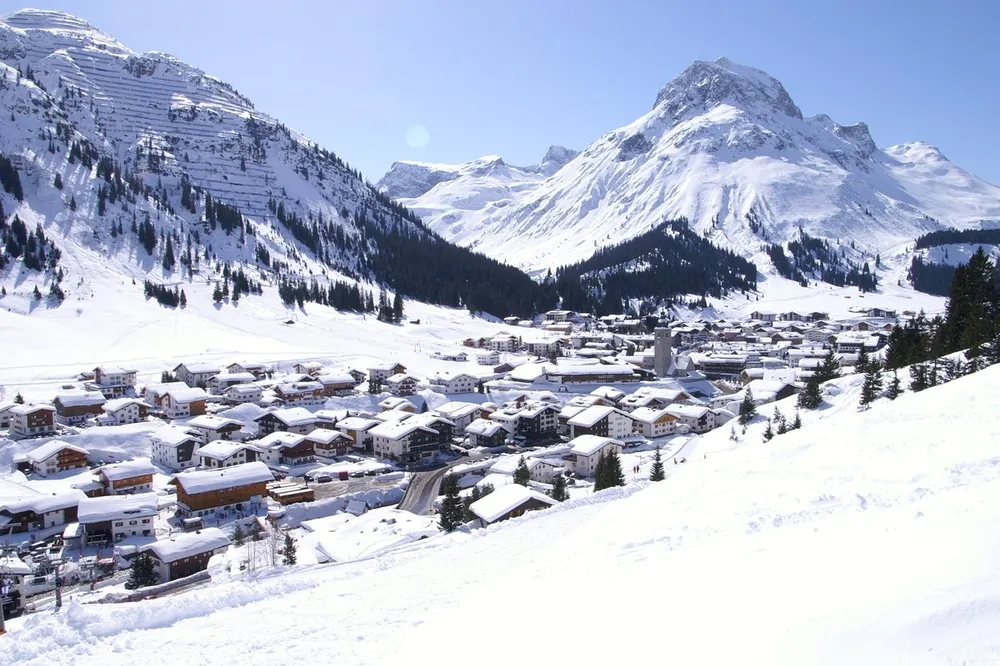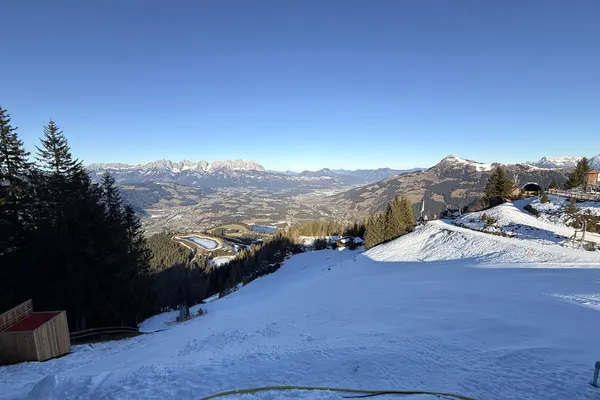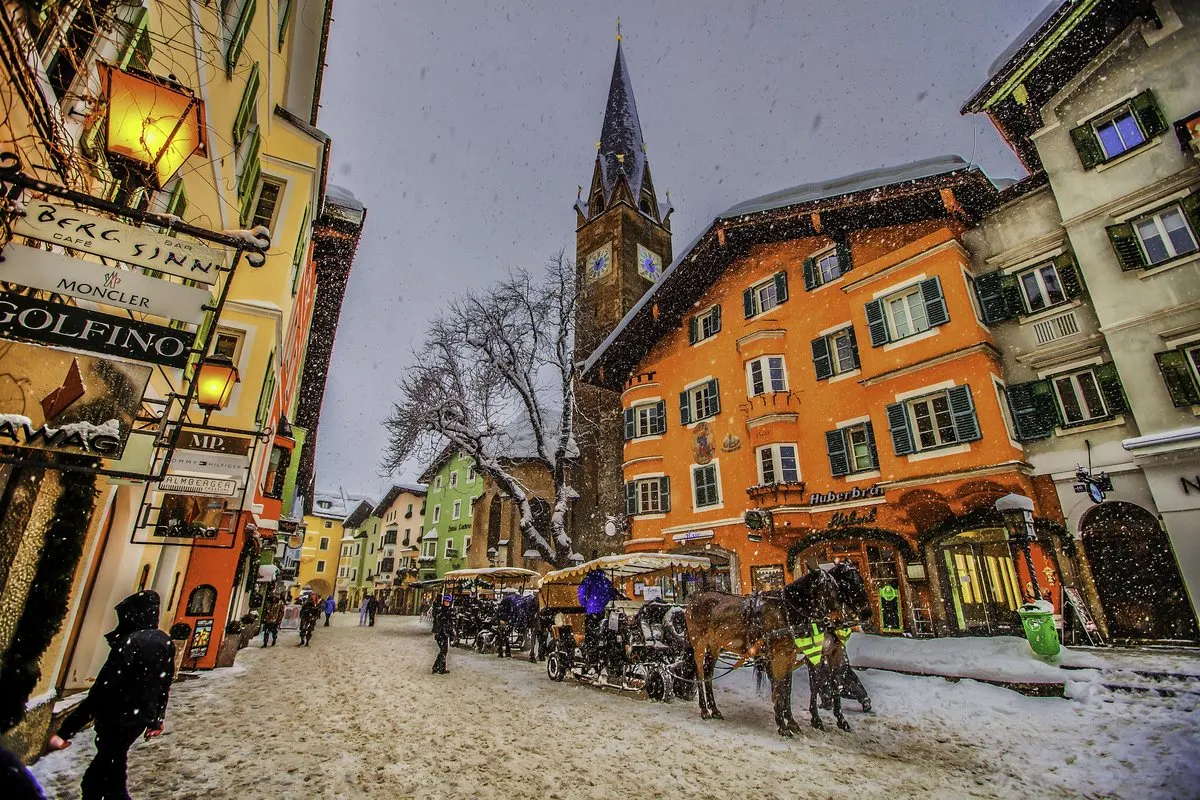
Kitzbühel was granted town rights in 1271 and is still a proper town with walls, towers and squares. Above lies the Streif, where the Hahnenkamm race is held every January.
In this story · 4 sections
Kitzbühel in Tyrol is one of the few ski resorts in the Alps that was a town long before anyone skied. On 6 June 1271 it was granted town rights by Duke Ludwig II of Bavaria, and since 30 June 1504 it has belonged to Tyrol. The old town lies at 762 metres, with colourful burgher houses, church towers and the remains of the town wall, and around 8,000 people live here.
Above the town rises the Hahnenkamm, and on its northern side runs the Streif – the downhill course that many skiers consider the most difficult on the World Cup circuit. It is the combination of a medieval town and top-level skiing that makes Kitzbühel unique.
Kitzbühel in numbers
- Town rights
- 6 June 1271
- Altitude of the town
- 762 m
- Streif, length and vertical drop
- 3,312 m, 860 m
- Steepest section
- Mausefalle, 85 per cent
- Pistes around the town
- 168 km
01The Streif in numbers
The Streif is 3,312 metres long and has a vertical drop of 860 metres, from the start at 1,665 metres to the finish at 805 metres, right next to the town. The steepest section, the Mausefalle, comes just after the start and has a gradient of 85 per cent. It is followed by sections whose names every downhill skier knows: Karussell, Steilhang, Seidlalmsprung, Hausbergkante and Zielschuss.
The course was first used in competition in 1937. The course record, 1:51.58, was set by the Austrian Fritz Strobl in 1997, at an average speed of 106.9 kilometres per hour. For ordinary skiers there is a groomed run that follows parts of the course, but the steep start deserves respect.
02The Hahnenkamm races in January
Every January the town hosts the Hahnenkamm races, the World Cup events in downhill, super-G and slalom. The slalom is run on the Ganslernhang, closer to the town. During the race weekend Kitzbühel fills up with spectators, and hotels and restaurants are fully booked well in advance. Anyone who wants to experience the town in peace should choose a different week; anyone who wants to see the race should book very early.
Kitzbühel's greatest skiing star is Toni Sailer, born in 1935, who won three Olympic golds in Cortina d'Ampezzo in 1956. He is one of several skiers from the town who have made Kitzbühel a household name in the sporting world.
03The ski area around the town
Around Kitzbühel there are, according to the town, 168 kilometres of pistes and 56 lifts, as well as 40 kilometres of groomed cross-country trails. The area stretches from the Hahnenkamm towards Pass Thurn and Jochberg, and on the other side of the town lies the Kitzbüheler Horn at 1,996 metres, with gentle, sunny runs.
Kitzbühel is low-lying for a ski resort, and this affects the snow. The resort invests heavily in artificial snow, but those who want to be certain should go in the middle of winter. The advantage of the low altitude is the forest: Kitzbühel is one of the best resorts in the Alps on a day with poor visibility.
04The town in summer
Kitzbühel is a year-round town. In summer there are four golf courses, tennis, walking and the Schwarzsee bathing lake just outside the town. In the old town, shops, cafés and restaurants occupy the old buildings along Vorderstadt and Hinterstadt, the two main streets that run parallel through the centre.
That is what sets Kitzbühel apart from the large French resorts: you stay in a town with churches, squares and year-round residents, and you ride up the mountain from the edge of town. The evenings are more about the town than about après-ski.
More destinations can be found among metromode.co's destinations. On site, Metro Mode Camera can tell you the story of the houses in the old town.