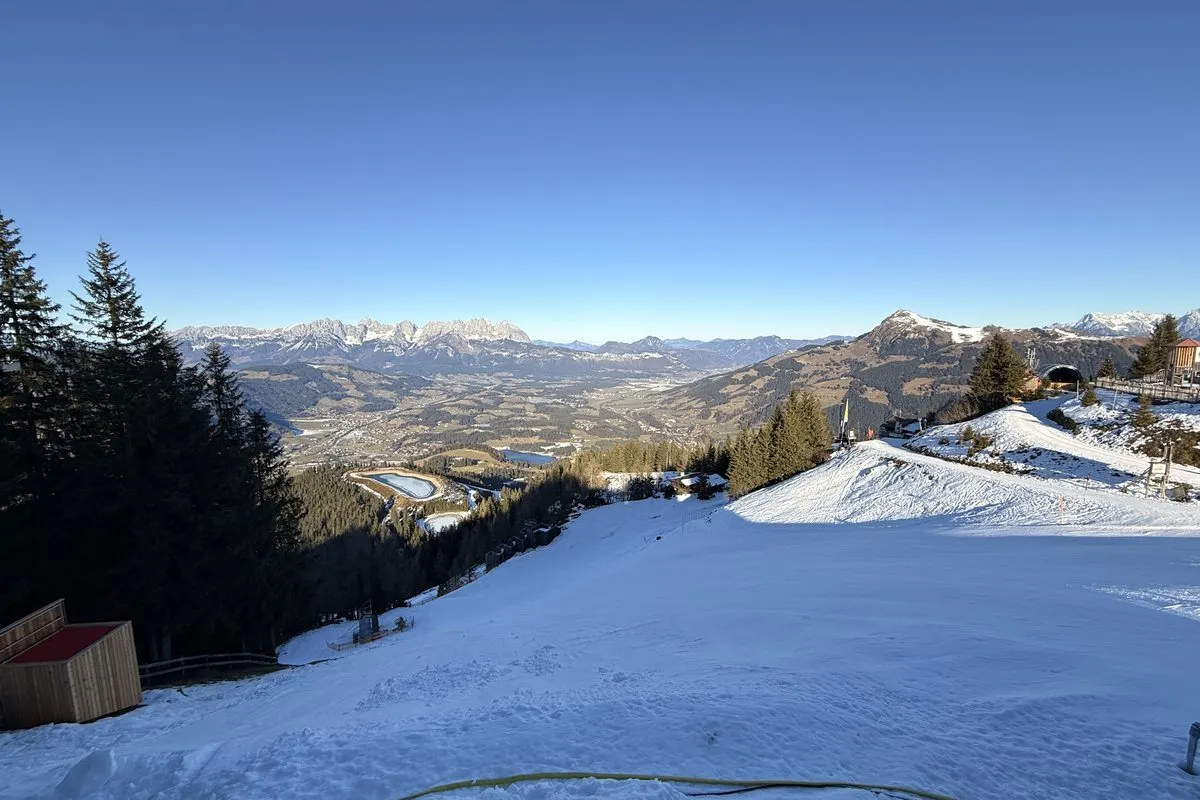
Each January, 50,000 people gather below the Hahnenkamm to watch the world's best downhillers hurl themselves at the Streif. From the Mausefalle to the Zielschuss, here is what makes this 3.3-kilometre course the most feared in the sport – and the medieval town that hosts it.
In this story · 4 sections
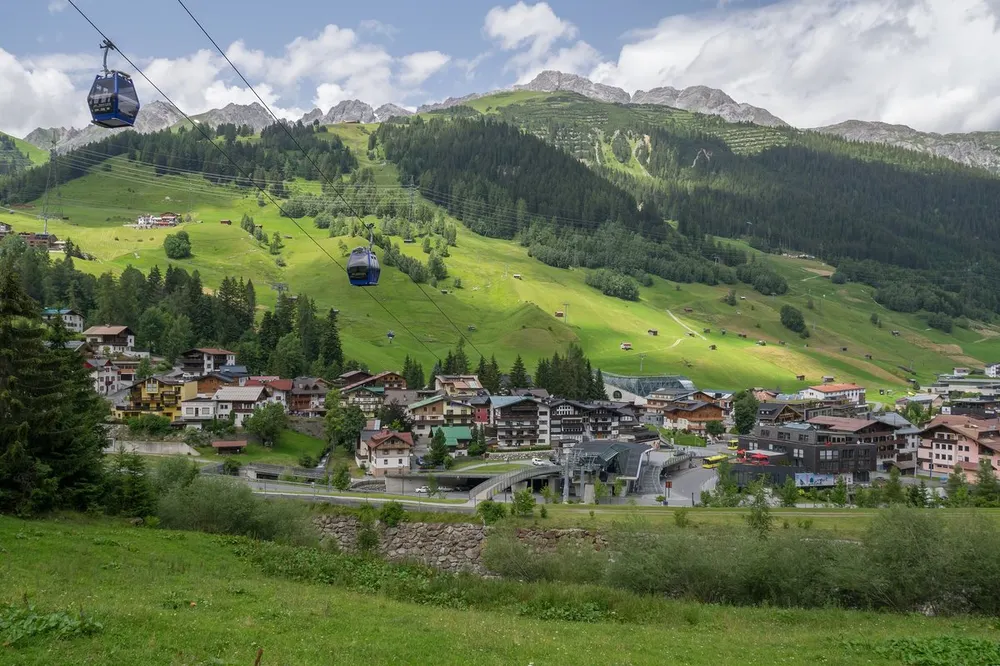
Kitzbühel is a medieval town on the Kitzbüheler Ache in Tyrol, granted its town rights in 1271 and spared by both world wars. Directly south-west rises the Hahnenkamm, 1,712 metres high, and down its north-east face runs the Streif – the downhill course widely regarded as the most demanding on the World Cup circuit. It is largely natural terrain, pasture in summer, and in January much of it lies in shade, which flattens the light just where racers need to read the snow. For more Alpine destinations, see our Alps guides.
2 places
A race since 1931
Kitzbühel held its first ski race in 1894. The Hahnenkamm Races began in 1931 on nearby courses and moved the downhill to the Streif in 1937; they have been part of the men's World Cup since its first season in 1967, and the World Cup itself was founded in 1966 at the Seidlalm farm beside the course. Since 1953 the races have been held in mid to late January, usually a week after the Lauberhorn in Wengen. The programme today is a downhill and a super-G on the Streif and a slalom on the neighbouring Ganslern slope.
The course, top to bottom
The start gate stands at 1,665 metres. In the Startschuss, a 160-metre pitch of 27 degrees, racers reach 100 km/h in about 8.5 seconds before launching into the Mausefalle, the mousetrap: at 40.4 degrees, or 85 per cent, the steepest part of the course, named around 1955 by the father of Toni Sailer. Then comes the Karussell, a 180-degree turn where riders take 3.1 g, and the Steilhang, a long right-hander at 35.8 degrees that spits them onto the flats.
Brückenschuss and Gschöss are the gentlest stretches, gliding sections where tuck and wax decide the time. The Alte Schneise follows, then the Seidlalmsprung at the halfway point, a blind jump that has to be taken with a turn already in mind. After the Lärchenschuss through the larches comes the decisive Hausbergkante, a jump off a 35-degree edge into a compression, and the Traverse, a rough sidehill of glare ice that has produced many of the race's worst falls. The Zielschuss carries racers past 145 km/h – Michael Walchhofer set the top-speed record of 153 km/h in 2006 – into the Rasmusleitn and the finish at 805 metres.
Records and legends
The record for the full course is 1:51.58, set by Fritz Strobl of Austria in 1997 – an average of 106.9 km/h. Didier Cuche of Switzerland won the downhill a record five times, the last in 2012, two days after announcing his retirement. The Streif featured in the 1969 film Downhill Racer with Robert Redford, and in 2023 Lindsey Vonn became the first woman to ski it, alone and outside competition. Weather has cancelled the downhill several times, most recently in 2005 and 2007.
The town below
Kitzbühel's old town rewards a slow afternoon. St Catherine's Church, High Gothic and built in 1360–65, has a carillon that plays at 11am and 5pm. The Café Reisch, designed in 1928 by Lois Welzenbacher, is a landmark of Tyrolean modernism, and the Museum Kitzbühel tells the town's story from its beginnings to the ski era, with a large collection of works by the painter Alfons Walde.
For more winter reading, browse Metro Mode Travel and our destination guides. Kitzbühel's property is among the most expensive in the world; for the French Alps, VERA PI tracks prices in Megève and its neighbours.
Streif finish area
Where 50,000 watch
The finish of the Hahnenkamm downhill at 805 metres, below the Rasmusleitn jump.
St Catherine's Church
High Gothic, 1360–65
The landmark spire of the old town; the carillon plays at 11am and 5pm.