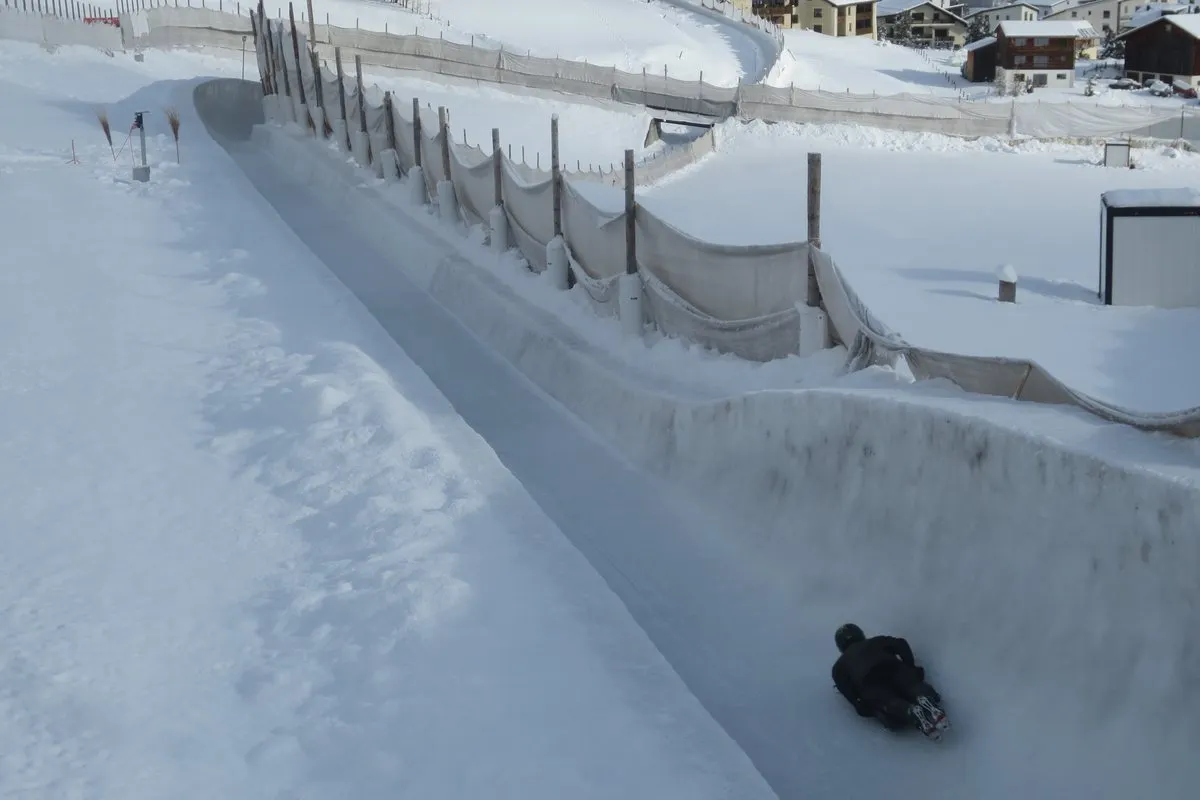
Every winter since 1885, riders have launched themselves head first down a ravine between St. Moritz and Celerina on a steel toboggan. The Cresta Run is a private club and a sporting relic – and, for a fee and an early start, something a first-timer can still try.
In this story · 4 sections
In St. Moritz the most exclusive club in town is not a restaurant or a nightclub but a frozen gully. The Cresta Run drops 157 metres over 1,212 metres from the edge of the resort to the hamlet of Cresta in Celerina, and riders take it lying face down on a heavy steel toboggan, chin a few centimetres above the ice. It is one of the very few runs in the world built purely for this kind of sliding, and it has been rebuilt every winter since the 1880s. For more of the mountains, see our Alps destinations.
Cresta Run
Sport · St. Moritz
The St. Moritz Tobogganing Club's natural ice run from St. Moritz down to Cresta in Celerina.
01Born of bored hotel guests
The story begins at the Kulm Hotel in the early 1870s. British winter guests, with time on their hands, took to racing sledges through the steep streets of St. Moritz, to the alarm of pedestrians. The hotel's owner, Caspar Badrutt, answered with a natural ice run of his own, and in 1884 a committee of Kulm guests and local people laid out the Cresta near the hamlet that gave it its name. The St. Moritz Tobogganing Club followed in 1887, and the run is still a partnership between the club and the community. Members still gather for lunch in the Sunny Bar at the Kulm.
Early riders went feet first, like luge. Then a new flexible-runner sledge arrived in 1887, a rider named Cornish tried it head first in that year's Grand National race, and by 1890 every competitor had followed. The Cresta was twice an Olympic venue, for skeleton at the Winter Games of 1928 and 1948 – the only Olympics with skeleton until 2002.
02Top, Junction and Shuttlecock
There are two starts. Top is the full run; Junction, beside the clubhouse, is about a third of the way down, and it is where every newcomer begins. Most of the track lies in a steep ravine, its banks packed with ice each winter. Unlike a bobsleigh run, the Cresta is open at the sides, which matters most at Shuttlecock, the famous bend where a rider carrying too much speed leaves the track and lands in straw bales. Those who do are admitted to the Shuttlecock Club, which holds its own annual dinner. An experienced rider from Top leaves the finish at more than 80 mph.
Insider tipBeginners book online; over 18 only.
The run has its awkward chapters. Women were barred from riding from 1929, partly on the strength of a medical belief long since discredited. Only in December 2018 did the club vote, by a two-thirds majority, to let women become riding members again.
03Riding the Cresta as a beginner
You do not need to be a member to ride. The club takes bookings for practice sessions online. Beginners must be over 18 and sign a disclaimer; the first day starts with a talk from the Secretary and an introduction to your instructor, known as a Guru, who coaches you through your first three rides. The upfront fee is CHF 700, which covers the first five rides, equipment and tuition. Expect two, perhaps three, rides on the first day and at least one a day after that – the club advises allowing three riding days to be sure of all five, since members have priority.
The day starts early. In December riders must arrive by 7.45am for an 8.30 opening; in January and February, by 7.15am for an 8am opening, and latecomers do not ride. Wear tough clothes – the club suggests jeans or cords, thick socks and a warm jacket – and the club supplies helmet, boots, knee and elbow pads and handguards. Bring ski gloves and goggles if you can.
04The Grand National and its champions
The high point of each season is the Grand National, raced from Top. Its early winners were British and American; after the Second World War the Italian Nino Bibbia, Olympic skeleton champion on this run in 1948, became its first serial winner. Swiss riders broke through from the 1970s, among them the brothers Reto and Franco Gansser, and Engadin locals such as Johannes Badrutt have since added their names to the list.
For the wider picture of winter travel, browse Metro Mode in English, and if the mountains tempt you to buy rather than visit, VERA PI tracks property prices in the French Alps, commune by commune.