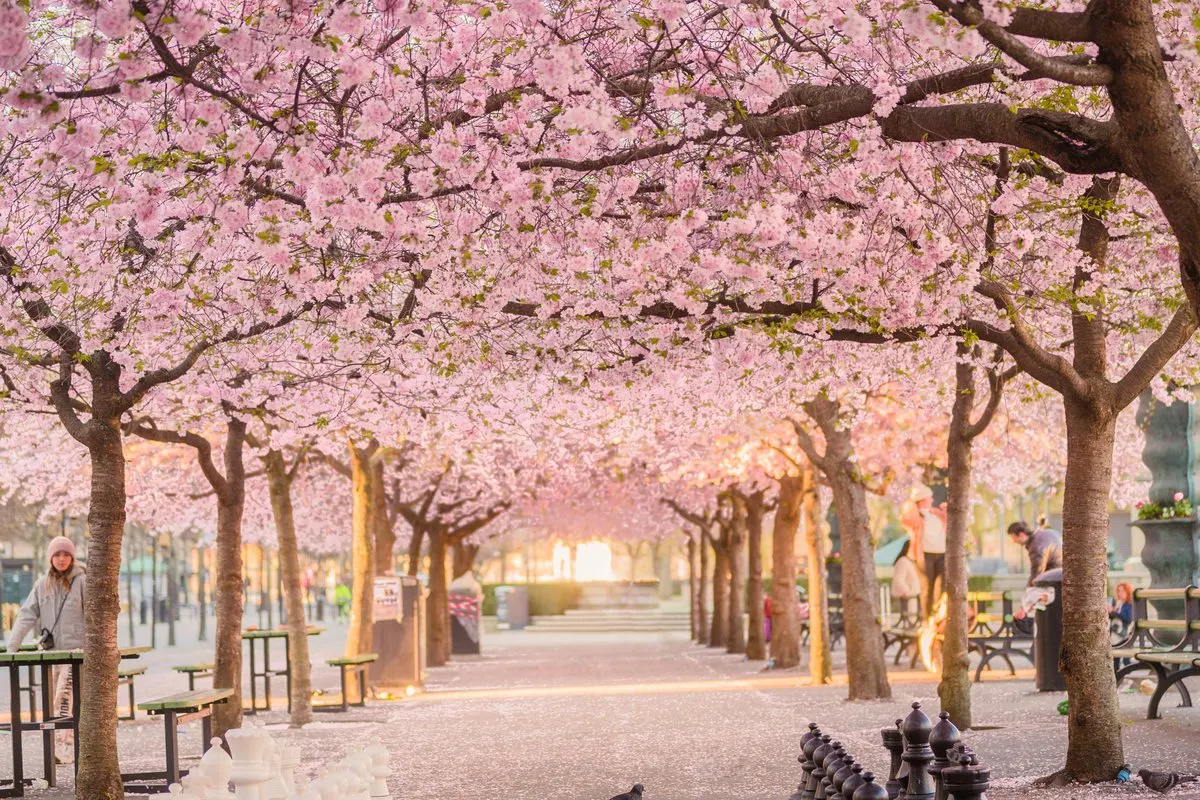
A medieval cabbage patch, a Baroque garden guarded by soldiers, a parade ground, the site of a famous protest – and every spring an avenue of Japanese cherry blossom. Kungsträdgården, the King's Garden, is Stockholm's living room.
In this story · 5 sections
Between the department stores of Hamngatan and the water facing the Royal Palace runs a long, open park framed by lime avenues, with a king on a pedestal at each end and a bronze fountain in the middle. Kungsträdgården – "Kungsan" to Stockholmers – is one of the two oldest surviving public parks in the city, along with Humlegården, and over five centuries it has been a royal kitchen garden, a Baroque pleasure ground, a parade square, a stage for open-air concerts and the scene of one of modern Stockholm's most famous protests. In spring, when its cherry trees bloom, it is one of the most photographed places in the city.
Kungsträdgården
Park · Norrmalm
© OpenStreetMap contributors · OpenFreeMap
- Address
- Kungsträdgården, Stockholm
- Location
- Norrmalm, between Hamngatan and Strömmen
- Opened to the public
- Eighteenth century, especially under Gustav III
- Charles XIII statue
- Erik Gustaf Göthe, 1821; lions by Fogelberg, 1824
- Charles XII statue
- Unveiled 30 November 1868
- Molin's Fountain
- Johan Peter Molin, 1873
- Cherry trees
- Planted during the 1997–1998 renovation
A park since the eighteenth century with statues of Charles XII and Charles XIII, Molin's Fountain and cherry trees.
01A garden for the court
The story begins with a cabbage patch: Eric of Pomerania is said to have grown cabbages here in the Middle Ages, on a site then bounded by St James's churchyard to the west and the Näckström channel, which separated the mainland from Blasieholmen, to the east. Gustav Vasa, Eric XIV and later kings brought in foreign gardeners to tend the royal gardens and plant rare trees and herbs. This was once also the site of the palace of Makalös. For centuries the garden was enclosed and reserved for the court, with armed guards at its gates. Under Charles XI a water display was installed, fed from Träsksjön; it was removed in 1767 and replaced with a lawn.
02Open to the public
It was only in the eighteenth century, and especially under Gustav III, that the public was admitted. A new orangery was built at the northern end in 1762, the garden was enclosed by stone walls with great iron gates, and once the people were let in it became a place of the merriest amusement, vividly described in several of Bellman's songs. In 1772 the orangery opened as the Vauxhall, a pleasure palace for public concerts and balls.
Insider tipBusiest during the cherry blossom in spring.
After 1796 the park was transformed. Trees were felled to let in light and air, lawns were laid, and the Vauxhall became an arsenal in 1801 and a spa salon in 1823 before it was demolished in 1851. Under Charles XIII and Charles XIV John the walls came down and almost everything green was removed; after De la Gardie's palace Makalös burned in 1825, the open square was extended down to the water. A royal letter of 26 March 1822 decreed that it should be called Karl XIII:s torg.
03Kings, lions and a fountain
At the centre stands the statue of Charles XIII by Erik Gustaf Göthe, unveiled on 5 November 1821, with four lions by Bengt Erland Fogelberg added in 1824. At the southern end, on Karl XII:s torg, Charles XII stands on a statue unveiled on 30 November 1868, the 150th anniversary of his death at Fredriksten. Between them stands Molin's Fountain by Johan Peter Molin, set up on 25 September 1873 after a public subscription; a plaster model had been shown at the Stockholm Exhibition of 1866, which was held in the park and was Sweden's first international exhibition of art and industry on the European model.
04A park for the people
The city took over the park's upkeep in 1875 for 5,000 kronor a year. For Stockholm's 700th anniversary in 1953 it was transformed to designs by Erik Glemme, with an open-air stage, restaurant buildings, a tea pavilion, kiosks and a beer hall among flower urns, flagpoles and benches. In November 1962 an artificial ice rink opened. The city has owned the park since 1971 – the year of the "Battle of the Elms" on 12–13 May, a protest that centred on the wych elms between the statues.
The park's northern part was remodelled in 1997–1998, when Stockholm was European Capital of Culture, to designs by Aleksander Wolodarski. A large central pool was created, an avenue of Japanese cherry trees was planted and ailing limes were replaced. Since 1998 the western avenue has been named after the tenor Jussi Björling, and since 2007 the eastern one after the soprano Birgit Nilsson.
05When to come
Kungsträdgården is a park for every season. Come in spring for the cherry blossom and in summer for the open-air life of the park. The Royal Opera, St James's Church and the Hallwyl Museum are all within a few minutes' walk. Read about the surrounding streets in VERA PI's guides to Kungsträdgårdsgatan, Västra Trädgårdsgatan and Hamngatan, plan the day with Metro Mode's Stockholm map, and point your phone at the statues with Metro Mode Camera.