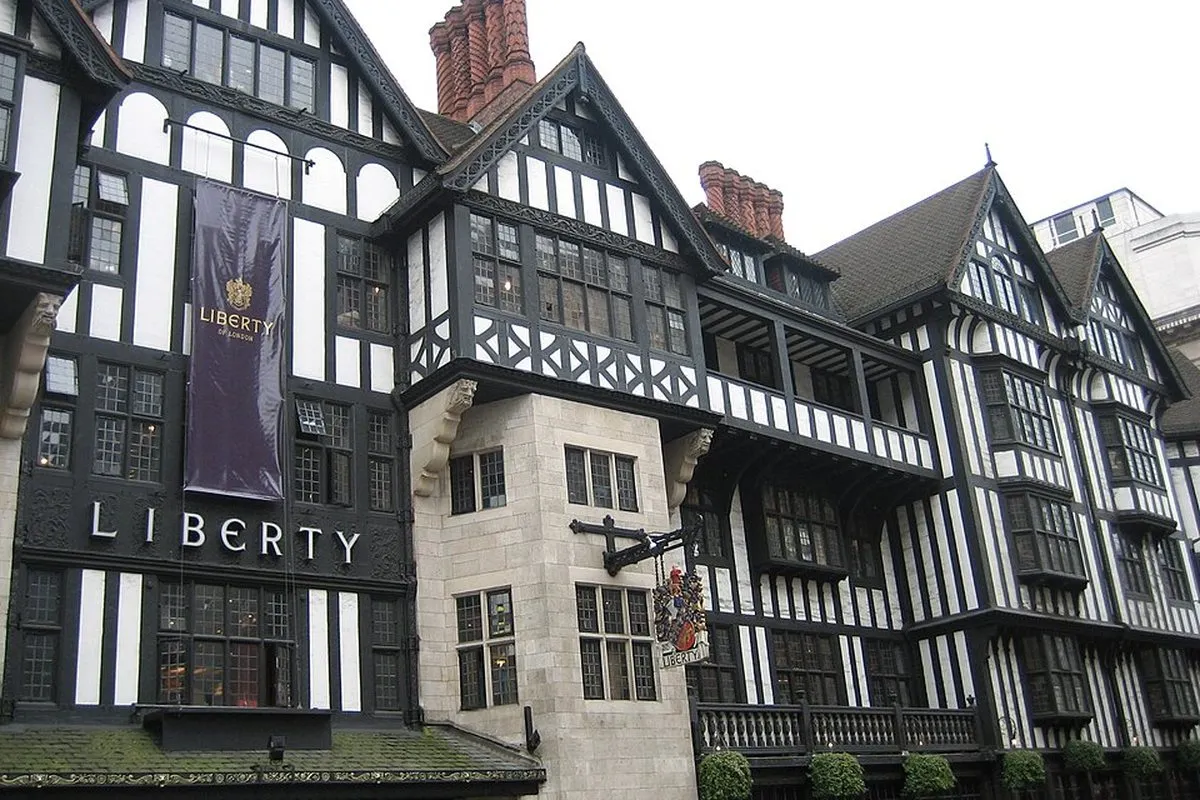
Liberty opened in half a shop on Regent Street in 1875 and became so closely linked with Art Nouveau that Italians still call the style Stile Liberty. Its mock-Tudor store on Great Marlborough Street was built in 1924 from the timbers of two warships. Here is the story of Liberty London.
In this story · 5 sections
Liberty, the department store on Great Marlborough Street in London's West End, is known around the world for its bold floral prints and its long connection with art and design. The mock-Tudor building stretches from Carnaby Street to Kingly Street, where a three-storey archway houses the Liberty Clock. Inside, fashion, beauty and homewares from established and emerging designers fill rooms built around three light wells.
Liberty London
Department store · West End
© OpenStreetMap contributors · OpenFreeMap
- Address
- Great Marlborough Street, London W1
- Founded
- 1875
- Building
- 1924, Edwin T. and E. Stanley Hall
- 1875
- Shop opens at 218a Regent Street
- 1884
- Costume department under E. W. Godwin
- 1924
- Tudor building completed
- 1972
- Grade II* listed
Fashion, beauty, homewares and Liberty fabrics in a Grade II* listed building from 1924.
01Arthur Liberty and the shop on Regent Street
Arthur Lasenby Liberty was born in Chesham, Buckinghamshire, in 1843, the son of a draper. He worked for Farmer & Rogers on Regent Street from 1862, and when he was refused a partnership he decided to start his own business across the road. With a £2,000 loan from his future father-in-law, he took the lease of half a shop at 218a Regent Street in 1875, with three staff. The shop sold ornaments, fabrics and objets d'art, especially from Japan and the East; Dante Gabriel Rossetti bought blue-and-white china there.
Within eighteen months Liberty had repaid the loan and taken the other half of the shop. In 1884 he opened a costume department directed by the architect Edward William Godwin, designed to challenge the fashions of Paris, and in 1889 Oscar Wilde wrote that “Liberty's is the chosen resort of the artistic shopper”. Arthur Liberty was knighted in 1913 and died in 1917.
02Stile Liberty – Arts and Crafts and Art Nouveau
In the 1890s Liberty built close relationships with English designers working in the Arts and Crafts and Art Nouveau styles, among them Archibald Knox, and helped develop Art Nouveau by encouraging them. The company became so associated with the style that in Italy Art Nouveau became known as Stile Liberty. The Cymric silverware and Tudric pewter ranges were made for the store from 1899 until the 1930s.
03A store built from two warships
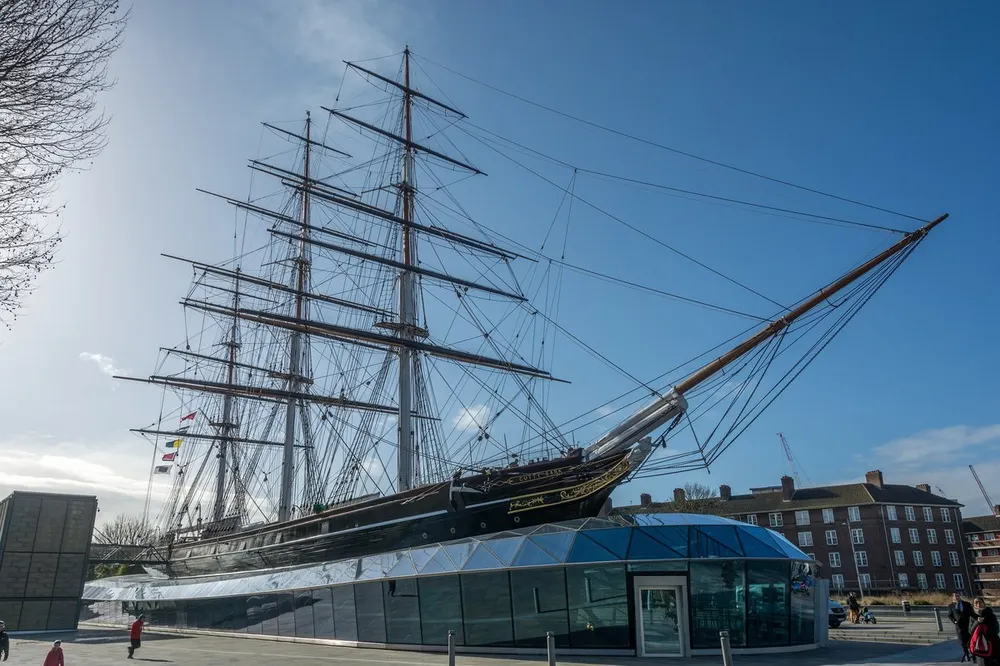
The Tudor revival building on Great Marlborough Street was completed in 1924 from the timbers of two ships, HMS Impregnable and HMS Hindustan; its frontage is the same length as the Hindustan. It was designed by Edwin Thomas Hall and his son Edwin Stanley Hall, and many of its smaller rooms had fireplaces, some of which survive. Not everyone approved: the architectural historian Nikolaus Pevsner wrote that “the scale is wrong, the symmetry is wrong”. The building was Grade II* listed in 1972, and since 2006 the whole store has traded from it.
04Liberty prints from Yves Saint Laurent to Ziggy Stardust
In the 1960s the designer Bernard Nevill reinvigorated Liberty's textile collections. Yves Saint Laurent bought thirteen designs from the winter 1970 collection in 34 colourways, and Nevill's “Corbusier” print became a jumpsuit for David Bowie on the cover of The Rise and Fall of Ziggy Stardust. The store has collaborated with names from William Morris to Vivienne Westwood, and it is still known for championing young designers early in their careers.
05How to visit Liberty
Enter from Great Marlborough Street to see the timbered façade, look up into the light wells, and leave through the Kingly Street arch to see the Liberty Clock. Carnaby Street is on the doorstep and Regent Street a minute away. Explore the streets in VERA PI's street files for Great Marlborough Street, Carnaby Street and Regent Street, or start with VERA PI's London guide.