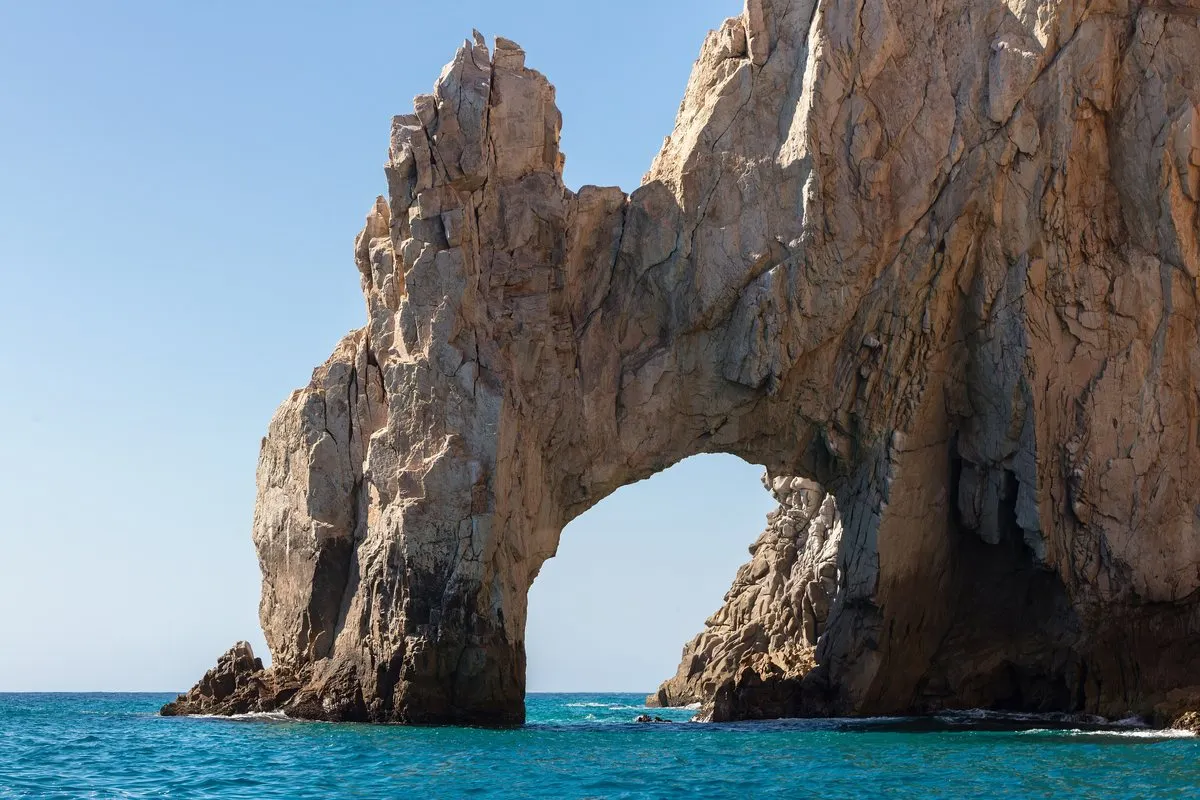
At the very tip of the Baja California peninsula the desert meets two seas, and a granite arch marks the point where the Pacific becomes the Gulf of California. Four days in Los Cabos, between the lively marina of Cabo San Lucas and the cobbled centre of San José del Cabo.
In this story · 5 sections
Los Cabos is the municipality at the southern tip of Mexico's Baja California peninsula, in the state of Baja California Sur. It takes in two towns – the busy resort city of Cabo San Lucas and the smaller municipal seat, San José del Cabo – linked by a 32-kilometre corridor of resorts. Remote and rural until the late twentieth century, when the Mexican government began developing Cabo San Lucas for tourism, it now receives more than two million visitors a year, over a million of them from the United States. They come for the meeting of desert and sea, for sport fishing, golf and the resorts.
Plan on four days: two at each end, with the corridor in between.
01Day one: El Arco and Land's End
Start at the end of the peninsula. El Arco, the arch of Cabo San Lucas, is a three-storey granitic formation carved by erosion from rock formed about 115 million years ago. Locals call the spot Land's End: here the Pacific Ocean becomes the Gulf of California. Sea lions gather on the rocks, and the arch stands between Lovers Beach on the calm Sea of Cortez side and Divorce Beach on the rougher Pacific side.
Most visitors go by boat from the marina; it is also reachable on foot from the beach of the last hotel on the Pacific, though that means scrambling over large rocks. Small craft should keep away from the sides of the arch when the sea is running.
02Day two: Cabo San Lucas and its waters
Cabo San Lucas, a city of more than 200,000 people, grew from a fishing village; the Pericú, who lived here for millennia, called the place Yenecamú. Its waters hold rays, sharks, dorado and striped marlin, which is why the Bisbee's Los Cabos Offshore, held every October, is the richest marlin tournament in the world. In winter, pods of whales arrive to give birth in the warm waters of the Gulf of California after travelling from as far as Alaska and Siberia – the season for whale-watching. The town also has a natural history museum, the Museo de Historia Natural de Cabo San Lucas.
03Day three: San José del Cabo
Drive the corridor to San José del Cabo, on a shallow bay on the Gulf coast. Growth here has been kept outside the centre, mostly towards the beaches in the south, so the historic town remains quiet and little changed, with cobbled streets, adobe houses, jacaranda trees and a central square in front of the church, where people gather in the cool of the evening.
The church belonged to the mission of Estero de las Palmas de San José del Cabo, founded in 1730; a tile mural on the facade shows the martyrdom of its founder, Nicolás Tamaral, killed by the Pericú. Many of the larger nineteenth-century houses around it are now restaurants, galleries and shops selling crafts, silver and local gemstones; the town has resisted shopping malls and chain stores. The Casa de Cultura occupies another nineteenth-century building.
04Day four: the estuary
Beside the town, the Río San José, which runs largely underground from the Sierra de la Laguna, feeds the largest body of fresh water in Baja California Sur: an estuary separated from the bay by a kilometre-long sandbar. Spanish galleons returning from the Philippines once took on fresh water here. It is also one of only two places where the critically endangered Baja California rice rat survives.
05When to go
The high season runs from October to May, when San José's galleries stay open late. Los Cabos has a tropical desert climate, but tropical storms occasionally bring heavy rain in late summer and autumn. Both towns are served by Los Cabos International Airport. More guides are on our destinations page, the Metro Mode home page and our pick of hotels worth a single night.