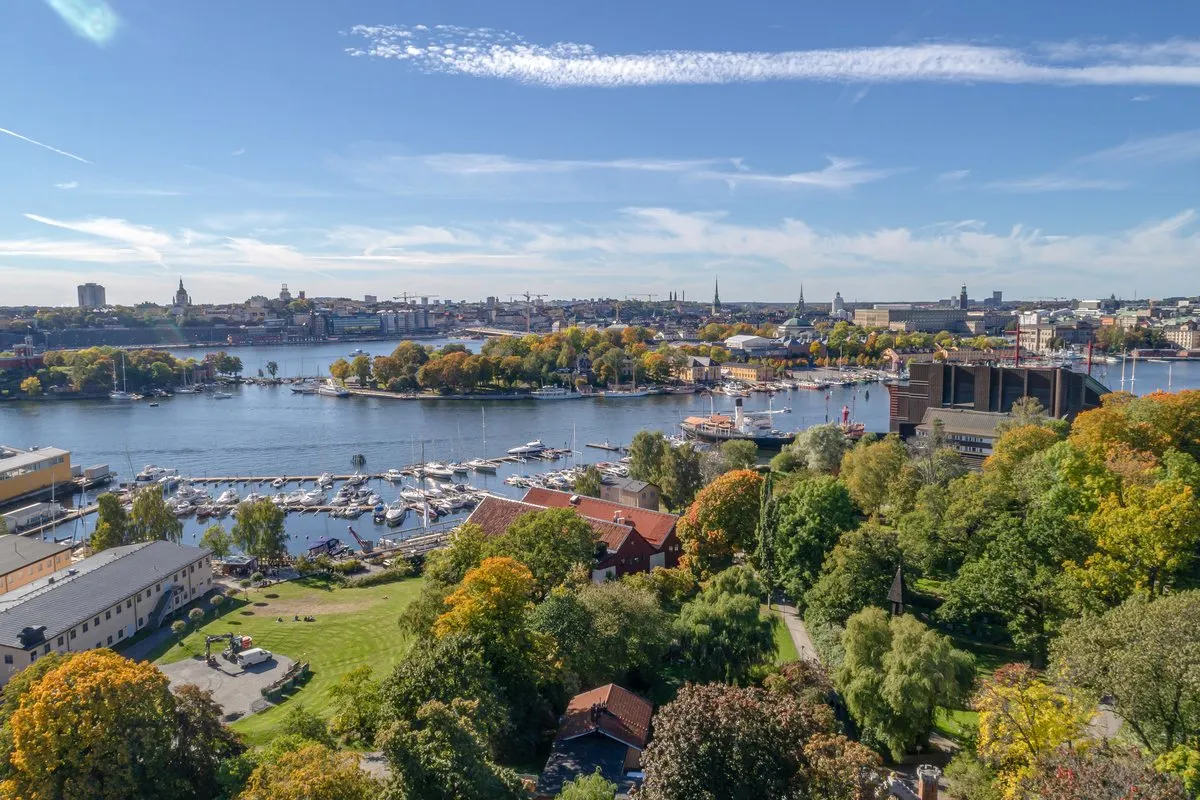
Midsummer is celebrated throughout Sweden close to the summer solstice, preferably outdoors: around a leaf-decorated pole, with pickled herring, new potatoes and strawberries. Here is the story behind the traditions, when the holiday falls and how to celebrate Midsummer in and around Stockholm.
In this story · 6 sections
Midsummer in Stockholm is a strange and beautiful experience for those coming from outside. The city empties of its inhabitants, who flee out to the archipelago and the countryside, and those who stay behind celebrate in parks and on islands beneath a sky that barely grows dark. Midsummer is generally celebrated in Sweden around the time of the summer solstice, and few holidays say as much about the country.
Skansen
Museum · Djurgården
© OpenStreetMap contributors · OpenFreeMap
- Address
- Djurgården, Stockholm
- Opened
- 1891
- Founder
- Artur Hazelius
- Midsummer's Eve
- Friday 19–25 June
- Midsummer Day
- Saturday 20–26 June, national flag day
- Food
- Herring, new potatoes, strawberries
- Dance
- Around the midsummer pole
Opened on 11 October 1891, around 140 buildings. Marks Midsummer.
01The origins of Midsummer – John the Baptist and the turn of the season
In popular belief, Midsummer has pre-Christian roots, but evidence of a pre-Christian festival around 24 June is lacking, according to Wikipedia. The Church has celebrated the birth of John the Baptist on 24 June since the 300s and brought the festival to Sweden in the 1000s. The word midsummer, on the other hand, appears to be pre-Christian and originally referred to the start of the third quarter of the year in July, a month later. In common usage, the word was then moved to the Christian celebration in June.
02The pole, the wreaths and the songs
The most common celebration is dancing around a midsummer pole – a pole adorned with leaves and flowers, often in the shape of a cross with wreaths. People form rings and dance around the pole while singing playful songs. The pole probably came from Germany in the 1300s or 1400s and is also called a maypole, perhaps after an old word meaning to adorn with leaves. Many, mainly children and women, wear a flower wreath in their hair, bound on a base of birch twigs or wire.
03Herring, new potatoes and strawberries
At Midsummer, people eat matjes herring with soured cream and chives, new potatoes with dill and strawberries for dessert, and many drink schnapps with the food. The tradition of new potatoes with the herring is relatively young – it was created in the big cities in the 1920s. In the past, it was seen as wasteful to eat potatoes that hadn't fully grown.
04Midsummer Night folklore
In peasant society, Midsummer Night was one of the most magical nights of the year, when the boundary between the human world and the supernatural was considered thinner than usual. Medicinal herbs were picked during the night so that they would be extra powerful, and anyone who walked barefoot in the Midsummer dew would stay strong and healthy throughout the year. The night was also a time for foretelling the future.
05When is Midsummer?
Since 1953, Midsummer Day has fallen on a Saturday between 20 and 26 June; before that, it was always on 24 June. Midsummer's Eve is the day before, a Friday between 19 and 25 June, and that is when the grand celebration takes place. Midsummer's Eve is not a public holiday but is treated as one under banking law and other legal texts. The weather is a perennial topic of conversation: it often rains on Midsummer's Eve, and according to statistics from SMHI, the Swedish weather service, for 1900–2019, the coldest Midsummer was probably 1987, when Stockholm had a high of 11 degrees.
06How to celebrate Midsummer in Stockholm
The easiest option for a visitor is Skansen on Djurgården, the open-air museum from 1891, which usually marks Midsummer among the year's festivities. If you want to celebrate in the archipelago, the boats depart from Nybrokajen – book both boat and table well in advance, as travel around the holiday is heavy and many people start their holiday then. See also the area page for Djurgården in My Stockholm, our story of Djurgården, from royal hunting ground to green island, and Djurgårdsvägen at VERA PI.