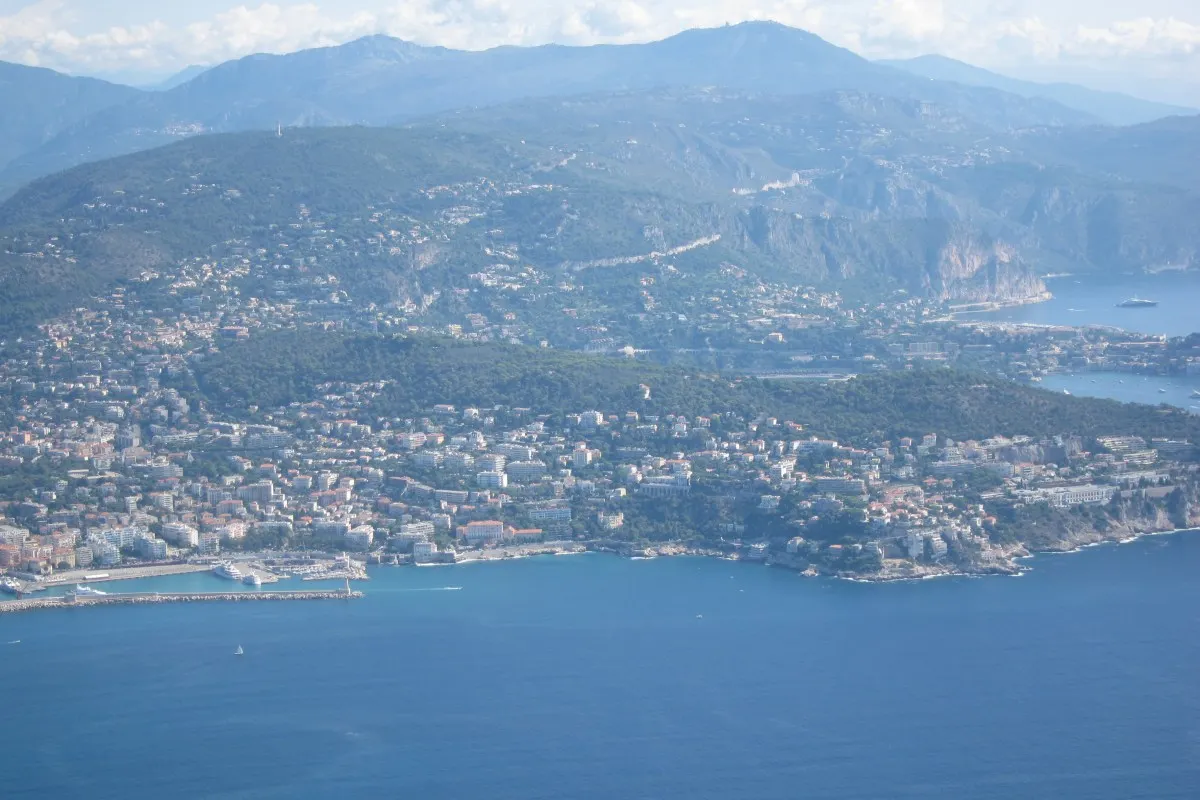
Between Port Lympia and the Villefranche roadstead rises a 191-metre hill of forest, belle-époque villas and a sixteenth-century fort – where Nice goes for air, a run or the widest view on this stretch of coast.
In this story · 4 sections
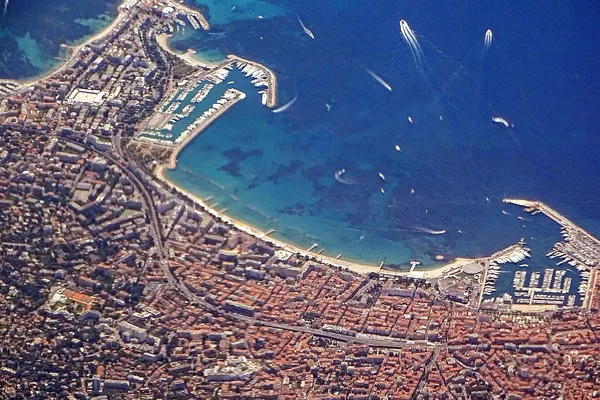
Stand on the Promenade des Anglais and look east, past the old town and Castle Hill, and the coast ends in a green headland. That is Mont Boron, the hill that separates the Baie des Anges from the roadstead of Villefranche-sur-Mer. It rises to 191.3 metres, carries one of Nice's most sought-after residential quarters on its flanks and, on its crown, a forest park that belongs to everyone.
It is where Nice comes to run before work, to walk on a Sunday and to look at itself from above. It is also where two centuries of Riviera history sit side by side: a fortress of the dukes of Savoy and a castle built by a British colonel back from India.
Mont Boron
Park · Mont Boron, Nice
© OpenStreetMap contributors · OpenFreeMap
- Address
- Boulevard du Mont Boron, 06300 Nice
- Height
- 191.3 metres
- Forest park
- 57 hectares, 11 km of trails, replanted in the 1860s
- Fort du Mont Alban
- Built 1557–1560 for Emmanuel-Philibert of Savoy
- Batterie du Mont Boron
- 1886–1887, 400 metres long
- Château de l'Anglais
- 1856–1858, for Colonel Robert Smith; listed in 2000
- Entry
- Free, every day of the year
A 191-metre hill with a free 57-hectare forest park and 11 km of trails, the Fort du Mont Alban of 1557–1560 and views over the Baie des Anges, Villefranche and Cap Ferrat.
01A hill between two bays
Mont Boron is the seaward extension of Mont Alban, just to the north, and the name of the quarter usually covers both. Its panoramas are the reason to come: the whole city and the Baie des Anges on one side, the Villefranche roadstead and Cap Ferrat on the other. At its foot lies the Grotte du Lazaret, a prehistoric site of the Middle Palaeolithic.
Nobody is quite sure where the name comes from. In 1843 the Nice writer Louis Roubaudi offered two theories: a corruption of a word for the Moors, the Saracens said to have fortified the hill in the Middle Ages, or a saint called Bobon who urged the people of Nice to drive them out.
02The forest
In the Middle Ages the hill was cleared so that the Saracens could not hide on it. The forest you walk through today was replanted in the 1860s under Prosper Demontzey, an engineer of the waters and forests, and the Parc forestier du Mont Boron now covers 57 hectares, the largest green space in the east of the city.
Insider tipGo early in the morning, when the light is soft over the Villefranche roadstead and the trails belong to the runners.
Eleven kilometres of trails cross it, shared by runners, families and walkers who come for the unusual vegetation and the shade. Entry is free and the park is open every day of the year, and dogs are welcome.
03The fort of the dukes of Savoy
On the summit of Mont Alban stands the fort built between 1557 and 1560 under Emmanuel-Philibert of Savoy, to protect Nice against invasion, notably by the Turks and the French. Squat, pale and bastioned, it was a key link in the defence of Savoy's window on the sea, and it kept a military role into the nineteenth century. Its enclosure was protected as a historic monument in 1909 and its ramparts in 1913.
Visits to the fort itself are currently suspended, but the view is the reward for the climb: from Bordighera in Italy to the Esterel, taking in Cap d'Ail, Saint-Jean-Cap-Ferrat, Nice, the Baie des Anges and the Garoupe at Antibes, and on clear days Corsica. Lower down, the Batterie du Mont Boron, a 400-metre enclosure built in 1886 and 1887, guarded both the Baie des Anges and the Villefranche roadstead.
04The Englishman's castle
On the western slopes, above the Boulevard Carnot, stands the strangest house in Nice. In 1856 Colonel Robert Smith, a British engineer officer who had served in India, bought 22,000 square metres of hillside and built, in three years, a castle in the neo-Mughal style, its battlements modelled on the Red Fort in Delhi, which he had restored. The estate ran down to the sea, scattered with towers, belvederes and kiosks in the same exotic spirit.
It divided opinion from the start. One writer called it a nightmare for classical architects; another, Stephen Liégeard, said it was neither castle, palace, tower, bastion nor villa, “nor anything that has a name in any language”. The estate was later divided, the castle became apartments after the Second World War, and it has been a listed monument since 2000. It is a private residence, best admired from the road below.