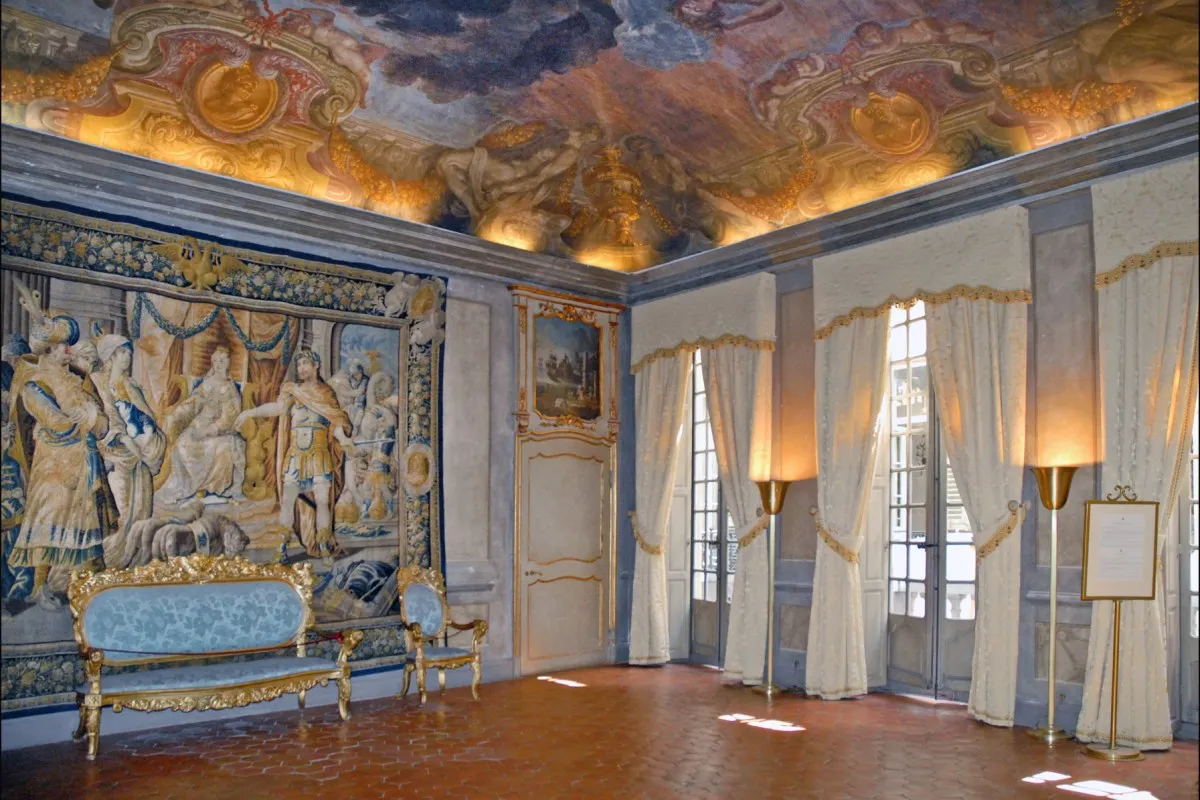
Behind a narrow façade on rue Droite, the seventeenth-century palace of the Lascaris-Vintimille family hides frescoed ceilings, a monumental staircase and one of France's great collections of historic musical instruments.
In this story · 4 sections
Rue Droite is one of the narrowest and oldest streets in Vieux Nice, a shaded lane of bakeries and workshops where you look up rather than ahead. Halfway along it, a façade of white marble balconies and heavy window surrounds announces something grander than its neighbours: the Palais Lascaris, the town house of one of the County of Nice's great noble families.
Inside, the palace is two museums in one. There is the baroque interior itself, with its painted vaults and state rooms, and there is the instrument collection that fills them, built on the bequest of a Nice music lover whose salon once welcomed Gabriel Fauré.
Palais Lascaris
Museum · Vieux Nice
© OpenStreetMap contributors · OpenFreeMap
- Address
- 15 rue Droite, 06300 Nice
- Built
- First half of the 17th century, altered in the 18th
- Family
- Lascaris-Vintimille, owners until 1802
- Style
- Genoese baroque; architects unknown
- Protected
- Historic monument since 15 February 1946
- Open to the public
- Since 1970; instrument museum since 2011
- Collection
- About 500 instruments, founded on the Gautier bequest of 1904
- Exhibition
- Coun – Libera l'Art, until 18 January 2027
Genoese baroque palace of the Lascaris-Vintimille family, with a frescoed staircase and state rooms and a collection of about 500 historic instruments, from a 1581 sackbut to Érard harps and Adolphe Sax saxophones.
01A noble house in the old town
The palace was built by the Lascaris-Vintimille family in the first half of the seventeenth century and altered in the eighteenth, and it stayed in their hands until 1802. No documents name its architects. Its style is the baroque of nearby Genoa, worked into the tight medieval fabric of the old town.
By the early twentieth century it had fallen into decay. The city bought it in 1942, intending a museum of regional popular arts, and it was classified as a historic monument on 15 February 1946. Restoration ran from 1963 to 1970, the year it opened to the public for good.
02The staircase and the piano nobile
The drama starts at the door. A vestibule with groined vaults, painted in strong colours, leads to a monumental staircase enclosed by arcaded galleries and decorated with statues and frescoes. The first floor is used for temporary exhibitions; the second, the piano nobile, holds the state apartments.
Insider tipLook up in the grand salon on the second floor: the Fall of Phaeton fresco dates from the mid-17th century.
Here the ceilings keep their original frescoes from the middle of the seventeenth century, among them a Fall of Phaeton in the grand salon; the statues and rocaille ornament were added in the eighteenth. Flemish and Aubusson tapestries hang on the walls, the furniture is of the seventeenth and eighteenth centuries, and religious paintings and reliquaries recall the family's ties to the Order of St John of Jerusalem.
03Antoine Gautier's instruments
The collection began with Antoine Gautier, born in Nice in 1825, a lawyer and amateur viola player who founded a string quartet with his brother at eighteen. His music room on rue Papacino drew the violinists Jacques Thibaud and Eugène Ysaÿe, and one evening in January 1902 Gabriel Fauré played several of his piano works there. When Gautier died in 1904 he left the city more than 225 instruments and his music library.
The collection moved between museums for a century before arriving here in 2001; the permanent display of historic instruments opened in 2011. With about 500 instruments, it is the second most important collection of its kind in France, according to the city of Nice.
04What to look for
The oldest pieces are startling: a tenor sackbut by Anton Schnitzer, made in Nuremberg in 1581, a viol by William Turner of London from 1652, and baroque guitars by Giovanni Tesler (Ancona, 1618), René Voboam (Paris, around 1650) and Jean Christophle (Avignon, 1645) – one of the oldest dated French guitars. There are violas d'amore from Bologna, Naples, Salzburg and Füssen.
The harps are a highlight: Sébastien Érard's first single-action and first double-action harps, and a Naderman harp of 1780 that belonged to the Vicomtesse de Beaumont. Further on come instruments by Adolphe Sax, including a saxophone quartet, a Pleyel piano of 1863 and one of the most famous playable guitars by Antonio de Torres, made in Almería in 1884. Deposits from the AXA group in 2009 and from the Institut de France in 2013, the latter with 18 historic harps, have enriched it further.
Until 18 January 2027, the temporary exhibition Coun – Libera l'Art brings the universe of the artist Coun into the palace.