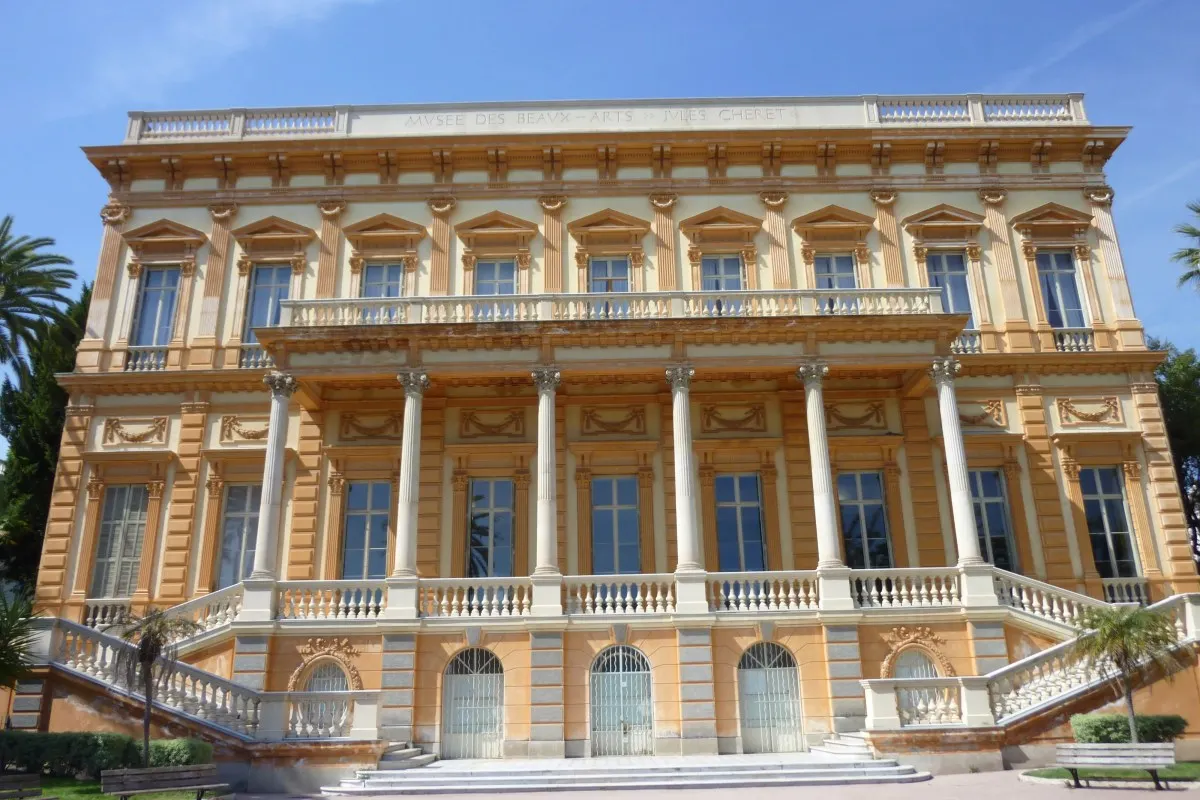
On the hill of Les Baumettes, a Genoese-style villa begun for a Russian princess in 1878 holds Nice's fine art collection – from Bronzino and the Van Loo dynasty to Monet, Bonnard and Dufy, and the posters of Jules Chéret, who died in Nice.
In this story · 5 sections
Nice's fine art museum is easy to miss and hard to forget. It stands a little above the western side of the city, in the residential quarter of Les Baumettes, behind palms and a flight of balustraded steps: an ochre and cream villa in the Genoese manner that looks as though it has wandered over from the Italian Riviera.
Inside are four centuries of painting and sculpture, from Flemish and Italian masters to the Impressionists and the painters who made the Riviera their subject, and a remarkable holding of Jules Chéret, the poster artist whose name the museum carries. It rarely feels crowded, which is part of the pleasure.
Musée des Beaux-Arts Jules Chéret
Museum · Les Baumettes, Nice
© OpenStreetMap contributors · OpenFreeMap
- Address
- 33 avenue des Baumettes, 06000 Nice
- Villa begun
- 1878, for Princess Elizaveta Kochubey
- Completed
- After 1883, by Constantin Scala for James Livingston Thompson
- Museum opened
- 7 January 1928
- Named after
- Jules Chéret, died in Nice in 1932
- Collections
- Painting and sculpture from the primitives to the 20th century
- Protected
- Façades and roofs classified in December 2023
- Exhibition
- Artistes et mondaines de la Belle Époque, until 9 May 2027
Nice's fine art museum in a Genoese-style villa begun in 1878 for Princess Elizaveta Kochubey: Bronzino, the Van Loos, Fragonard, Monet, Bonnard, Dufy, Rodin and a major collection of Jules Chéret.
01A villa for a princess
In 1878 Prince Lev Kochubey, a privy councillor to Tsar Alexander II, settled in Nice with his wife, Princess Elizaveta Kochubey. The princess bought land and began a villa inspired by the Italian Renaissance, after the Genoese and Michelangelesque models fashionable at the time. Three years later it was still unfinished, and the princess, perhaps tired of the slow progress, decided to sell.
On 18 April 1883 the villa was bought by James Livingston Thompson, a wealthy American-born entomologist, and the Nice architect Constantin Scala completed it. The Thompsons spared nothing on the interiors and gave the house their name; James Thompson died there in 1897. The villa was sold in 1920 and part of its park divided into plots, and in 1925 the city bought it for its fine art museum. It opened as the Palais des Arts Jules Chéret on 7 January 1928. Its façades and roofs were classified as a historic monument in December 2023.
02Jules Chéret
The painter and poster artist Jules Chéret spent his last years in Nice and died there in 1932. His bright, airy women in colour lithographs defined the look of the Belle Époque street, and the museum holds an important collection of his work, from posters to paintings such as Le Déjeuner sur l'herbe of 1904. Seeing them in a villa of the same era is the point.
Insider tipPause in the glass-roofed patio, the villa's old winter garden, before you start upstairs.
03From the primitives to the Van Loos
You enter through the patio, once the winter garden, under a tall Belle Époque glass roof. The ground floor runs chronologically from the regional primitives to the eighteenth century: Louis Bréa, a Christ on the Cross by Bronzino rediscovered in recent years, Jan Brueghel the Elder, Fragonard and Hubert Robert. One large room belongs to the Van Loo dynasty, with Carle Vanloo's Theseus Vanquishing the Bull of Marathon of 1745 among its showpieces.
04Monet, Bonnard and Dufy upstairs
A monumental staircase leads to the first floor and the nineteenth and early twentieth centuries. Academic painting and sculpture give way to the Impressionists, the Nabis and the Fauves: Cabanel and Benjamin Constant, Boudin, Monet's Falaise de Fécamp of 1897, Sisley, Vuillard and Bonnard, Raoul Dufy, Kees van Dongen and Marie Laurencin. The sculpture includes Carpeaux, Rude and Rodin, and there are ceramics by Picasso.
Two painters from the Académie Julian in Paris are well represented: Marie Bashkirtseff, the Franco-Ukrainian diarist and artist, and her rival Louise Catherine Breslau, whose self-portrait came to the museum through the bequest of her companion, Madeleine Zillhardt. Since 2023 the Musée d'Orsay has been the museum's scientific partner.
05On show until May 2027
From 19 June 2026 to 9 May 2027 the museum presents De la scène à la toile. Artistes et mondaines de la Belle Époque, a new hang of the collection on the years 1871 to 1914. It brings together carnival scenes, portraits of composers and foreign princesses, and above all the opera and theatre singers who won international fame and independence, with a thread on portraiture, fashion and self-presentation from stage costume to early haute couture. After it ends, the museum closes from 10 May to 17 June 2027.