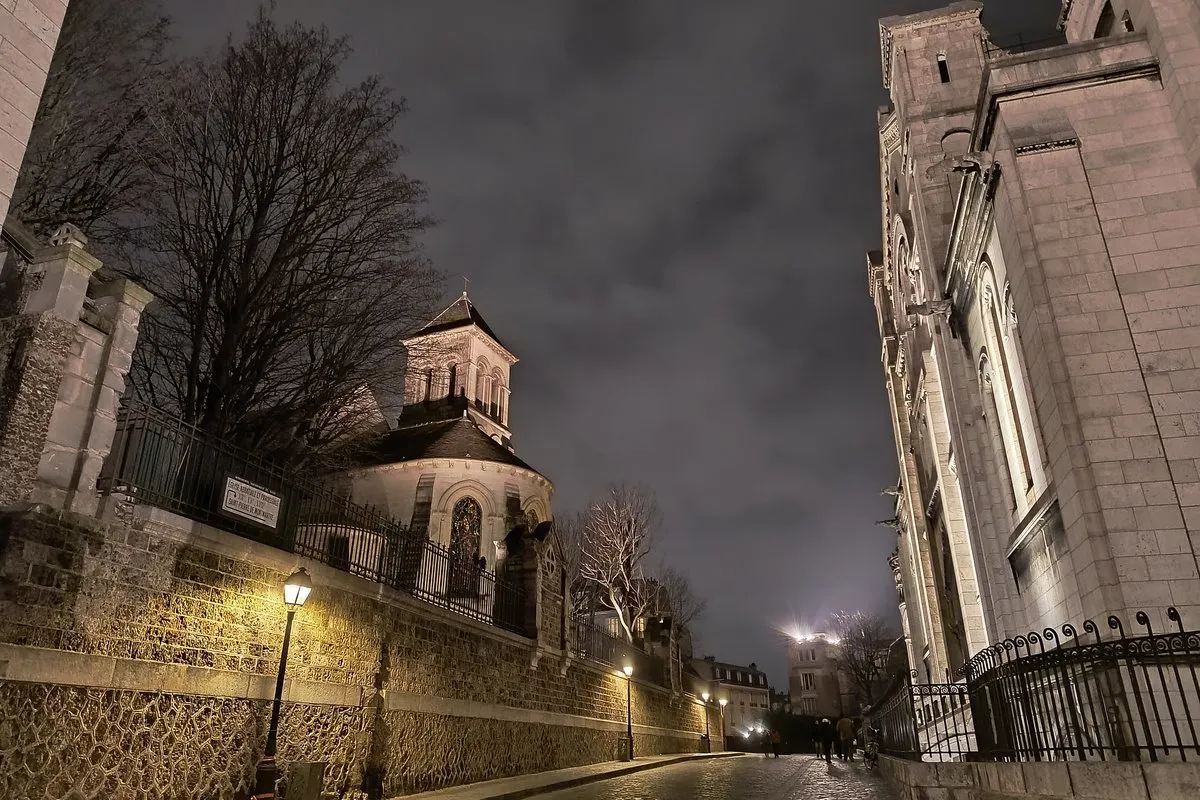
Before nine o'clock, Montmartre is a village on a hill: empty cobblestone streets, closed studios and Paris brightening beneath the Sacré-Cœur. Here is a morning walk in ten stops from Abbesses to the basilica.
In this story · 10 sections
Montmartre in Paris's 18th arrondissement is a 130-metre-high hill and one of the city's most visited places. In the middle of the day, Place du Tertre is full of easels and tourists. But those who arrive early, when the cafés are still setting out their chairs, get to see the village the artists once moved to: steep alleys, a vineyard and the view over Paris in the morning light. The walk is around two kilometres, but the hills mean it takes a couple of hours.
6 places
© OpenStreetMap contributors · OpenFreeMap
1. Abbesses: start at the bottom of the hill
Take the metro to Abbesses on line 12. Montmartre was an independent commune until 1 January 1860, when it was incorporated into Paris. The name may come from the Latin Mons Martis, the mountain of Mars, or Mons Martyrum, the mountain of the martyrs, after the legend of Saint Denis who, according to Hilduin, was beheaded here in the year 250. At 11 rue Yvonne-Le Tac, Ignatius of Loyola and his companions took their vows on 15 August 1534 – the first step towards the Jesuit order.
2. Bateau-Lavoir: Picasso's studio
Go up to Place Émile-Goudeau. At number 13 stood the Bateau-Lavoir, the building where Pablo Picasso, Amedeo Modigliani and other artists lived and worked from 1904 to 1909. It was here that Picasso painted Les Demoiselles d'Avignon. During the Belle Époque, when rents were low, Renoir, Degas, Toulouse-Lautrec, Suzanne Valadon, Maurice Utrillo and Van Gogh also lived and worked on or around the hill. Most of the artists moved to Montparnasse when the First World War broke out.
3. Moulin de la Galette
Continue up towards rue Lepic. The first windmills were built on the west side of the hill in 1529 and milled wheat, barley and rye. At most there were thirteen, but by the end of the 1800s only two remained. The Moulin de la Galette is the most famous – it was the dance here that Renoir painted in Bal du moulin de la Galette in 1876.
4. Rue de l'Abreuvoir
Via rue Girardon you reach rue de l'Abreuvoir, which slopes down towards the north with small houses and gardens. At impasse Girardon nearby lies the fontaine Saint-Denis, to which the saint, according to legend, carried his head. At dawn, the streets here are at their quietest.
5. The vineyard on rue Saint-Vincent
In the 15th century, the hill's northern and north-eastern slopes were home to a village surrounded by vineyards and orchards. On rue Saint-Vincent there remains a small vineyard carrying on the tradition, producing around 500 litres of wine a year. Right next to it lies a wild garden that is home to midwife toads.
6. Au Lapin Agile
Near the vineyard lies the cabaret Au Lapin Agile, where the artists on the hill worked and met. It is one of Montmartre's most famous subjects, and in the morning you have the house to yourself.
7. Musée de Montmartre on rue Cortot
Walk up rue des Saules and turn into rue Cortot. At number 12, Renoir rented a studio in 1876 to paint Bal du moulin de la Galette. Maurice Utrillo lived here 1906–1914, and Raoul Dufy shared a studio here 1901–1911. Today, the building is the Musée de Montmartre. Check the opening hours – the museum probably opens later than your walk begins.
8. Place du Tertre
The square lies on the site of the old abbey and was, from 1790, the location of the commune's town hall. During the day, artists set up their easels among the tables and parasols. Early in the morning, Place du Tertre is quiet, and you can see the houses around the square instead of the crowds. Rue Norvins leads into the square from the west.
9. Saint-Pierre de Montmartre
Next to the basilica stands the hill's second church, Saint-Pierre de Montmartre. King Louis VI bought the Merovingian chapel in 1134 and founded a Benedictine abbey, and the church from 1147 was the abbey's church. The abbey was destroyed in 1790 during the Revolution, but the church was saved. It is one of the oldest in Paris and a peaceful counterpoint to Sacré-Cœur.
10. Sacré-Cœur and the view
The basilica was designed by Paul Abadie, whose proposal was chosen from among 77, and the foundation stone was laid on 16 June 1875. The hill was undermined by old gypsum quarries, so 83 wells, each 30 metres deep, had to be dug and filled with stone and concrete. The dome was completed in 1899, the bell tower in 1912 and the church in 1914, but it was not consecrated until 1919, after the war. The white stone is a travertine from Château-Landon which releases calcite in the rain and therefore stays white. In the bell tower hangs the Savoyarde, France's largest bell, cast in 1895 in Annecy. Since 8 December 2022, the basilica has been classified as a historic monument.
From the steps in front of the basilica, you can see the whole of Paris in the morning light. Go down via the 222 steps of rue Foyatier or take the funicular to Place Saint-Pierre. The streets on the hill can be found on VERA PI's page about the 18th arrondissement, and the rest of the city is in our 48 hours in Paris.
Bateau-Lavoir
Stop 2
Picasso's and Modigliani's studio building 1904–1909.
13 place Émile-Goudeau, 75018 Paris
Musée de Montmartre
Stop 7
The former studios of Renoir, Utrillo and Dufy.
12 rue Cortot, 75018 Paris
Sacré-Cœur
Stop 10
The basilica from 1875–1914 and the view over Paris.
Insider tipThe funicular departs from Place Saint-Pierre.