At the western end of the Promenade des Anglais, Kenzo Tange built Nice a museum of white marble and glass that seems to float on a lake. Inside are four civilisations and a rotunda devoted to Buddhism – and entry is free.
In this story · 4 sections
Most people who see the Musée des Arts Asiatiques see it by accident, from a taxi on the way in from the airport: a cluster of white cubes and a drum crowned by a glass pyramid, standing in a lake beside the Promenade des Anglais. It is worth stopping. This is one of the quietest museums on the Riviera, one of the few built from the ground up by a Pritzker Prize-winning architect, and it costs nothing to enter.
It belongs to the Département des Alpes-Maritimes and was inaugurated on 16 October 1998, in the Arénas district at the western end of the city, next to the Parc Phoenix.
Musée des Arts Asiatiques
Museum · Arénas, Nice
© OpenStreetMap contributors · OpenFreeMap
- Address
- 405 promenade des Anglais, 06200 Nice
- Opened
- 16 October 1998
- Architect
- Kenzo Tange; displays by François Deslaugiers
- Owner
- Département des Alpes-Maritimes
- Galleries
- India, China, Japan, South-East Asia; Buddhism in the rotunda
- Entry
- Free
- Hours
- 10.00–17.00 September–June · 10.00–18.00 July–August · closed Tuesdays
Free museum of Asian art by Kenzo Tange, opened in 1998: four marble cubes for India, China, Japan and South-East Asia, and a rotunda under a glass pyramid devoted to Buddhism.
01A jewel of snow
The Japanese architect Kenzo Tange (1913–2005) described the building as “a jewel of snow shining in the azure of the Mediterranean”. He built it on two old Japanese symbols: the square, standing for the earth, and the circle, for the sky. Four marble-clad cubes, set out over the water, carry a large cylinder topped by a glass pyramid, and solid walls alternate with transparent ones so that the lake and the light come into the galleries.
Together the forms recall a Tibetan mandala. The displays, designed by François Deslaugiers, rest on glass plinths under careful lighting, so that the objects seem to hang in the white space.
02Four civilisations and a rotunda
The plan is the collection. The four cubes are given to the two “mother” civilisations, India and China, and to the cultures they shaped, Japan and South-East Asia. The rotunda on the upper floor, beneath the pyramid, is devoted to Buddhism, the thread that runs across the continent.
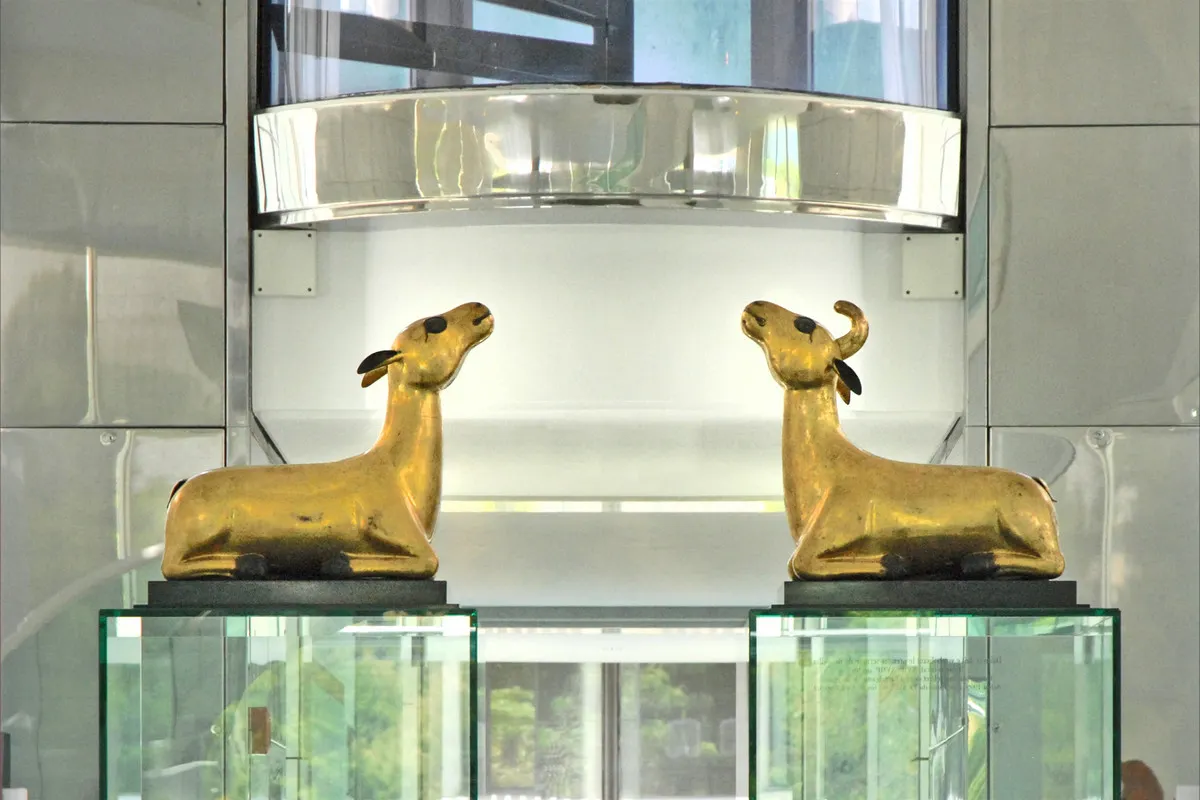
Insider tipLook for the pair of gilded Tibetan deer in the rotunda.
The collections were assembled from scratch. In the mid-1980s the artist Pierre-Yves Trémois offered his Asian art collection to the city, but the donation fell through, and the Département built its own, with support from France's museums directorate and loans from the Musée Guimet, the Musée de l'Homme, the Musée des Arts Décoratifs and the national contemporary art fund. The result mixes court art, religious objects, everyday things, popular and tribal works and some contemporary pieces.
03What to look for
From China come jades, bronzes, glazed terracottas and celadons; from India, traditional motifs worked in ivory and stone. Among the pieces worth seeking out are a Gandharan sculpture of the second century, one of the oldest representations of the Buddha in human form; a Cambodian sandstone deity of the early twelfth century in the style of Angkor Wat, probably Vishnu; and a wooden ossuary in the shape of a water buffalo, made by the Toraja of Sulawesi.
And at the heart of the building stands a pair of gilded deer that once flanked a Wheel of the Dharma above the gate of a Tibetan monastery – the image most visitors take home.
04Tea, gesture and performance
The museum is more than its galleries. Through the year it holds tea ceremonies, demonstrations of Asian gestures and live performances, and its temporary exhibitions turn to lesser-known traditions – the religious world of the Naxi of south-western China, for instance, or the Taiwanese custom of burning paper replicas of everyday objects for the dead. The programme changes, so check the museum's website before you go.
Pair a visit with the Parc Phoenix next door, or with a walk along the Promenade des Anglais, which runs east from here all the way to the old town.