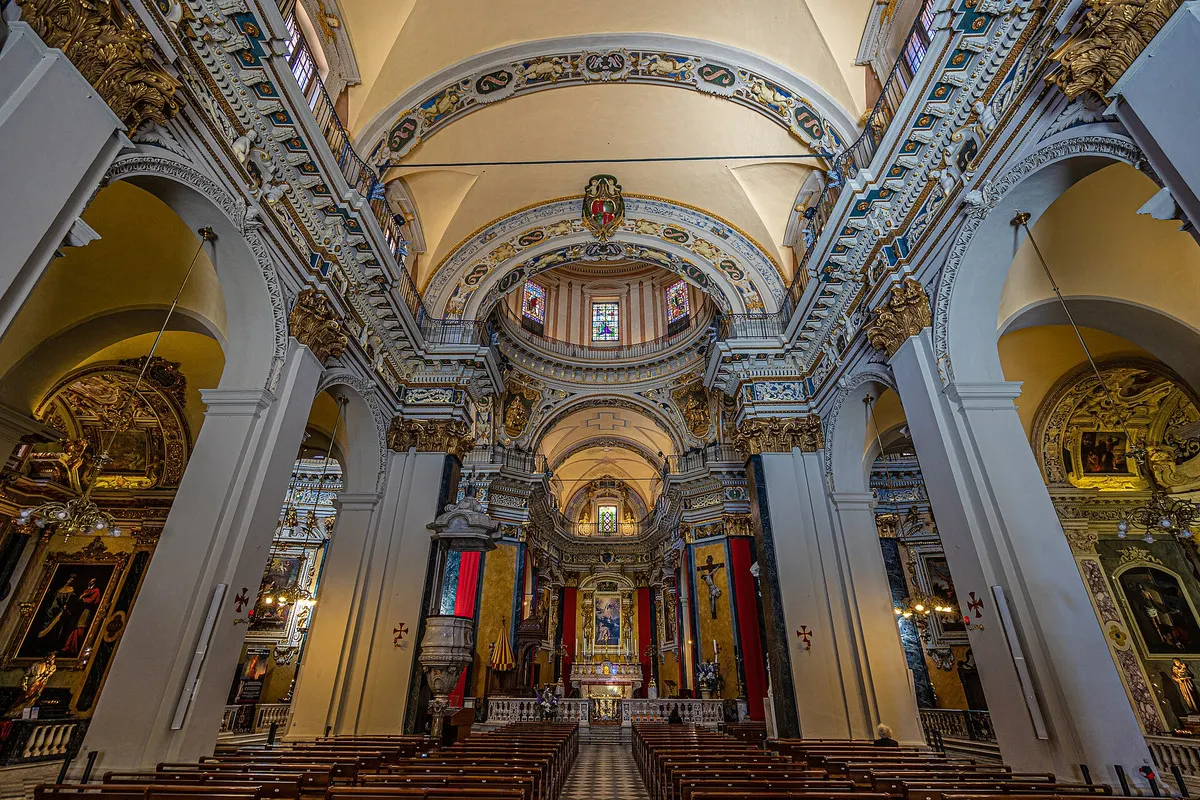
Behind the plain façades of Nice's old town lies a run of baroque interiors to rival Genoa and Turin. Here is how to see the best of them in a morning – the cathedral of Sainte-Réparate, the Jesuits' Gesù and the Miséricorde on the Cours Saleya.
In this story · 4 sections
Vieux Nice is best known for what happens outside: the market on the Cours Saleya, the socca stalls, the washing strung across lanes too narrow for the sun. Yet some of its finest rooms are behind church doors. For two centuries, while Nice belonged to the House of Savoy, its bishops, religious orders and confraternities built in the manner of Turin, Genoa and Rome, and the result is a cluster of baroque interiors within a few minutes' walk of one another.
They are working churches rather than museums, and entry is free. Go in the morning, when the doors are open and the light falls through the high windows, and keep your voice down.
3 places
© OpenStreetMap contributors · OpenFreeMap
- 01Cathédrale Sainte-RéparateCathedral · Vieux Nice
- 02Église du Gesù (Saint-Jacques-le-Majeur)Church · Vieux Nice
- 03Chapelle de la MiséricordeChapel · Cours Saleya, Vieux Nice
- Monday–Friday
- 9.00–12.00 and 14.00–18.00
- Saturday
- 9.00–12.00 and 14.00–19.30
- Sunday
- 9.00–13.00 and 15.00–18.00
Sainte-Réparate, the cathedral on Place Rossetti
The cathedral's story begins in 1078, when relics of Saint Reparata, a virgin martyr, were brought from Rome and an oratory was founded at the foot of the castle. As the town moved down from Castle Hill, so did its cathedral: in the sixteenth century the see was transferred from Sainte-Marie on the hill to the church of Sainte-Réparate, which was formally recognised as the cathedral in 1590.
The building you see was commissioned in 1649 by Bishop Didier Palletis from the Nice military engineer Jean-André Guiberto, and work began on 7 January 1650. It was not a smooth job. On 18 September 1658 the nave vault collapsed in front of the bishop, who was struck on the head and died a few hours later. Work resumed only in 1673 and was finished by the Ticino-born architect Marc-Antoine Grigho; the cathedral was consecrated on 30 May 1699.
Its plan is a Latin cross on the model of Santa Susanna in Rome, with a dome of glazed tiles in the Genoese fashion over the crossing. The bell tower followed between 1731 and 1757, and the baroque façade was added between 1825 and 1830. Inside are ten chapels, once owned and decorated by noble families and guilds, three organs, and the high altar with the Glory of Saint Reparata, whose remains have rested here since 1690. The cathedral was listed in 1906 and made a minor basilica in 1949; in May 2021 its great bell rang in full peal for the first time in a hundred years.
The Gesù on rue Droite
A short walk along rue Droite stands the church of Saint-Jacques-le-Majeur, still known by the name of the Jesuit mother church in Rome on which its nave is modelled: the Gesù. In 1603 Pons Ceva, a rich Nice merchant living in Rome, gave a large sum for a Jesuit college in his home town, and the fathers arrived in 1605. The present church was begun in 1642 and its shell finished in 1650; its likeness to the cathedral means it is attributed, almost certainly, to the same Guiberto.
According to Nice's tourist office, its architecture inspired most of the baroque churches on the Côte d'Azur. The Jesuits were expelled in 1773, the church became a parish in 1802, and it received its present façade only in 1825. Look for the bell tower, 42 metres of bare brick – rare in Nice – capped with polychrome tiles in the Ligurian manner, and inside, the barrel vault, 36 metres long, painted with the life of Saint James after designs by the Nice painter Hercule Trachel.
The Miséricorde on the Cours Saleya
The jewel stands on the Cours Saleya itself, among the flower stalls. The Chapelle de la Miséricorde was built between 1747 and 1770 for the Theatine order, on the site of the King of Sardinia's old salt warehouses, to designs by the Turin architect Bernardo Antonio Vittone. Squeezed into a tight plot, with the convent built above it, the church is an ellipse ringed by elliptical side chapels – all curves, gilding and stucco under a dome whose fresco seems to open onto the sky. It is widely considered the masterpiece of Nice baroque.
Today it is the chapel of the Black Penitents, the Archiconfrérie de la Miséricorde. Its sacristy keeps two early paintings of the Virgin of Mercy, one by Jean Miralhet and one attributed to Louis Bréa. The chapel has been a historic monument since 1921. Cracks caused by an underground car park nearby led to a rescue in 2002 and 2003, when it was braced on micropiles, and its façades were restored from 2009.
Two more on the way
If there is time, add two more. On Place Saint-Augustin, the church of Saint-Martin-Saint-Augustin occupies a former Augustinian convent and holds a Pietà attributed to Louis Bréa, painted around 1504; Garibaldi's baptismal certificate is displayed at the entrance. And the church of the Annonciation, one of the oldest in Nice, is better known as Sainte-Rita, after a chapel to the saint added in 1934 that quickly became one of the old town's most popular devotions.
At a glance
Three churches in brief
| Church | Built | Architect | Historic monument |
|---|---|---|---|
| Cathédrale Sainte-Réparate | 1650–1699 | Jean-André Guiberto, Marc-Antoine Grigho | 1906 |
| Gesù (Saint-Jacques-le-Majeur) | 1642–1650, façade 1825 | Attributed to Jean-André Guiberto | 1971 |
| Chapelle de la Miséricorde | 1747–1770 | Bernardo Antonio Vittone | 1921 |
Cathédrale Sainte-Réparate
Nice's cathedral, consecrated in 1699
Baroque cathedral begun in 1650 by Jean-André Guiberto on the model of Santa Susanna in Rome, with a glazed-tile dome, ten chapels and the relics of Saint Reparata.
3 place Rossetti, 06300 Nice
Insider tipStand under the dome and look up before walking to the high altar.
Église du Gesù (Saint-Jacques-le-Majeur)
The Jesuit church of 1642–1650
Former church of the Jesuit college, modelled on the Gesù in Rome, with a 42-metre bare-brick bell tower and a 36-metre painted barrel vault.
Place Saint-Jacques-le-Majeur, rue Droite, 06300 Nice
Insider tipStep back into the square to see the tiled cap of the bell tower.
Chapelle de la Miséricorde
Vittone's elliptical chapel of the Black Penitents
Built 1747–1770 to designs by Bernardo Antonio Vittone: an elliptical nave and chapels under a painted dome, now the chapel of the Archiconfrérie de la Miséricorde.
Cours Saleya, 06300 Nice
Insider tipCombine it with the morning flower market on the Cours Saleya.