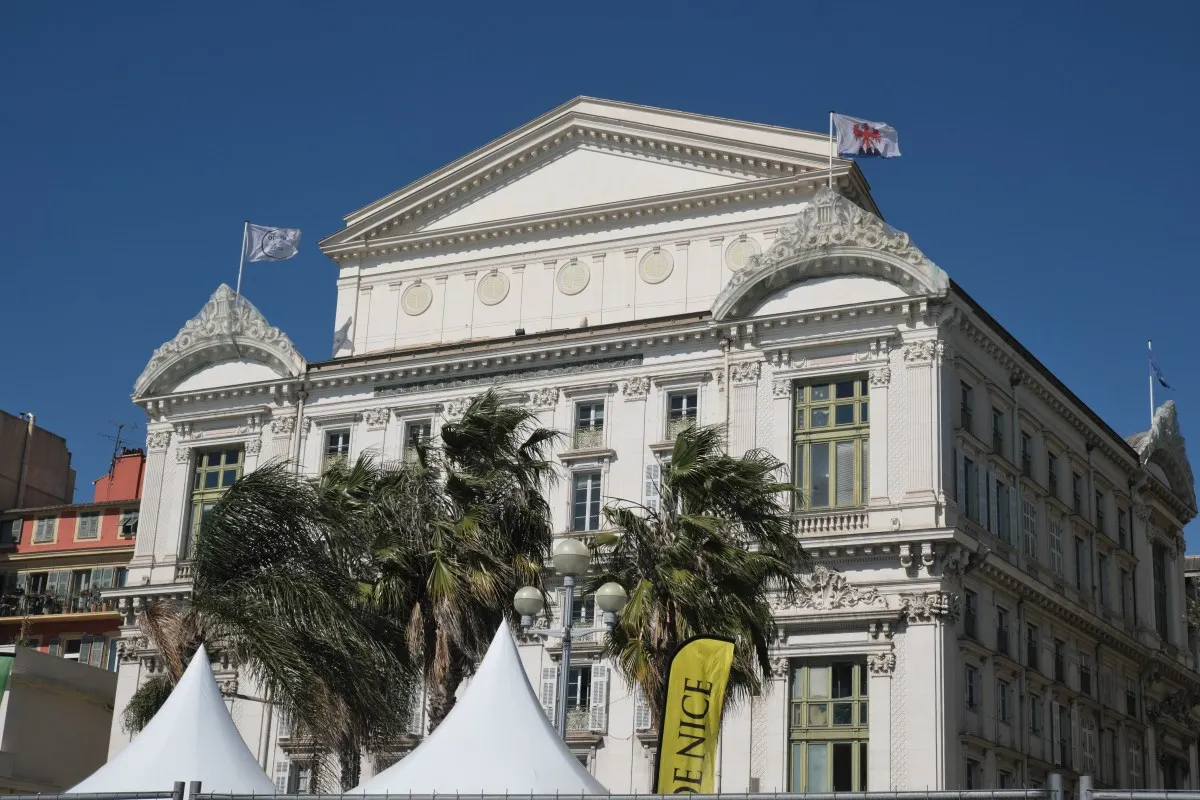
Rebuilt after a fire in 1881 and opened with Aida in 1885, Nice's opera house stands between the old town and the Quai des États-Unis. This season brings Bertrand Bonello's first opera production, a new Tristan und Isolde, and the French premiere of Unsuk Chin's Alice.
In this story · 4 sections
Nice's opera house has two faces. To the north, its entrance opens onto rue Saint-François-de-Paule, a few steps from the Cours Saleya. To the south, a grand white façade looks across the Quai des États-Unis to the sea, on a stretch of shore once taken up by the town ramparts. Few opera houses anywhere sit closer to the water.
Inside is a horseshoe auditorium of 1,083 seats, home to the Philharmonic Orchestra of Nice, the opera chorus and the ballet. The 2026–27 season is placed under an invitation to “escape from reality”, and its centrepiece is the first opera ever staged by one of France's leading film directors.
Opéra de Nice
Opera house · Vieux Nice
© OpenStreetMap contributors · OpenFreeMap
- Address
- 4–6 rue Saint-François-de-Paule, 06300 Nice
- Opened
- 7 February 1885, with Verdi's Aida
- Architect
- François Aune, plans approved by Charles Garnier
- Auditorium
- Horseshoe, 19 × 23 m, ceiling fresco by Emmanuel Costa
- Seats
- 1,083
- Protected
- Historic monument since 31 March 1992
- General director
- Bertrand Rossi
Opera house opened in 1885 with Aida, designed by François Aune with plans approved by Charles Garnier: a 1,083-seat horseshoe auditorium under Emmanuel Costa's ceiling fresco, home to the Philharmonic Orchestra of Nice, the chorus and the ballet.
01A theatre on the same spot since 1776
The story begins in 1776, when the Marquise Alli-Maccarani turned her family house here into a small wooden theatre. In 1826, on the advice of King Charles Felix of Sardinia, the city bought it, pulled it down and built an Italian-style house in its place, designed by the city architect Brunati and the Turin architect Perotti, with four tiers of boxes. It became the imperial theatre under the Second Empire and the municipal theatre in 1870.
On 23 March 1881, during the overture to Lucia di Lammermoor, a fire – most likely caused by a gas leak at the footlights – destroyed the theatre and killed 63 people. The city decided to rebuild at once.
02The 1885 house
On 7 November 1882 the council chose the Nice-born architect François Aune, and his plans were approved by Charles Garnier, architect of the Paris Opera. Outside, the building is stone, brick and lime around a metal frame. Inside, the horseshoe auditorium, nineteen metres wide and twenty-three long, takes up three quarters of the building's volume; the boxes are trimmed in gold on cream and lined in red, and Emmanuel Costa's mythological ceiling fresco is lit by a monumental crystal chandelier.
Insider tipWalk round to the Quai des États-Unis after the performance to see the sea façade floodlit.
It opened on 7 February 1885 with Verdi's Aida and took the name Opéra de Nice in 1902. In 1960 the main entrance moved to rue Saint-François-de-Paule, where it remains. The house has been a listed historic monument since 31 March 1992, and its general director is Bertrand Rossi.
03A house of firsts
Nice has a long habit of hearing things before Paris. The company gave the French premieres of La forza del destino in 1873, Lohengrin in 1881, Eugene Onegin in 1895 and Das Rheingold in 1902, staged La Prise de Troie, the first half of Berlioz's Les Troyens, in 1891, and in 1903 gave the first staging of Massenet's Marie-Magdeleine.
The great voices came too: Régine Crespin in many productions from 1953, Montserrat Caballé, whose name the foyer now bears, Luciano Pavarotti in La Bohème in 1976 and Plácido Domingo in Samson et Dalila in 1985. Sets and costumes are made in the opera's own workshops, the Diacosmie, which also houses rehearsal rooms for the orchestra and the ballet.
04The 2026–27 season
The season opened with Handel's Orlando, conducted by Jean-Christophe Spinosi and staged by Mariame Clément. The headline event follows in winter: Tristan und Isolde, Wagner's first return to Nice in more than fifteen years, in a new production by the film director Bertrand Bonello, his first opera staging. Marko Letonja conducts, with Samuel Sakker as Tristan, Annette Dasch as Isolde and Albert Dohmen as King Marke, and the run coincides with the international congress of Richard Wagner societies, which Nice hosts in 2027.
In March comes Unsuk Chin's Alice in Wonderland, in its French premiere and the world premiere of its French version, staged by Antoine Gindt with Raquel Camarinha as Alice. Puccini's Manon Lescaut, conducted by Ariane Matiakh and staged by Oliver Mears, and Leoncavallo's Pagliacci, staged by Jean-Philippe Clarac and Olivier Deloeuil, close the opera season. In December the ballet, led by Pontus Lidberg, dances his Sleeping Beauty, and the Philharmonic gives seven symphonic concerts, four of them under its honorary conductor Lionel Bringuier, ending with Beethoven's Ninth in June.
At a glance
The 2026–27 season at a glance
| Dates | Production | Prices |
|---|---|---|
| 11–13 November 2026 | Lehár, La Veuve joyeuse (The Merry Widow) | €6–57 |
| 16–31 December 2026 | Tchaikovsky, The Sleeping Beauty (ballet, Pontus Lidberg) | €11–47 |
| 27 January–3 February 2027 | Wagner, Tristan und Isolde (new production, Bertrand Bonello) | €12–94 |
| 9–14 March 2027 | Unsuk Chin, Alice in Wonderland (French premiere) | €12–94 |
| 30 April–6 May 2027 | Puccini, Manon Lescaut | €12–94 |
| 25–30 May 2027 | Leoncavallo, Pagliacci | €12–94 |