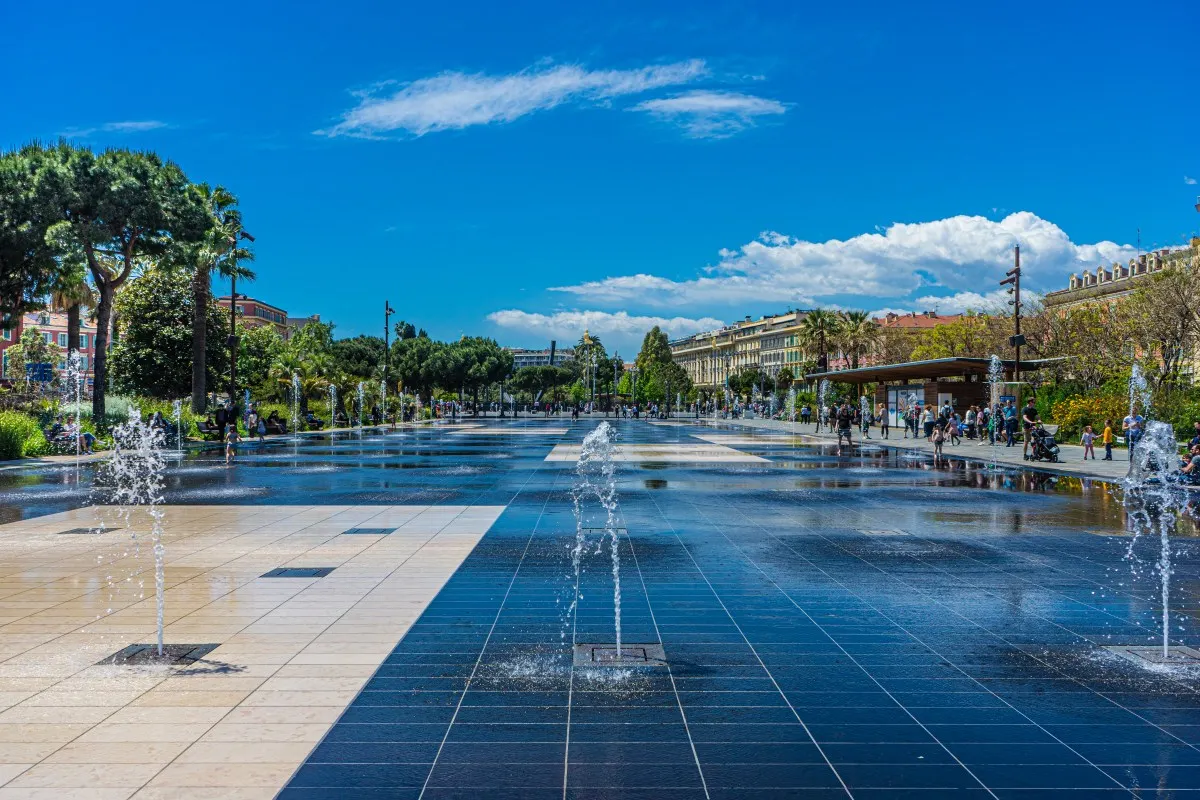
Where a river once ran, and later a bus station and a congress hall stood, Nice now has a ribbon of park from the Promenade des Anglais into the heart of the city – its second promenade, completed with an urban forest in October 2025.
In this story · 4 sections
Nice has always had one famous promenade. Since 2013 it has had two. The Promenade du Paillon runs inland from the sea, between the old town and the nineteenth-century city, along the line of a river that disappeared underground long ago. It is where the people of Nice cross town, meet after work and let their children loose in the fountains on summer evenings.
In October 2025 it doubled in ambition. A new section, planted as an urban forest on the site of a demolished theatre and congress centre, brought the park to around 20 hectares and gave the city a green spine from the Baie des Anges almost to the foot of the hills.
Promenade du Paillon
Park · Between Vieux Nice and Place Masséna, Nice
© OpenStreetMap contributors · OpenFreeMap
- Address
- Promenade du Paillon, 06000 Nice
- First section
- Opened 26 October 2013 · 12 ha · Michel Péna
- Extension
- Opened 18 October 2025 · 8 ha · Alexandre Chemetoff
- Total area
- About 20 hectares
- Water mirror
- 3,000 m² with 128 jets, beside a 1,400 m² mist plateau
- Planting (2013)
- 1,600 trees, 6,000 shrubs, 50,000 perennials
- Cost
- €40 million (2013) · €45 million for the 2025 park
- Opening hours
- 7.00–21.00 October–March · 7.00–23.00 April–September
About 20 hectares of park over the covered Paillon: Michel Péna's 2013 promenade with its 3,000 m² water mirror, and Alexandre Chemetoff's urban forest, opened in October 2025.
01A river under the city
The Paillon is a mountain torrent that once separated old Nice from the new town. Work to cover it began in 1868, and the ground won above it filled up, decade by decade, with the municipal casino and squares, an esplanade in 1931, an exhibition hall in 1954, a bus station and car park in 1973, the Acropolis congress centre in the 1980s, a rebuilt national theatre in 1989 and the MAMAC modern art museum in 1990. By the end of the century the river was a strip of concrete.
02The first promenade
Work began in 2010 with the demolition of the bus station and its hanging gardens. The landscape architect Michel Péna designed a coulée verte, a green corridor, 1.2 kilometres long, running from the Promenade des Anglais past the Jardin Albert-Ier and the Théâtre de Verdure. It cost 40 million euros and was inaugurated on 26 October 2013.
Insider tipStart at the sea end and walk inland at dusk, when the water mirror reflects the old town.
Its 12 hectares hold 1,600 trees, 6,000 shrubs and 50,000 perennials. The centrepiece is the miroir d'eau, a 3,000-square-metre water mirror with 128 jets, beside a 1,400-square-metre plateau of mist; together they reflect the old town's bell towers and, on a hot day, half the children of Nice. Property prices around the park were reported to have risen by 20 per cent soon after it opened.
03The 2025 urban forest
In January 2020 the city announced an extension that meant demolishing the Théâtre National de Nice, with its grey marble façades by Yves Bayard, and the Palais des Congrès Acropolis. The landscape architect Alexandre Chemetoff designed the new section, about a kilometre long and eight hectares in area, as an urban forest: shaded undergrowth, lawns, play and sports trails, artworks and water gardens, with species chosen to need little water and give shade.
Beneath it, rainwater storage holds the equivalent of an Olympic swimming pool. The park itself cost 45 million euros according to the city, with a further 43 million for roads, an underground car park and the library. It was inaugurated on 18 October 2025. The trees are still young; this is a park to watch grow.
04Art along the way
Walking north from the sea you pass a bronze copy of Michelangelo's David, cast in Pietrasanta, the monument to Marshal Masséna by Albert-Ernest Carrier-Belleuse and Nikaïa, an original bronze by Cyril de La Patellière unveiled in 2019. Further on stands the Tête Carrée, the sculpture-building that houses the Bibliothèque Louis Nucéra and was kept in the new design.
The MAMAC, the museum of modern and contemporary art that bridges the Paillon with its white Carrara marble towers, closed in January 2024 for a major renovation; its reopening has been announced for 2029. Its collection of Nouveaux Réalistes, from Yves Klein to Niki de Saint Phalle, will be worth the wait.