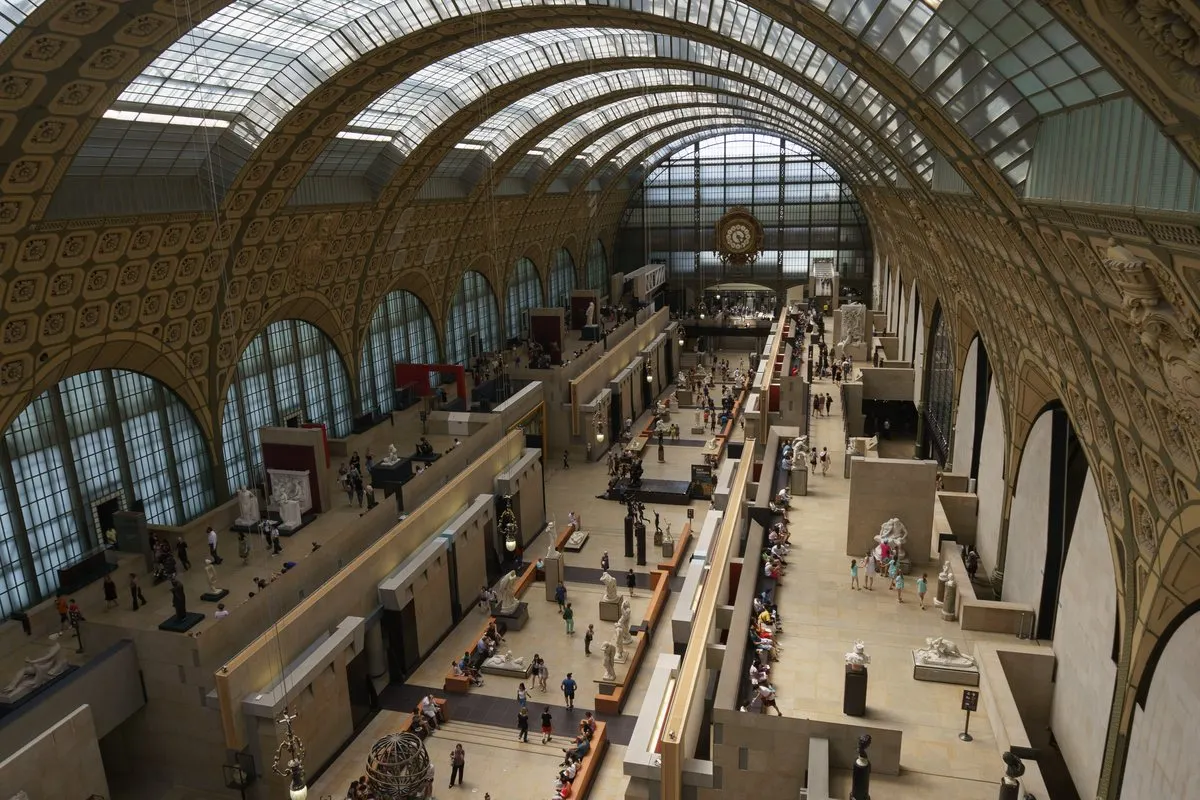
A Beaux-Arts railway station on the Left Bank now holds the world's largest collection of Impressionist and Post-Impressionist painting. Here is how to visit the Musée d'Orsay without rushing, and what to look for once inside.
In this story · 5 sections
Few museums announce themselves as clearly as the Musée d'Orsay in Paris. You walk in at one end of a former railway station, beneath a barrel vault of iron and glass, and the whole of nineteenth-century French art seems to lie ahead of you on a single, long platform. It is a building that rewards a little planning, because the paintings most people come for are not where you first look.
Musée d'Orsay
Museum · 7th arrondissement
© OpenStreetMap contributors · OpenFreeMap
- Address
- Esplanade Valéry Giscard d'Estaing, 75007 Paris
- Building
- Former Gare d'Orsay, 1898–1900, by Victor Laloux
- Opened as a museum
- 1986
- Collection
- French art 1848–1914
- Known for
- Monet, Renoir, Degas, Manet, Van Gogh, Cézanne
- Area
- 7th arrondissement, Left Bank
The world's largest collection of Impressionist and Post-Impressionist masterpieces, in a Beaux-Arts railway station on the Seine.
01From Gare d'Orsay to museum
The station was built between 1898 and 1900 for the Paris–Orléans railway, finished in time for the Exposition Universelle of 1900. Its architect, Victor Laloux, dressed the steel frame in limestone so that it would sit politely opposite the Louvre and the Tuileries on the other bank of the Seine. Within a few decades its platforms were too short for modern trains, and for years the building drifted between uses before the decision was taken to turn it into a museum for the art of the second half of the nineteenth century.
It opened in 1986, gathering works that had previously hung at the Jeu de Paume, the Louvre and elsewhere. The result is a museum with a precise remit, French art from 1848 to 1914, which neatly fills the gap between the Louvre and the modern collections of the Centre Pompidou. Painting, sculpture, decorative arts, architecture drawings and early photography all sit within that span.
02Start at the top: the Impressionist gallery
The instinct on arrival is to wander down the central nave. Resist it. The Impressionist and Post-Impressionist rooms are on the upper level at the far end of the building, and they fill up as the morning goes on. Head straight up and work your way back down.
Insider tipClosed on Mondays. Late opening on Thursday evenings.
This is where the museum earns its reputation: Monet's studies of Rouen Cathedral in shifting light, Renoir's Bal du moulin de la Galette, Degas's dancers, Sisley's and Pissarro's riverbanks, and the paintings of Berthe Morisot, one of the movement's founding members. Natural light falls from above, and the great clock faces of the old station frame views across the river towards Montmartre and the Louvre. Pause at one of them; it is the best free view on this stretch of the Seine.
Nearby rooms are given to the Post-Impressionists. Van Gogh's self-portrait of 1889, with its swirling blue background, and Starry Night over the Rhône draw the largest crowds. Gauguin's Tahitian canvases, Cézanne's still lifes and Seurat's pointillist experiments are close by, and they are often easier to see properly.
03The ground floor: Manet, Courbet and the Salon
Back at platform level, the side galleries tell the story of how the Impressionists came to be. Here are the vast academic canvases the official Salon favoured, and the works that broke with them: Courbet's A Burial at Ornans, enormous and deliberately unheroic, and Manet's Olympia, which scandalised Paris in 1865. Manet's Le Déjeuner sur l'herbe, rejected by the Salon in 1863, hangs in the museum too. Seeing these rooms after the light-filled Impressionist gallery makes it clear how radical the later painters were.
The nave itself is lined with sculpture, from Carpeaux's lively groups to the smoother marbles of the Second Empire, and it is the place to sit for a moment and take in the scale of the station roof.
04Decorative arts, and a lunch with gilded ceilings
Between the Impressionists and the ground floor, the middle level is quieter. It holds Art Nouveau furniture and objects, including work by Hector Guimard, the designer of the Paris Métro entrances, and Émile Gallé's glass from Nancy. It is a good place to recover from the crowds upstairs.
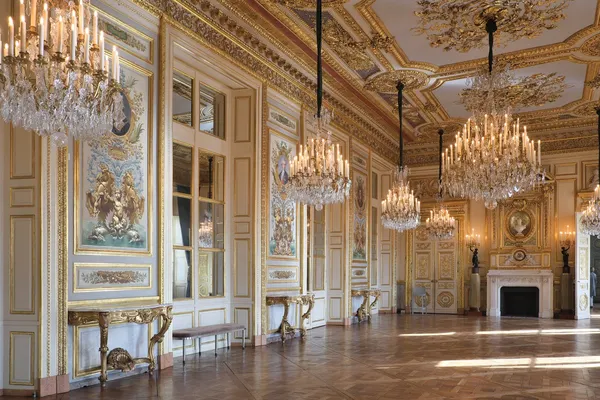
The museum restaurant occupies the dining room of the former station hotel, with painted ceilings and chandeliers from 1900; it is one of the more theatrical lunch rooms in the city. For something quicker, the café behind one of the great clocks on the upper floor has the view, though not always a free table.
05How to plan a visit to the Musée d'Orsay
Book a timed ticket online and arrive for opening, or come on the late evening, when the galleries feel calmer. Two to three hours is enough to see the highlights without fatigue; a full day is possible but rarely a pleasure. If you are also visiting the Musée de l'Orangerie across the river, a combined ticket is usually available.
Afterwards, walk east along the river and turn into rue du Bac for the antiques dealers and old shopfronts of the Carré Rive Gauche, or continue along rue de Lille, a quiet street of hôtels particuliers immediately behind the museum. Our street guide to the 7th arrondissement has more, and you will find other cities in the Metro Mode destinations.