In twenty years Oslo has turned its face to the fjord. Where there were once a container port, a motorway and shipyards, there now stand an opera house you can walk up onto, a museum for Edvard Munch and Renzo Piano's art museum on an islet where thieves were once executed. A walk along Oslo's new waterfront.
In this story · 6 sections
Oslo lies at the head of the Oslofjord, but for much of the 20th century the city was cut off from the water by docks, shipyards and the E18 motorway. The Fjordbyen urban renewal project has changed that. It began with Aker Brygge in the 1980s and continued with Bjørvika and Tjuvholmen in the 2000s, and when the E18 was moved into the Bjørvika tunnel the biggest barrier between city and fjord disappeared. The walk below runs from east to west along the water.
01The Opera House – a roof to walk on
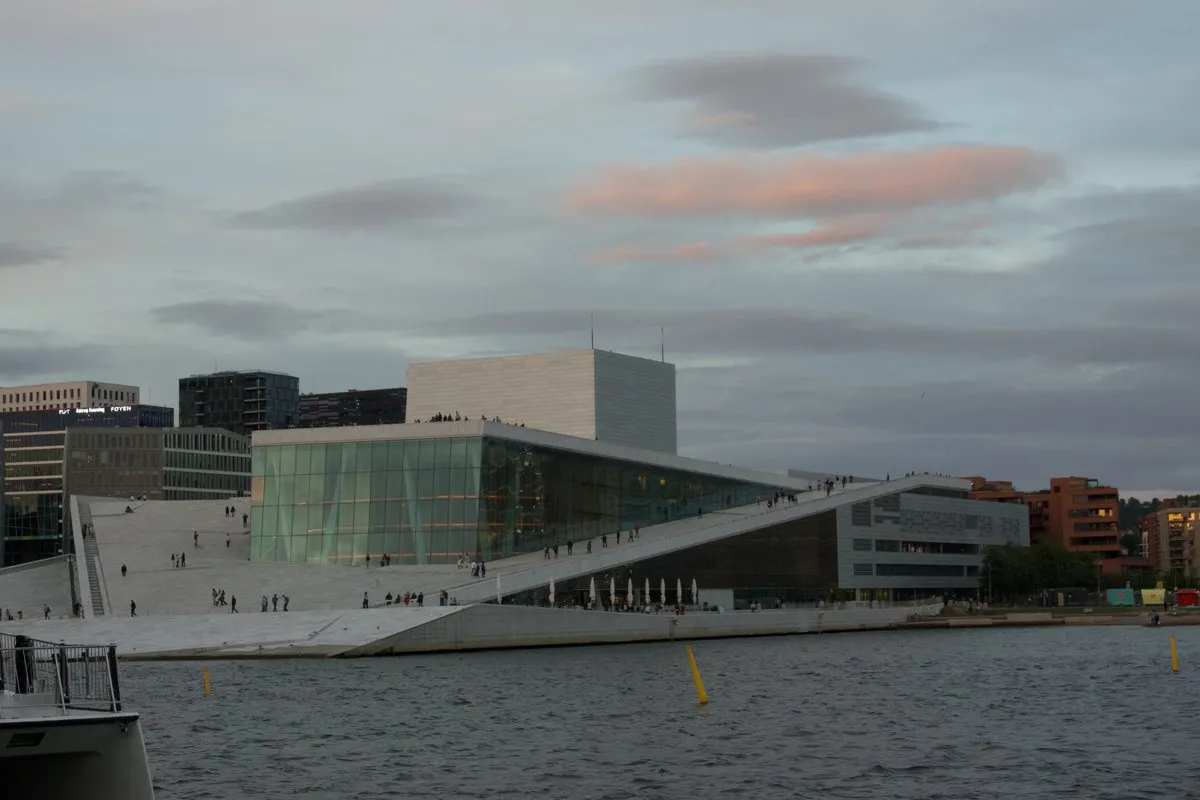
Start at the Opera House in Bjørvika, home of Den Norske Opera & Ballett. The Storting, Norway's parliament, decided in 1999 to build a new opera house, and from 350 competition entries the Norwegian practice Snøhetta won. Construction ran from 2003 to 2007 and finished ahead of schedule and NOK 300 million under its NOK 4.4 billion budget. The building opened on 12 April 2008 and is the largest cultural building put up in Norway since Nidaros Cathedral was completed around 1300.
The sloping roof, clad in white granite and Carrara marble, runs right down to the ground and becomes a public square where anyone can walk up and look out over the city and the fjord. Inside, oak contrasts with the white, and the horseshoe-shaped auditorium, with 1,364 seats, is lit by an oval chandelier with 5,800 handmade crystals. In the fjord alongside floats Monica Bonvicini's sculpture She Lies, in stainless steel and glass. The building won the EU Prize for Contemporary Architecture in 2009.
02MUNCH – a whole life's work by the water
A few hundred metres away stands MUNCH, the museum devoted to Edvard Munch. It first opened at Tøyen in 1963, a hundred years after the artist's birth, and moved to the new building in Bjørvika in 2021. Munch's bequest to the City of Oslo is one of the world's largest collections of a single artist's work: almost 28,000 artworks and more than 42,000 museum objects. The museum always shows five collection exhibitions, plus six or seven temporary exhibitions a year featuring other artists. In 2025 it had 775,000 visitors.
Behind the museum and the opera house, Bjørvika has become a new district, with the Barcode row of high-rises and the city's main library, Deichman – Norway's first and largest public library, founded as early as 1785.
03Past Akershus to Rådhusplassen
Walk west along the quay, round Akershus Fortress, which is a national monument and therefore exempt from the redevelopment. At Rådhusplassen, the City Hall square, which became car-free in 1994 when the Festningstunnelen opened, the bay of Pipervika opens up with the City Hall as its backdrop.
04The National Museum – The Scream and 400,000 works
A block back from the water, where the old Vestbanen railway station stood, the National Museum, Nasjonalmuseet, opened in June 2022. The museum was formed in 2003 by merging the National Gallery, the Museum of Contemporary Art, the Museum of Architecture and the Museum of Decorative Arts and Design, and the new building by the German firm Kleihues + Schuwerk houses the entire collection of more than 400,000 works of art, architecture and design – among them the first version of Munch's The Scream, from 1893. Critics have attacked the building, some saying it looks like a prison; about the collection there is no doubt.
05Aker Brygge – the shipyard that became a district
West of Rådhusplassen lies Aker Brygge, on the site of the former Akers Mekaniske Verksted shipyard, founded in 1854 and closed in 1982. The first phase of the redevelopment was completed in 1986, with several of the large workshop halls turned into shops and restaurants. A new master plan was carried out in 2010–2014. Around 6,000 people work here and 900 live here, and the area has around twelve million visits a year. Ferries to Nesodden leave from the quay.
06Tjuvholmen – art at the far end
The walk ends at Tjuvholmen, a peninsula jutting out from Aker Brygge. The name means Thieves' Islet – thieves were executed here in the 1700s. Since 2005 the area has been redeveloped with around 1,200 flats. At the far end is the Astrup Fearnley Museum, housed since 2012 in buildings by Renzo Piano and focused on international contemporary art, from Jeff Koons and Cindy Sherman to Olafur Eliasson. The museum caused a stir in 2002 when it bought Koons's sculpture of Michael Jackson and the chimpanzee Bubbles for $5.1 million. Next to it is a sculpture park, also by Piano, and a bathing spot facing the inner fjord.
More Nordic destinations can be found among Metro Mode's destinations. Further north, drive Lofoten along the E10, and read our perfect day in Helsinki and the story of Copenhagen's New Nordic cuisine.