Built in six months, opened by King Oscar II and restored to its original colours in 2020, Östermalms Saluhall is where Stockholm's chefs and food lovers have queued at the same counters for more than a century.
In this story · 5 sections
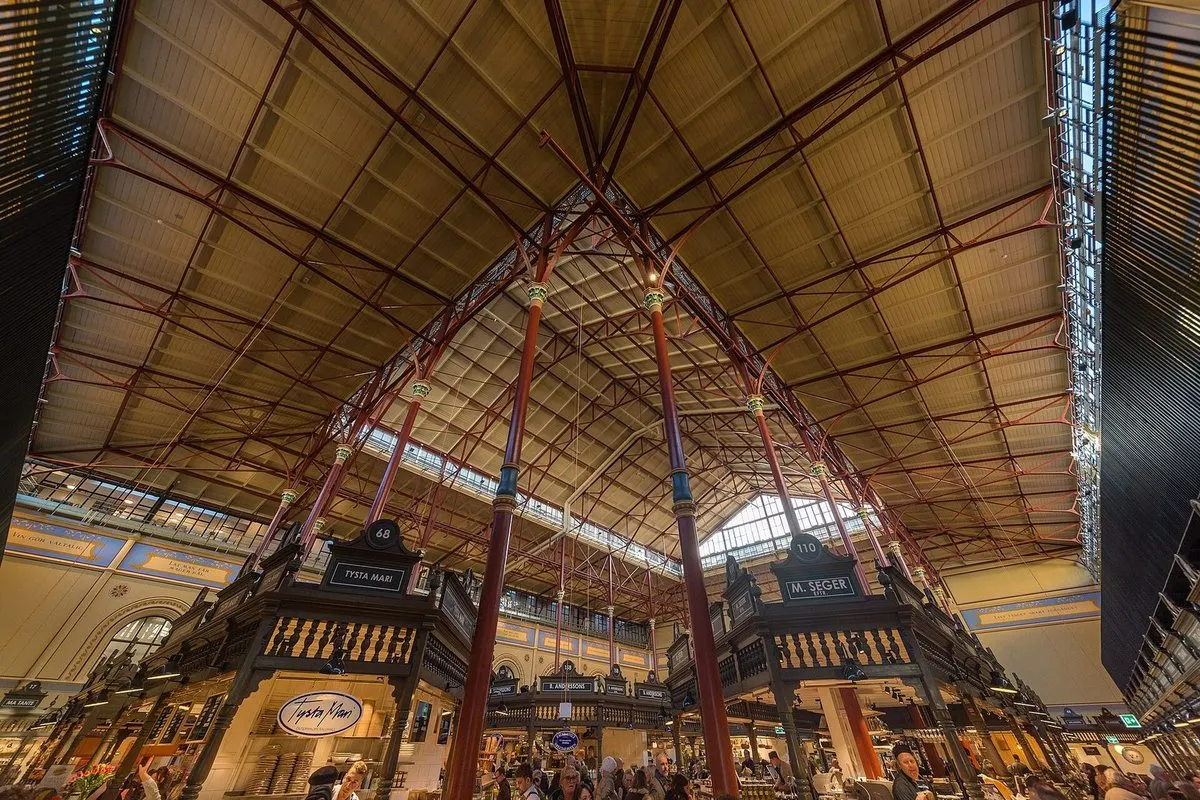
On the corner of Nybrogatan and Humlegårdsgatan, facing Östermalmstorg, a red-brick building with a slate-roofed corner tower stands like a small cathedral in the middle of Stockholm's most elegant district. At the top of the tower, a lantern carries a winged Mercury's hat, the symbol of trade. This is Östermalms Saluhall – Östermalmshallen, or simply Hallen, to Stockholmers – the city's great food hall, where fishmongers, cheesemongers, game dealers, chocolatiers and restaurants share an interior of iron, glass and timber that has fed the neighbourhood since 1888.
Östermalms Saluhall
Food hall · Östermalm
© OpenStreetMap contributors · OpenFreeMap
- Address
- Östermalmstorg, Stockholm
- Address
- Östermalmstorg, Stockholm
- Opened
- 1 December 1888
- Architects
- Isak Gustaf Clason and Kasper Salin
- Size
- Around 3,000 square metres
- Renovation
- 2016–2020, reopened 5 March 2020
- Opening hours
- Mon–Fri 9.30–19, Sat 9.30–17, Sun closed
Clason and Salin's brick hall with fish, game, cheese, chocolate and restaurants.
01Six months to build a temple of food
The hall was built at remarkable speed. The company Östermalms Saluhallar AB was formed in March 1888 to build and let market halls in Östermalm, and between 300 and 500 men worked on the record-breaking construction. The hall, of around 3,000 square metres, was inaugurated in the presence of King Oscar II on 30 November 1888, just six months after building began, and opened its doors to the public the next day. From the start, according to Wikipedia, head chefs, court caterers and ordinary shoppers queued on equal terms at the counters of their favourite traders. The hall is entered through five doorways, and several shops also open directly onto the street.
02Clason and Salin's brick cathedral
The architects were Isak Gustaf Clason and Kasper Salin, who were also responsible for the complex cast-iron structure inside. They had found inspiration on a study tour of 1883–1886, looking at new brick architecture in northern Germany, Italy and France, where monumental cast-iron structures of this advanced kind had been built. The frame was a novelty in Sweden, and the façades were built of brick from Börringe. From the very beginning the hall had electric light, with both arc lamps and incandescent bulbs. It is not formally a listed building, but it is protected in practice to the same degree.
Insider tipClosed on Sundays.
03A long renovation
From 2016 to 2020 the hall was closed for a thorough renovation, while trading continued in a temporary hall in the middle of Östermalmstorg designed by Tengbom. The work took longer and cost far more than planned: the reopening, first set for April 2018, finally came on 5 March 2020. The hall was restored to its original form and colours, connected to the neighbouring building to the south and given two glazed courtyards, restaurants and an entrance from Nybrogatan. In 2021 Stockholmers voted it Stockholm Building of the Year.
04The traders
The traders are the reason to come. The most famous is Lisa Elmqvist. According to the hall, the fisherman's daughter Lisa Elmqvist began on an open-air market by the water in central Stockholm in the early 1920s and moved into the hall in 1926; she retired in 1968, and today the fourth generation of the family runs the business on the same spot. Its fish counter is close to seven metres long, and the firm says it stocks around 450 lines, from live shellfish from the west coast to cold-smoked salmon and sturgeon caviar. In 1986 its oyster bar was rebuilt as a fish restaurant.
Elsewhere you will find B. Andersson for game and poultry, from roe deer and elk to quail; Arla Unika, the dairy's premium cheese shop and restaurant, opened with the hall in 2020; and Betsy Sandberg, whose handmade pralines, truffles and nougats use chocolate from Belgium and France. Among the restaurants are Beirut Café, Bistrot du Passage for classic French bistro dishes, the Spanish Casa Maca, the Italian Gabagool and Hedvig, upstairs in the hall.
05How to visit
Come in the morning on a weekday to see the hall at its busiest with locals, or at lunch to eat at one of the counters. Buy something to take home – smoked fish, cheese or chocolate – and walk on through Östermalm. The hall is open Monday to Friday from 9.30am to 7pm and Saturday from 9.30am to 5pm, and closed on Sundays; the restaurants are open in the evenings. Holiday hours differ, so check before Christmas and New Year.
Pair the visit with our plan for a day on Östermalm and Nybrogatan, our street of the week, read about the streets in VERA PI's guide to Nybrogatan and Humlegårdsgatan, and point your phone at the brick façade with Metro Mode Camera.