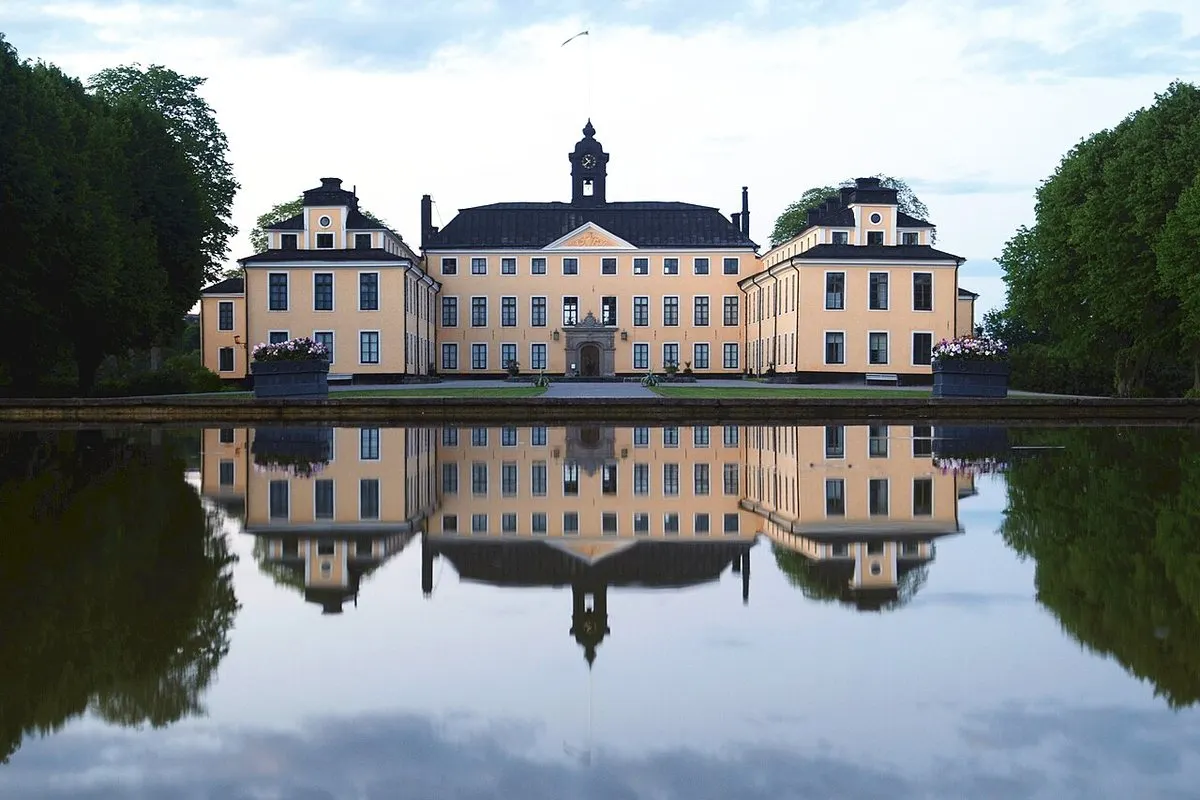
A seventeenth-century palace on a quiet inlet, Sweden's oldest surviving theatre, a sculpture museum in an orangery and an inn of carved timber. Ulriksdal, just north of the city, is the royal park most visitors never find.
In this story · 6 sections
On the shore of Edsviken, an inlet in Solna just north of Stockholm, a pale palace with a central clock tower and two corner pavilions is mirrored in a long still pond. Ulriksdal Palace lies within the Royal National City Park, and around it stretch gardens, woods and a small village of royal buildings: a chapel, a theatre, an orangery and a celebrated inn. It is less famous than Drottningholm, which is exactly its charm.
Ulriksdal Palace
Palace · Solna
© OpenStreetMap contributors · OpenFreeMap
- Address
- Ulriksdals slott, Solna
- Location
- Edsviken, Solna, within the Royal National City Park
- Built
- Around 1638–1645, Hans Jacob Kristler
- Later architects
- Nicodemus Tessin the Elder, Carl Hårleman
- Confidencen
- Opened 1753, Sweden's oldest surviving theatre
- Orangery Museum
- Swedish sculpture, since 1988
- Palace tours
- June–August
A seventeenth-century palace with Confidencen theatre, the Orangery sculpture museum and a historic inn.
01From Jacobsdal to Ulriksdal
The palace was built around 1638–1645 for Jakob De la Gardie, whose architect and master builder, Hans Jacob Kristler from Strasbourg, was at the same time building the palace of Makalös in Stockholm. It was first called Jacobsdal, and it quickly became a favourite with aristocrats and royalty. Queen Christina visited often and liked it so much that her coronation procession in 1650 set out from here.
In 1669 the palace was sold to the queen dowager Hedvig Eleonora, who in 1684 gave it as a christening gift to her grandson Prince Ulrik, son of Charles XI – hence the name Ulriksdal. When he died the following year it returned to her, and on her death in 1715 it passed to the state. Under Lovisa Ulrika and Gustav III it was the scene of brilliant parties, and Queen Sofia Magdalena died here in 1813.
The present exterior was shaped by Nicodemus Tessin the Elder in the late seventeenth century and completed by Carl Hårleman in the mid-eighteenth, when the palace received one of the very first mansard roofs in Sweden.
02Veterans, a painter king and a crown prince
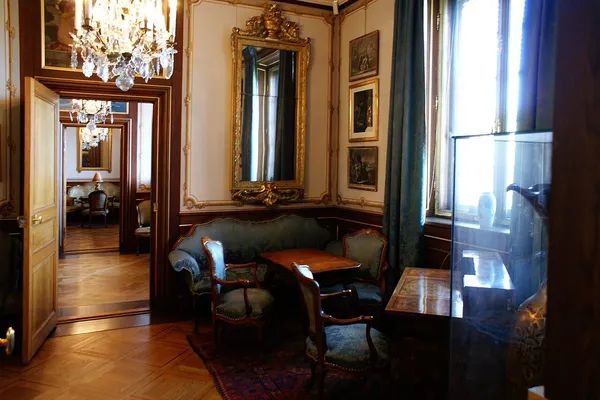
Between 1822 and 1849 Charles XIV John turned the palace into a home for disabled war veterans; at most 82 lived here at once, and some 200 who died are buried in the small Veterans' Cemetery in the south-east of the grounds. Charles XV then transformed Ulriksdal into a museum of antique furniture, porcelain and art, much of it later bequeathed to the state and now part of Nationalmuseum's collections. With his friend the architect Fredrik Wilhelm Scholander he created the Knights' Hall in a romantic historicist style, with a suit of armour above the great fireplace.
Insider tipPalace tours June–August.
In the twentieth century Ulriksdal became the home of Crown Prince Gustaf Adolf – later Gustaf VI Adolf – and Louise Mountbatten, who used it from 1923 and lived here every spring for the rest of their lives. Carl Malmsten turned the Knights' Hall into their living room, furnished largely with a wedding gift from 8,000 Stockholmers, intended as a showcase of the city's applied arts. Their monogram, GAL, adorns the gate to the palace park. During the Winter War, Crown Princess Louise set up a home here for Finnish war children.
03Confidencen
Ulriksdal's greatest treasure may be its theatre. Confidencen, fitted out on Queen Lovisa Ulrika's initiative in the old riding house and opened in 1753, is Sweden's oldest surviving theatre. Gustav III and Carl Michael Bellman both used it, and in the 1980s it was rediscovered by the opera singer Kjerstin Dellert. During a major restoration in 1994–1997 the mirrored Confidence dining room, with the "magic table" that gave the building its name, was recreated on the basis of archaeological evidence, archive records and comparisons with the mechanism at the Chinese Pavilion at Drottningholm. In summer there are performances of opera and ballet as well as concerts, and guided tours of the interiors.
04Orangery, chapel and coronation coach
The Orangery, designed by Nicodemus Tessin the Younger in the early eighteenth century and built, unusually for the time, in stone, has since 1988 housed Nationalmuseum's collection of Swedish sculpture from the early eighteenth to the twentieth century, with works by Johan Tobias Sergel, Bengt Erland Fogelberg, Johan Niklas Byström and Christian Eriksson. The palace chapel, consecrated in 1865 to Scholander's design, is one of Sweden's most sought-after wedding churches. In the stables, the museum of Queen Christina's coronation equipage shows the reconstructed coronation coach of 1650 with its original textiles; it opens for a few weeks each summer and for booked groups.
05Ulriksdals Wärdshus
Opposite Confidencen stands Ulriksdals Wärdshus, a timber building rich in carved decoration, built after its proprietor petitioned the court and King Charles XV in 1867 to replace an older inn from the 1740s. It is now run by Svenska Brasserier, the group behind Sturehof and Riche in the city.
06Visiting Ulriksdal
The palace has been open to the public since 1986, with guided tours from June to August, when Nationalmuseum shows parts of Charles XV's collection alongside the rooms furnished for Gustaf VI Adolf and Queen Louise. The Swedish office of WWF occupies the south wing. Combine the visit with a walk along Edsviken, and check tour and theatre schedules in advance.
Find Ulriksdal on Metro Mode's Stockholm map, explore the area in VERA PI's guide to Solna, read our guide to your first time in Stockholm, and point your phone at the palace façade with Metro Mode Camera.