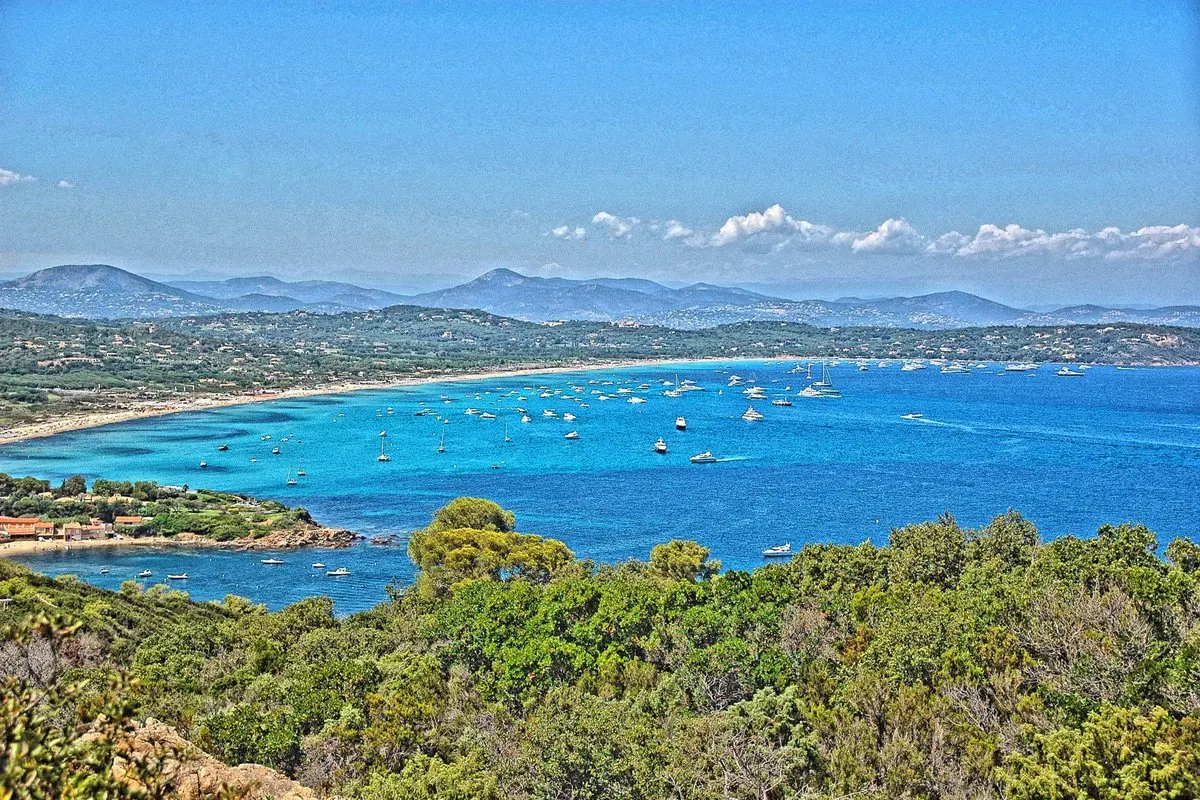
Four and a half kilometres of sand, a fisherman's cottage that became the world's most famous beach restaurant, and a village that once defended itself with beehives. The story of Ramatuelle and Pampelonne is bigger than its reputation.
In this story · 4 sections
From the village of Ramatuelle, perched on a hill amid vineyards and pine forest, you can see the whole of Pampelonne Bay lying below like a bright arc between two headlands. It is one of the Mediterranean's most famous beaches, and it is almost always called by the wrong name. In the press it is known as Saint-Tropez beach, but it lies entirely within Ramatuelle – a village with medieval roots, its own wine district, and a history that begins long before the jet set discovered it.
The commune is located on the Saint-Tropez peninsula and has more than sixteen kilometres of coastline: Pampelonne, several smaller beaches and the two headlands Cap Camarat and Cap Taillat. Facts about the commune can be found on VERA PI's page about Ramatuelle.
5 places
© OpenStreetMap contributors · OpenFreeMap
- 01RamatuelleVillage · Village
- 02Club 55Restaurant · Pampelonne
- 03Phare du Cap CamaratSight · Cap Camarat
- 04Cap TaillatNature · Cap Taillat
- 05Moulins de PaillasViewpoint · Paillas
- Length
- 4.5 km
- Area
- Around 27 hectares of sand
- Municipality
- Ramatuelle
- Landing
- August 1944
- The film
- Et Dieu… créa la femme, 1956
The village that defended itself with beehives
The area was populated by a Celto-Ligurian tribe, the Camatullici, before the Romans arrived and established two farms near Pampelonne. In the 9th century, the Saracens held the area for just over eighty years. Where the name Ramatuelle comes from is disputed; one explanation links it to the Camatullici.
The most dramatic chapter came during the Wars of Religion. Ramatuelle was a stronghold of the Catholic League, and in 1592 the village was besieged by the militia from Saint-Tropez, who were loyal to Henri IV. According to tradition, the villagers threw beehives at the attackers when their ammunition had run out. It did not help: the village was razed to the ground. In 1620 it was rebuilt, and only parts of the wall – among them the Porte Sarrasine – and the church tower, an old watchtower, are older than that.
The village is built in rings on the hill, dense and concentric, and up until the mid-19th century it barely changed. Go through the gate and let the lanes lead you upwards. In the cemetery lies the actor Gérard Philipe, who was buried here in 1959.
Pampelonne – from landing beach to legend
Pampelonne is 4.5 kilometres long and comprises around 27 hectares of sand between Cap Pinet in the north and Cap Camarat in the south. The beach already appears on the Cassini map in the 1700s, then under the name «Pampalaune». In August 1944, it was one of the beaches where the Allies landed in Provence, and the American army dug a road up from the sand, which the villagers subsequently continued to use.
Then came the ethnologist Bernard de Colmont. In 1947, he discovered the beach while filming a documentary about orange transports, and the following year he bought a fisherman's cottage there, moving in with his wife and children. The place was wild and almost unbuilt. When Roger Vadim filmed Et Dieu… créa la femme with Brigitte Bardot in 1956, the film was shot by the cottage, and Colmont's wife agreed to cook for the film crew. The cottage was never meant to be a restaurant – but it became Club 55.
In 1962, there were about a dozen beach shacks on Pampelonne. By the turn of the century, they had grown into entire establishments, and from the 1980s onwards, they became meeting places for the jet set. Today, the beach is recognised as an «espace naturel remarquable» under French coastal law, and Ramatuelle manages it through a concession from the state in order to reconcile beach life with the protection of nature.
Cap Camarat, Cap Taillat and the vineyards
South of Pampelonne, another Ramatuelle begins. Up on Cap Camarat stands the lighthouse with a view over the entire coast, and further south lies Cap Taillat, a headland joined to the land only by a narrow strip of sand. On its western side is the Var dolmen that lies closest to the sea, from the end of the Neolithic, and at the foot of the headland a customs barracks from the 1800s.
Behind the beaches, the vineyards spread out. Wine growing in Ramatuelle dates back to antiquity. It was badly damaged during the 1944 landing but was rebuilt, and in 1946 the district received its AOC. Today the commune has a wine cooperative and five wine estates. On the ridge between Ramatuelle and Gassin stand the old windmills, the Moulins de Paillas, offering one of the peninsula's best views.
Theatre and summer evenings
Since 1985, a theatre festival has been held in the village, started on the initiative of Jean-Claude Brialy, and in the summer it is supplemented by a jazz festival and a classical music festival. Those who want to see both the beach and the village without crowds should come in May, June or September. As for restaurants, La Voile at La Réserve Ramatuelle has two stars in the 2026 Michelin Guide.
Also read our guides to Saint-Tropez out of season and La Vague d'Or, and see the neighbouring village of Gassin at VERA PI. You'll find more destinations at metromode.co.
Ramatuelle
The village on the hill
The village is built concentrically, rebuilt in 1620, with the Porte Sarrasine and Gérard Philipe's grave.
Club 55
The fisherman's cottage that became a beach restaurant
Bernard de Colmont's cottage, where Et Dieu… créa la femme was filmed in 1956.
Phare du Cap Camarat
The lighthouse south of Pampelonne
The lighthouse on the headland with a view over the entire coast.
Cap Taillat
A headland on a strip of sand
Headland with a dolmen from the end of the Neolithic and a customs barracks from the 1800s.
Moulins de Paillas
The windmills on the ridge
The old windmills on the ridge between Ramatuelle and Gassin, with a wide view over the peninsula.