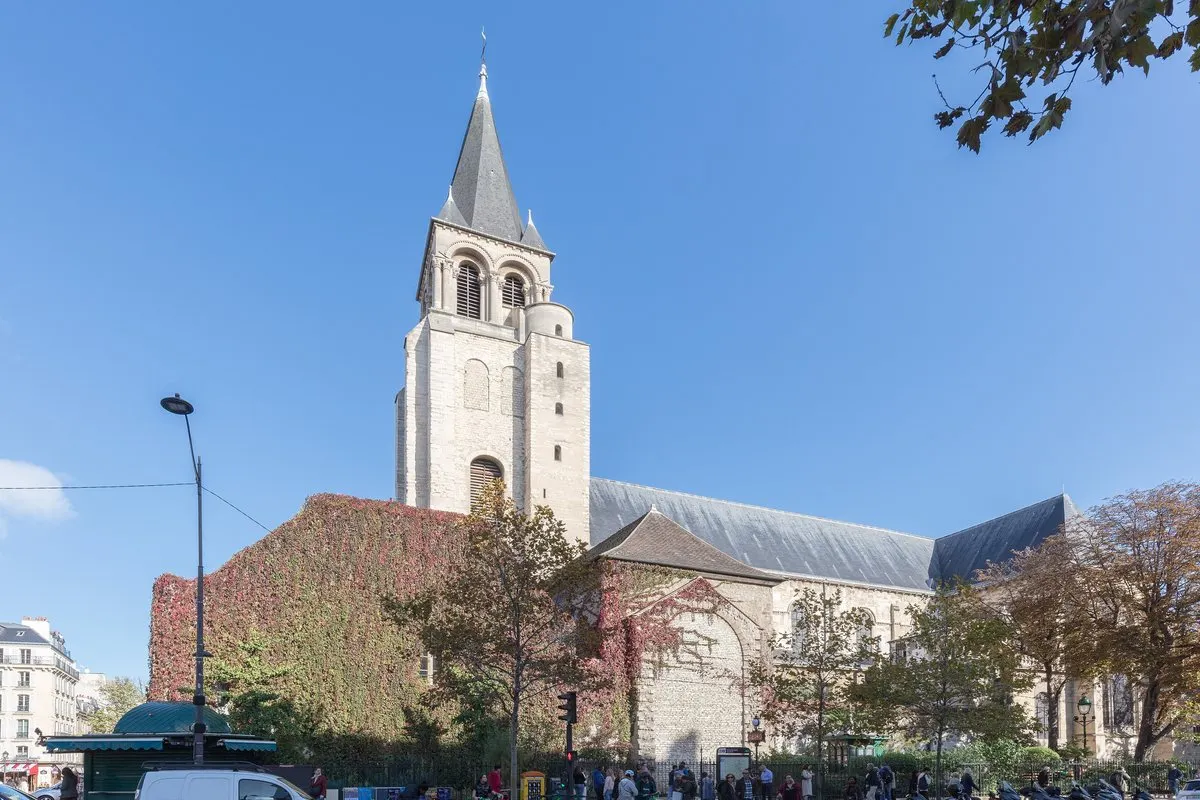
A church considered to be Paris's oldest, the cafés where existentialism was born, and the studio where Delacroix died. Saint-Germain-des-Prés is the Left Bank's most elegant district – here is our portrait.
In this story · 6 sections
Saint-Germain-des-Prés is one of four districts in Paris's 6th arrondissement, between the Seine to the north and rue du Four to the south. The name means Saint-Germain in the meadows, as the land remained open until the 17th century and was flooded by the river. Today it is one of the city's most elegant areas, with bookshops, publishing houses, galleries and the cafés where Sartre and Beauvoir wrote. The inhabitants are called germanopratins.
4 places
© OpenStreetMap contributors · OpenFreeMap
The church: the oldest in Paris
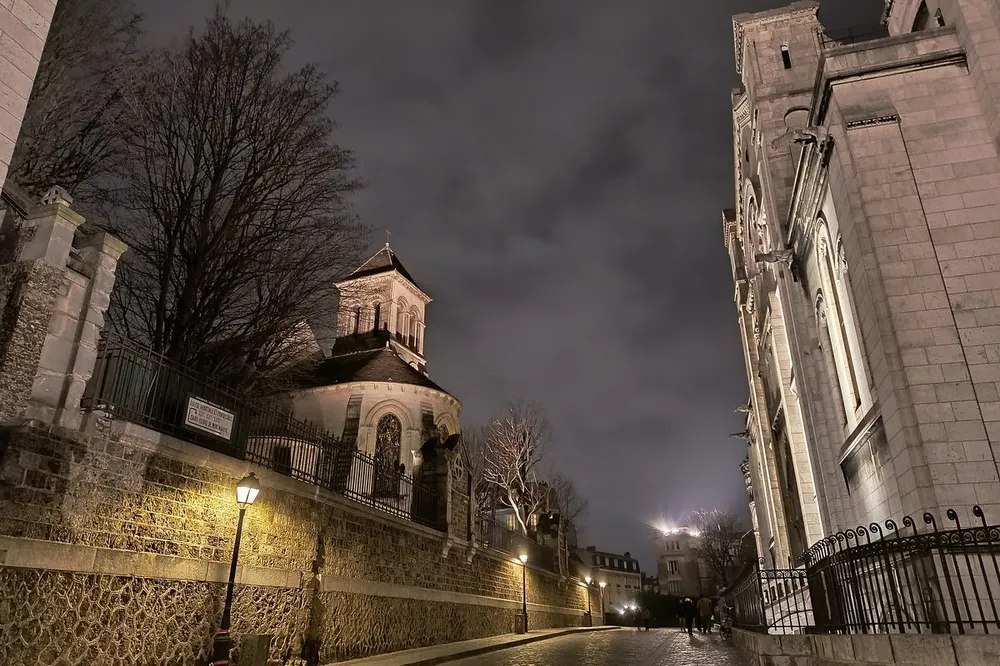
The abbey was founded by Childebert I, son of Clovis, to house relics he had brought back from the siege of Zaragoza, among them a piece of Saint Vincent's tunic. The church was consecrated in 558, the same year Childebert died, and became the burial place of the Merovingian kings. Around 754 it was dedicated to Saint Germain, bishop of Paris. The Vikings destroyed it twice in the late 800s, and it was rebuilt around the year 1000. In the 1100s it received some of the first flying buttresses in Île-de-France. The church is considered the oldest surviving one in Paris. Most of the abbey was demolished during the Revolution, but the church and the abbot's palace were saved.
The monastery was also a marketplace. The Foire Saint-Germain was already well known in 1176 and attracted merchants from across Europe. The street names recall the monastic life: rue du Four stands where the monastery's ovens were, and the dining hall lay along today's rue de l'Abbaye. The square in front of the church can be found on VERA PI's page about Place Saint-Germain-des-Prés.
Cafés and existentialism
In the 1940s and 1950s, Saint-Germain-des-Prés, like the rest of the Quartier latin, was the centre of existentialism. Around the square lie Les Deux Magots, where the Prix des Deux Magots has been awarded since 1933, Café de Flore with its art deco interior, and Brasserie Lipp, opened on 27 October 1880. Le Procope, founded in 1686, lies a few blocks east. We tell you about all four in our guide to Paris's great cafés and brasseries. Sit on a terrace on boulevard Saint-Germain and watch people go by – it's the neighbourhood's oldest pastime.
Rue de Furstemberg and Musée Delacroix
Behind the church lies rue de Furstemberg, an 82-metre-long street with a small square, named after Cardinal Guillaume-Egon de Fürstenberg, who became abbot here in 1697. The square was once the monastery's stable yard. According to Les Échos, the street was France's most expensive in 2024, calculated by property price per square metre.
At number 6 lies the Musée national Eugène Delacroix, in the painter's last flat and studio. He moved here on 28 December 1857 and lived here until his death on 13 August 1863 – close to the church of Saint-Sulpice, where he painted the Chapelle des Saints-Anges. The museum has a small garden and has been run by the Louvre since 2004. It is open every day except Tuesdays.
Rue Jacob, rue de Seine and the galleries
North of the church, towards the Seine, lie the streets that have given the neighbourhood its reputation for art and antiques. Rue Jacob and rue de Seine lead down towards the École des Beaux-Arts by the quay. The neighbourhood is also home to Sciences Po and several universities and research institutes, which gives the streets a mix of students and collectors.
Le Bon Marché and Lutetia
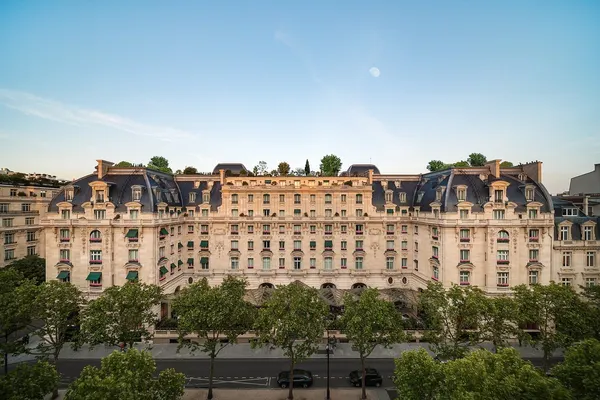
On the southern edge of the district, on rue de Sèvres in the 7th arrondissement, lies Le Bon Marché, founded in 1838 and revamped by Aristide Boucicaut from 1852 with fixed prices and the right to exchange goods. It is considered one of the world's first modern department stores, and in 1872 it was extended with the help of Gustave Eiffel's engineering firm. Opposite lies Lutetia, the art nouveau hotel from 1910 built by the Boucicaut family and known since 2025 as Mandarin Oriental Lutetia, Paris – we describe it in our guide to the palace hotels of Paris.
Walk through the neighbourhood like this
Start at the church of Saint-Germain-des-Prés, walk around it to rue de Furstemberg and Musée Delacroix, and continue north along rue Jacob and rue de Seine towards the Seine. Finish with a coffee on the boulevard or lunch at Lipp. The whole neighbourhood is featured on VERA PI's page about the 6th arrondissement, and the rest of the city is in our 48 hours in Paris.
Église Saint-Germain-des-Prés
The oldest church in Paris
The abbey church consecrated in 558, rebuilt around the year 1000.
Insider tipMetro: Saint-Germain-des-Prés (line 4).
Les Deux Magots
The existentialists' café
Sartre, Beauvoir and the Prix des Deux Magots.
6 place Saint-Germain-des-Prés, 75006 Paris
Musée national Eugène Delacroix
The painter's last studio
Delacroix's flat, studio and garden.
6 rue de Furstemberg, 75006 Paris
Insider tipClosed on Tuesdays.
Le Bon Marché
The department store from 1838
One of the world's first modern department stores.
24 rue de Sèvres, 75007 Paris