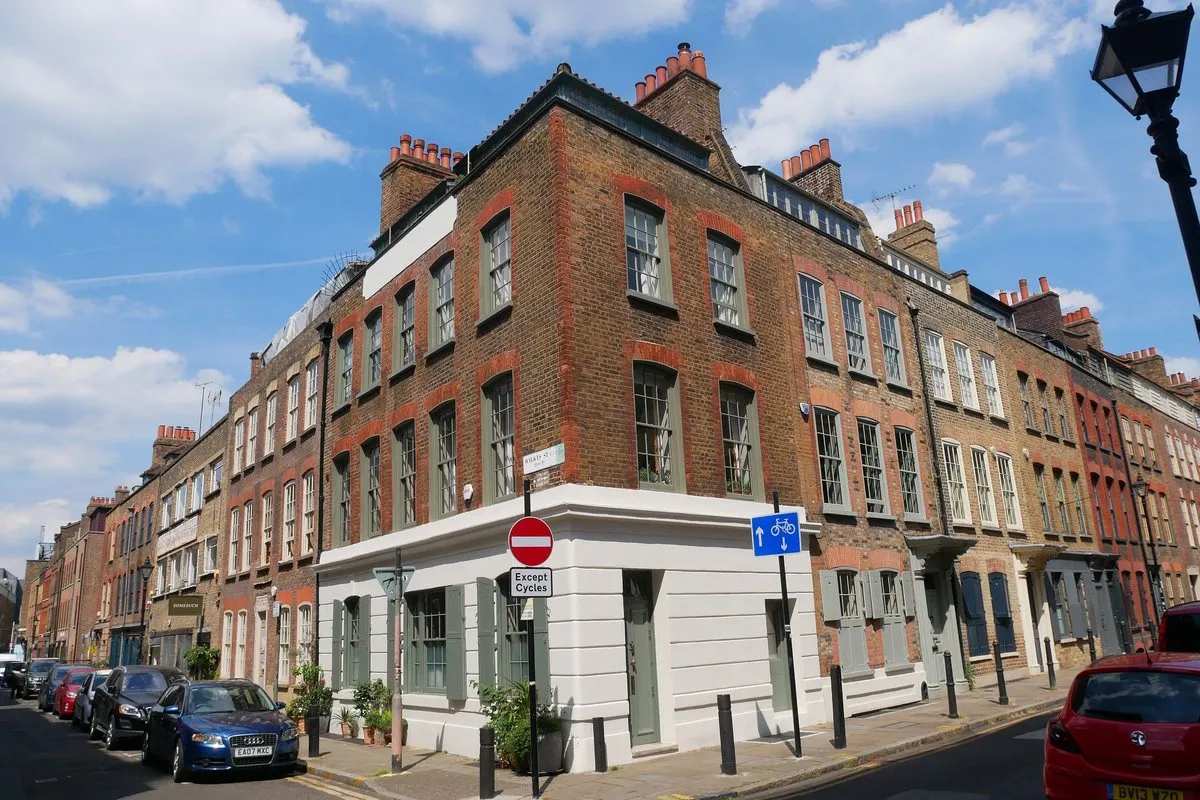
In the 1720s French Huguenot silk weavers built some of the finest early Georgian townhouses in Britain on the edge of the City of London. Spitalfields still has them – along Fournier Street, beneath Nicholas Hawksmoor's Christ Church – and one of them is a house where time stopped on purpose.
In this story · 5 sections
Spitalfields lies just outside the City of London in the borough of Tower Hamlets, around Commercial Street and Brick Lane. It is a place of markets – Old Spitalfields Market, Brick Lane Market and Petticoat Lane – and of waves of migration: French Huguenots in the 18th century, Jewish families from Eastern Europe in the 19th, and since the second half of the 20th century a large Bangladeshi community. Its Georgian streets are among the best preserved in Britain.
2 places
© OpenStreetMap contributors · OpenFreeMap
Spitalfields in dates- 1197
- St Mary Spital founded
- 1714–1729
- Christ Church built
- 1720s
- Fournier Street houses built
- 1743–44
- Huguenot chapel, now the Great Mosque
- 1979
- Dennis Severs buys 18 Folgate Street
From St Mary Spital to a silk-weaving suburb
The name goes back to St Mary Spital, a priory and hospital founded on the east side of Bishopsgate in 1197 – “spital” being a corruption of “hospital”. It appears as Spittellond in 1399. Spitalfields was a hamlet of the ancient parish of Stepney and became a parish of its own in 1729. By then a significant community of wealthy French Huguenots had settled here, many bringing silk-weaving skills from Nantes, Lyons and other cities.
Fournier Street – the master weavers' houses
Fournier Street, formerly Church Street, runs between Commercial Street and Brick Lane. It was the last street built on the Wood-Michell estate, and its houses, mainly from the 1720s, form one of the most important and best preserved collections of early Georgian townhouses in Britain. They were bought and leased by master silk weavers and mercers, and have fine panelling, carved staircases and door-cases. The looms were in the highly glazed lofts at the top, for the best light, and the ground-floor rooms served as showrooms. At Howard House, No. 14, built around 1726, the silk for Queen Victoria's coronation gown was woven.
At the Brick Lane end stands a building that tells the area's whole story: built as a Huguenot chapel in 1743–44, later a Methodist church, from 1898 the Machzike Hadath Synagogue and since the 1970s the London Jamme Masjid, the Great Mosque. Its sundial still reads “Umbra sumus” – “we are shadows”.
Christ Church – Hawksmoor's English Baroque
At the western end of Fournier Street rises Christ Church Spitalfields, designed by Nicholas Hawksmoor, a former assistant of Christopher Wren, and built between 1714 and 1729. The Grade I listed church is widely considered the highest expression of English Baroque architecture. Opposite stands the Ten Bells pub, notorious for its connection with Jack the Ripper in the 1880s.
Dennis Severs' House – a still-life in ten rooms
At 18 Folgate Street, a Grade II listed house from around 1724, the Californian Dennis Severs lived from 1979 to 1999 and recreated its ten rooms in the styles of former centuries, as if a family of Huguenot silk weavers – the fictional Jervises – had just left the room. There is half-eaten bread, candlelight, smells and sounds; his friend Dan Cruickshank called it “an evocation of a world”. The house's motto is “Aut Visum Aut Non!” – you either see it or you don't. Severs was part of the group sometimes called the Neo-Georgians, who restored Spitalfields houses from the late 1970s.
How to walk Spitalfields
Start at Old Spitalfields Market, cross Commercial Street to Christ Church, walk slowly down Fournier Street looking up at the weavers' lofts, and turn into Brick Lane. Book ahead for Dennis Severs' House on Folgate Street. Explore the streets in VERA PI's street files for Fournier Street and Folgate Street, see all of Tower Hamlets, or start with VERA PI's London guide.
Christ Church Spitalfields
Hawksmoor's Baroque church
Built 1714–1729, Grade I listed.
Commercial Street, London E1
Dennis Severs' House
A Georgian house as a still-life
Ten rooms recreated as the home of a family of Huguenot silk weavers.
18 Folgate Street, London E1