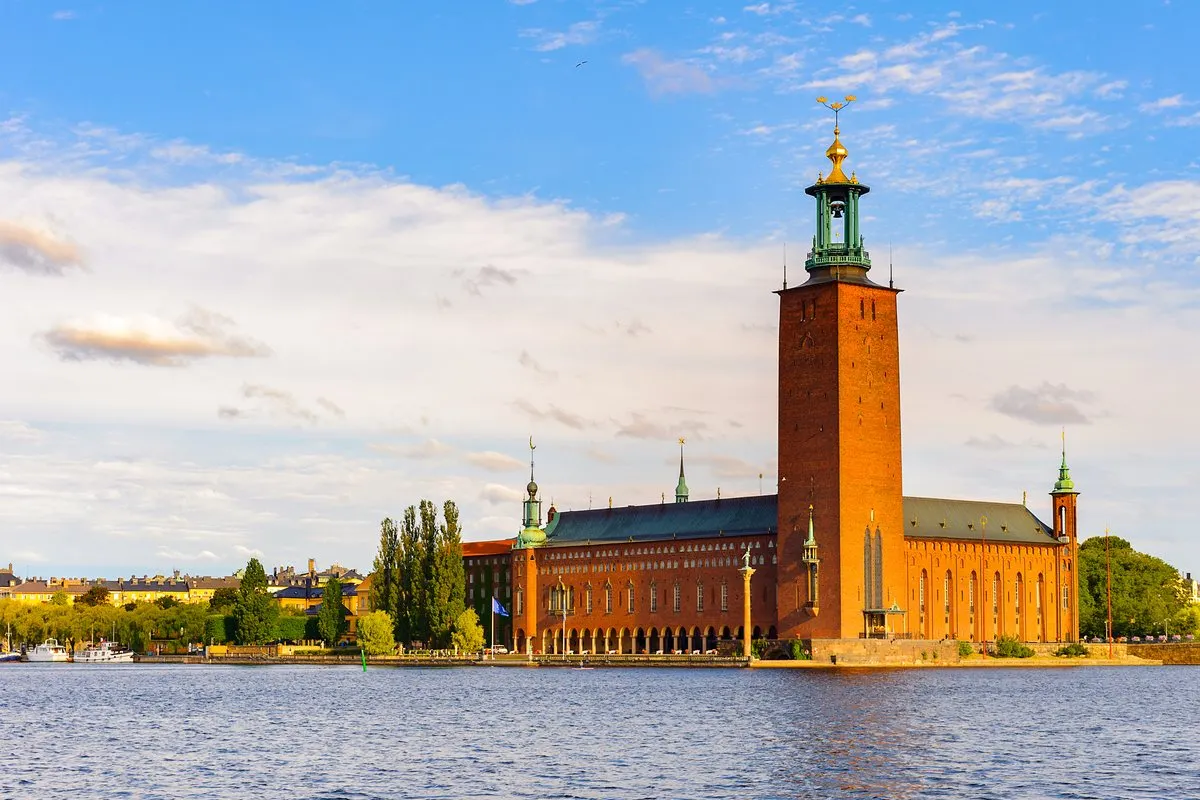
Eight million bricks, more than 18 million mosaic pieces of glass and gold, and a hall that never turned blue. Stockholm City Hall is the masterpiece of National Romanticism – and every December the venue for the world's most watched dinner.
In this story · 6 sections
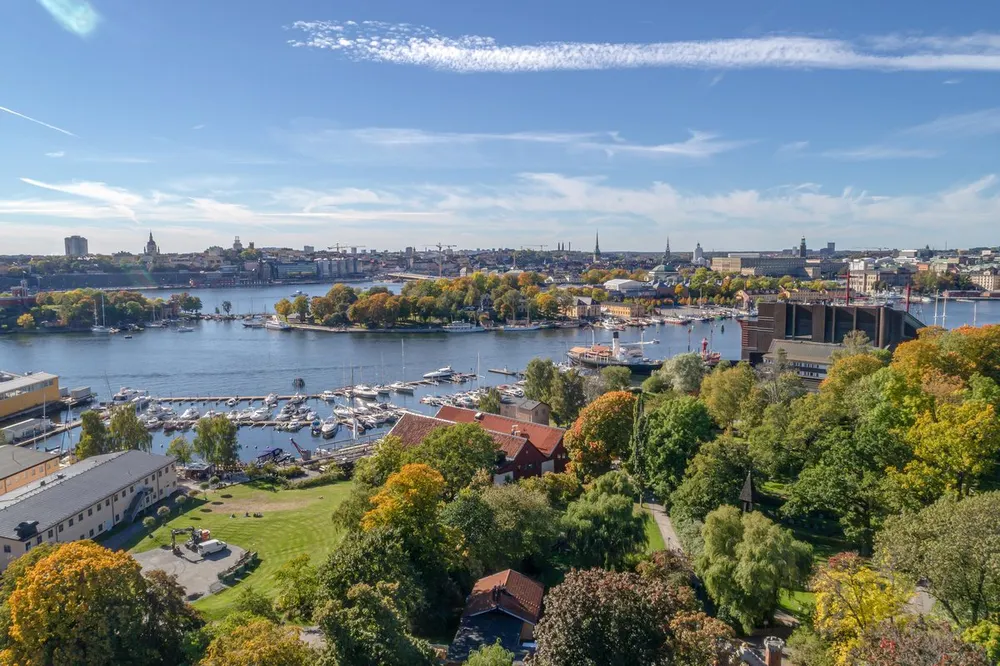
From the cliffs of Södermalm, Stockholm City Hall appears to rise straight out of Riddarfjärden: a long, dark red brick building with arcades facing the water and a tower that narrows towards three gilded crowns 106 metres up. It is one of the city's most photographed buildings, and anyone who has seen it in evening light understands why. But the City Hall on Kungsholmen is more than a silhouette. It is a working municipal building, an art museum in brick – and the place where the Nobel laureates dine every December.
Stockholm City Hall
Sight · Kungsholmen
© OpenStreetMap contributors · OpenFreeMap
- Address
- Hantverkargatan 1, Stockholm
- Architect
- Ragnar Östberg
- Opened
- 23 June 1923
- Height of the tower
- 106 metres
- Bricks
- Just over 1 million hand-made, just under 7 million machine-made
- Mosaic pieces in the Golden Hall
- Just over 18.6 million
- Organ pipes
- 10,271
The Blue Hall, the Golden Hall, the Prince's Gallery and a tower 106 metres tall with a view over the city.
01Fifteen years to build
Stockholm City Council decided in 1908 to erect a municipal building with a ceremonial hall on the old Eldkvarn site by Lake Mälaren, after a proposal for a combined town hall had come to nothing. The commission went to the architect Ragnar Östberg, whose proposal Mälardrott had already been selected in an architectural competition for the site. The construction took fifteen years, and the City Hall was inaugurated on Midsummer's Eve, 23 June 1923 – four hundred years after Gustav Vasa's entry into Stockholm.
Östberg is said to have been inspired by the volume and waterside arcades of the Doge's Palace, and by St Mark's Campanile in Venice, which he had visited on his scholarship trip in 1897. But the resemblance ends there. The exterior and interior of the City Hall bear traces of Italian Renaissance, Nordic Gothic, Byzantine and Islamic art, woven together into an entirely distinctive style of its own. Just over one million hand-made and nearly seven million machine-made bricks were used, and the construction of the City Hall has been called the last genuine masons' lodge in Sweden. Since 2025, the building has been part of Sweden's cultural canon.
02The tower and the three crowns
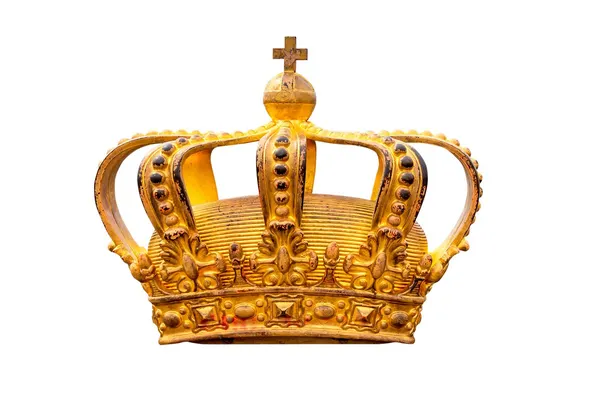
The tower was what concerned Östberg most. As late as 1919 it was still unclear how it should be finished, and the caricaturists suggested schnapps glasses and equestrian statues. The solution became a slender, copper-clad spire with a gilded finial and three crowns, Sweden's old symbol, to show that the building was a concern for the whole kingdom. The crowns have a diameter of 2.2 metres each and face broadside towards the Royal Palace.
Insider tipThe tower is only open during the summer half of the year – book in advance.
A lift goes up to the tower's fifth floor, but you can also climb the 365 steps. There you'll find the tower museum, which includes the 7.6-metre-high plaster model of Saint Erik, which was intended to stand in the tower but could never be hoisted up. Higher up, a sloping passage leads around the tower's walls to the viewing terrace 73 metres above sea level. The tower is open during the summer half of the year; for safety reasons, a maximum of 30 people may be there at the same time, and each visit lasts 35 minutes.
03The Blue Hall – which is not blue
The Blue Hall, the great banqueting hall, was meant to be rendered blue. But when Östberg saw the dark red brick, he changed his mind and instead had the surface hammered to give it texture. The name remained. This is also where the City Hall organ stands, with 10,271 pipes distributed across 135 stops – Scandinavia's largest musical instrument – and it is here that the Nobel Banquet is laid out every year.
04The Golden Hall and the Prince's Gallery
One floor up lies the Golden Hall, named after the more than 18.6 million mosaic pieces of coloured glass and gold that cover the walls. The mosaic was created by Einar Forseth, then only thirty years old, and depicts motifs from Sweden's history. The entire end wall is occupied by the Queen of Lake Mälaren, the symbol of Stockholm, with the City Hall in her lap. The mosaic was assembled in 1921–1923 by the German firm Puhl & Wagner in Berlin and was funded by a donation from Josef Sachs, the founder of Nordiska Kompaniet.
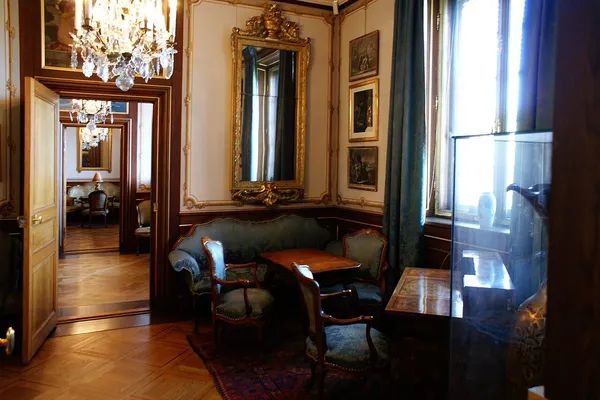
Along the south side of the building runs the Prince's Gallery, about 45 metres long, named after Prince Eugen. On one of the long walls, the prince painted in fresco the view over Riddarfjärden and Södermalm – the same view seen through the windows opposite. In the Council Hall, where the city council meets, the ceiling rises nineteen metres with exposed roof trusses inspired by the Viking Age, and the furniture was designed by Carl Malmsten.
05The Nobel Banquet
The first Nobel Banquet in 1901 had 113 guests, all of them men, and before 1930 the banquet was held at the Grand Hôtel. Since then it has usually been held in the Blue Hall of the City Hall on 10 December. Today there are around 1,300 guests, of whom 200 are students. The dinner lasts for four hours, the menu is not revealed until the evening itself, and the dishes are carried in in a procession. Two toasts are proposed: a toast to the King and the King's toast to the memory of Alfred Nobel. Since the early 1970s, the flowers have come from San Remo, where Nobel lived when he died. After the dinner, the guests go up the stairs to the Golden Hall to dance. The banquet is broadcast every year by SVT, the Swedish public broadcaster.
06How to visit the City Hall
The City Hall's ceremonial halls are shown on guided tours year-round; a tour takes around 45 minutes and goes through the Blue Hall and the Golden Hall, in English and Swedish. According to Wikipedia, the halls were visited by around 500,000 people in 2018 – do book in advance during the summer. The City Hall is also a popular venue for civil wedding ceremonies, which are held in the Oval Hall on Saturdays.
Combine the visit with a walk along Kungsholmen's quay. Check facts and sun position in VERA PI's street guide to Norr Mälarstrand and to Hantverkargatan, read our plan for a day on Kungsholmen and our review of Norr Mälarstrand, Kungsholmen's sunny side. And from the other side of the water: point your phone at the City Hall with Metro Mode Camera.