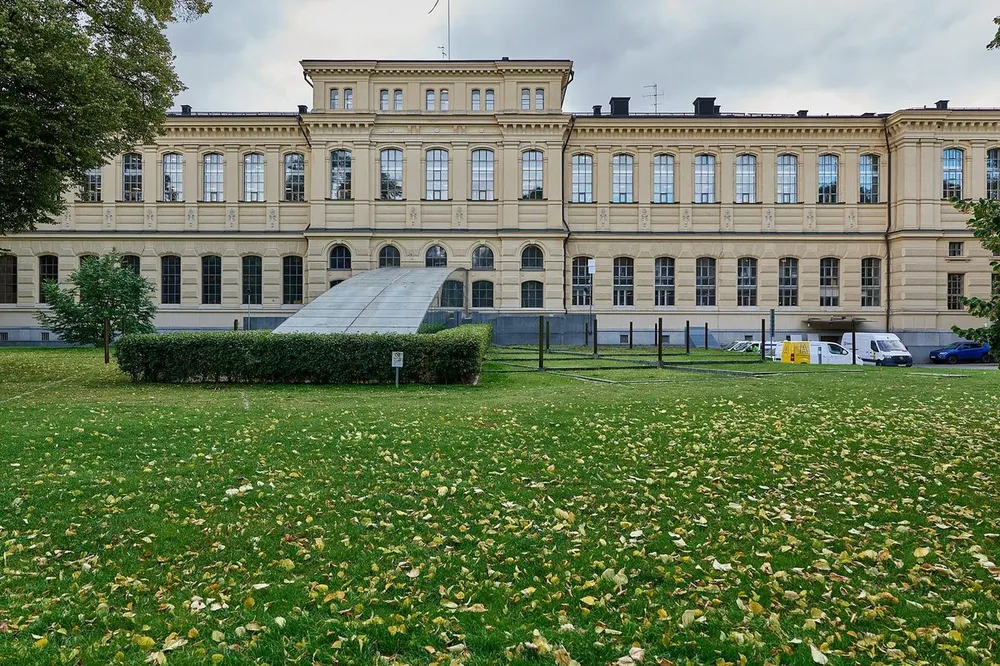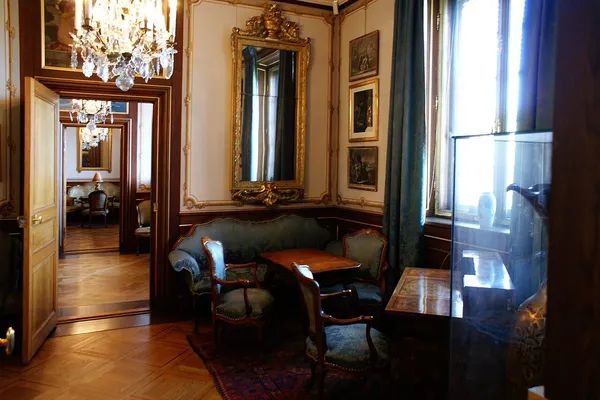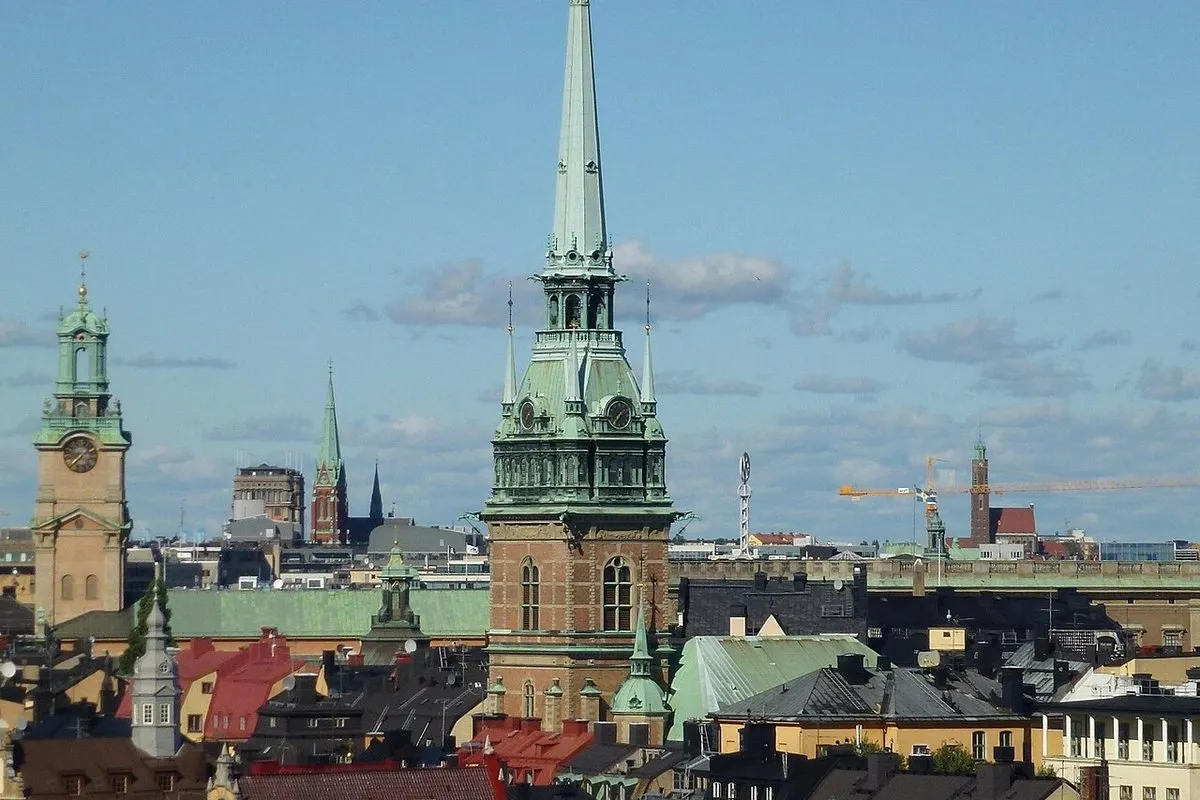
A Hanseatic merchants' guild house turned Baroque hall church, a royal gallery by Tessin, a pulpit of ebony and alabaster and a copper spire whose gilded cockerel marks the highest point of the old town. St Gertrude's, the German Church, is Gamla stan's quiet showpiece.
In this story · 6 sections
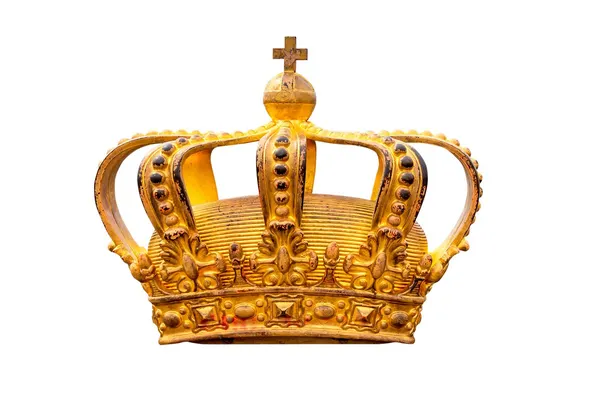
Look up from almost anywhere in Gamla stan and you will find it: a slender copper-green spire flanked by four turrets and crowned by a gilded cockerel, rising above the red roofs between Svartmangatan and Tyska brinken. This is the German Church, also known as St Gertrude's, and its cockerel, 96 metres above the water, is the highest point of the old town. Inside the courtyard gate lies one of the richest Baroque interiors in Stockholm, built by and for the German merchants who did so much to shape the medieval city.
The German Church
Church · Gamla stan
© OpenStreetMap contributors · OpenFreeMap
- Address
- Svartmangatan 16A, Stockholm
- Address
- Svartmangatan 16A, Gamla stan
- Dedication
- St Gertrude of Nivelles
- Congregation
- Founded 1571
- Hall church
- 1638–1642, Hans Jacob Kristler
- Spire
- 1887, Julius Raschdorff
- Organ
- Reconstruction of the Baroque organ, 2004
Former Hanseatic guild house rebuilt as a Baroque hall church, with Tessin's royal gallery.
01From guild house to church
The church stands on the site of the guild house of St Gertrude, founded in the fourteenth century by German merchants in the great age of the Hanseatic League. Gertrude of Nivelles was the patron saint of travellers and seafarers – according to legend she saved sailors who called on her in a storm – and her cult spread to the Nordic countries in the mid-fourteenth century, often through guilds in towns with German populations. Before the Reformation the guild had a hall with a banqueting room here, while its services were held in a chapel of its own in nearby Storkyrkan. The guild house's vaulted cellars survive beneath the church.
After the Reformation the guild was dissolved and the house passed to the crown, but in 1571 John III granted Stockholm's German congregation a series of new privileges, and in 1607 it regained the guild house. It was converted into a single-aisled vaulted chapel and later extended into a parish church; the round-arched windows on the north wall date from that time. A first tower followed in 1613–1618, to designs by Hubert de Besche.
02Kristler's hall church
The church owes its present form to Hans Jacob Kristler of Strasbourg, one of the leading master builders of his day and the man behind the famous Makalös palace for Jacob De la Gardie. In 1638–1642 he rebuilt the chapel as a two-aisled hall church in late Gothic style, mixed with German-Dutch Renaissance forms, and the new south façade was given tall pointed Gothic windows in contrast to the older round-arched ones on the north side. The walls are of dark red brick divided by buttresses, with details of grey sandstone. The main portal, in restrained Baroque, carries sandstone sculptures by Joest Henne from Westphalia of Jesus and Moses, crowned by Faith, Hope and Charity.
Insider tipCheck opening times – an active parish church.
Over the gate from Tyska brinken into the churchyard, a gilded German inscription reads "Fürchtet Gott! Ehret den König!" – "Fear God, honour the King", from the First Epistle of Peter.
03The spire
On the night of 7 October 1878 a fire destroyed the tower. The Berlin architect Julius Raschdorff – later the architect of Berlin Cathedral – designed both the restoration of the interior and the new copper-clad spire, completed in 1887. Hymn music sounds from the tower four times a day.
04Inside
The church room is an airy, almost square hall under star vaults, carried on half-columns of limestone, with a floor of black, white and brown patterned marble. Where a Swedish church would normally have its central aisle towards the altar, two mighty sandstone pillars hold up the vaults – one reason the room feels unusually broad.
The altarpiece, almost 10 metres high, was created in 1641–1659 by Marcus Hebel from Holstein; medallions show its donors, the merchant Hans Bremer and his wife. The octagonal pulpit of ebony with alabaster figures of Christ and the apostles, by an unknown master, was given in 1660 by the burgher couple Peter Hanssen and Anna Hansdotter Stecker. The royal gallery was designed in 1672 by Nicodemus Tessin the Elder, a member of the congregation, for the dowager queen Hedvig Eleonora and the young Charles XI, and its ceiling carries a painting by David Klöcker Ehrenstrahl, another member. The pews date from 1649, and the painted glass windows were made in Munich in the late nineteenth century.
The baptismal chapel in the south-east corner holds the church's oldest furnishings, from around 1580, including a gilded silver font bowl made in 1670 by the Stockholm silversmith Arvid Falk.
05The organ
The church's original Baroque organ was sold at the end of the eighteenth century, and most of it has stood in Övertorneå church in the far north of Sweden since 1779. In 2004 a reconstruction, based on the original as it appeared in the mid-1680s and built by Grönlunds Orgelbyggeri in Gammelstad, was inaugurated on the gallery.
06Visiting
Most services follow the Church of Sweden's order but are held in German; the parish is one of the Church of Sweden's non-territorial congregations. Check opening times before you go, and walk on along the lanes around the church. Read about them in VERA PI's guides to Svartmangatan, Tyska brinken and Prästgatan, explore Gamla stan with VERA PI, find the church on Metro Mode's Stockholm map and point your phone at the spire with Metro Mode Camera.