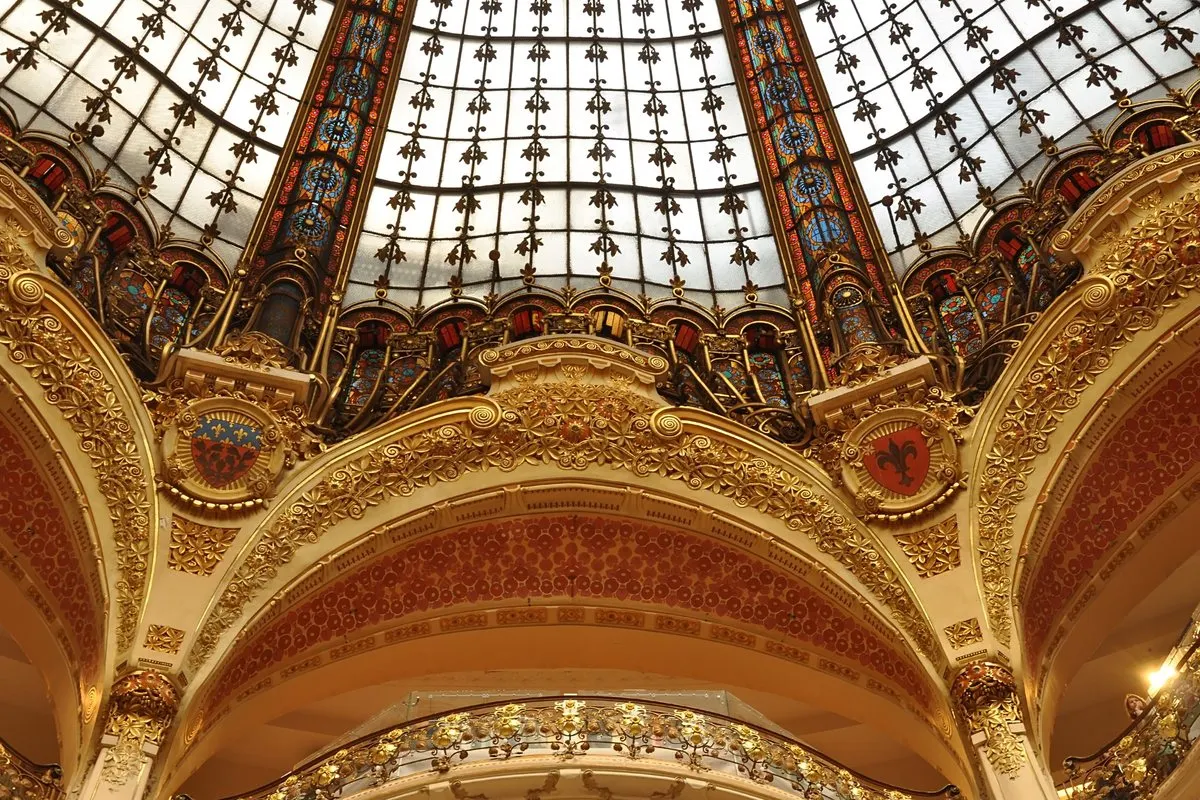
Paris invented the modern department store, and four of the great houses still trade under glass domes and iron galleries. Galeries Lafayette, Printemps, Le Bon Marché and La Samaritaine: what each does best, and how to shop them with some ease.
In this story · 5 sections
The department store is a Paris invention, or near enough. In the second half of the nineteenth century, as Haussmann cut new boulevards through the city, merchants built palaces of commerce with fixed prices, open displays and the freedom to browse without buying. Émile Zola wrote a novel about it. Four of the great houses, the grands magasins, still trade today, and each has a distinct character worth knowing before you go.
Le Bon Marché Rive Gauche
Department store · 7th arrondissement
© OpenStreetMap contributors · OpenFreeMap
- Address
- 24 rue de Sèvres, 75007 Paris
- Le Bon Marché
- 1838; reinvented 1852; Left Bank, 7th
- Galeries Lafayette
- 1894; dome completed 1912; 9th
- Printemps
- Boulevard Haussmann, 9th
- La Samaritaine
- 1870; reopened 2021; 1st
- Best for
- Fashion, beauty, food halls, architecture
A calm, curated department store owned by LVMH, with La Grande Épicerie food hall next door at 38 rue de Sèvres.
01Le Bon Marché: the original, on the Left Bank
Le Bon Marché was founded in 1838 as a modest shop selling lace, ribbons and bedding. In 1852 Aristide Boucicaut became a partner and changed everything: fixed prices replaced haggling, goods could be exchanged or refunded, and the range widened. Annual income rose tenfold within eight years. A much larger building followed in 1869 at the corner of rue de Sèvres, designed by Louis-Auguste Boileau, and it was extended in 1872 with the engineering firm of Gustave Eiffel.
Today it belongs to LVMH and is the most refined of the four: calmer, more curated, with crossing escalators in white beneath the skylights and a clientele that is largely Parisian. Next door at 38 rue de Sèvres, La Grande Épicerie de Paris is its food hall, and among the best in Europe for olive oils, French butter, tinned fish and pastries. If you visit only one store, make it this one.
02Galeries Lafayette Haussmann: the dome
In 1894 Théophile Bader and his cousin Alphonse Kahn opened a small fashion shop at the corner of rue La Fayette and the Chaussée d'Antin. By 1905 they had bought the buildings on boulevard Haussmann, and the architect Georges Chedanne and his pupil Ferdinand Chanut gave them a glass and steel dome and Art Nouveau staircases, completed in 1912.
Insider tipMétro line 10 or 12 to Sèvres–Babylone.
The dome is the reason to come. Stand beneath it on the ground floor and look up through tiers of gilded balconies to the stained glass. The store is busy and international, strong on fashion, beauty and accessories; go early on a weekday if you want space to think. Do not leave without taking the escalators to the top: the rooftop has a bar, a restaurant and a terrace with a panoramic view taking in the Eiffel Tower, Les Invalides and the Opéra Garnier next door.
03Printemps Haussmann: the neighbour
A few doors west along the boulevard, Printemps occupies several linked buildings with fine historic façades and its own stained-glass cupola. It is the natural counterpart to Lafayette, with separate buildings for womenswear, menswear and beauty, and a strong luxury floor. Its upper terraces also offer views across the rooftops of the 9th arrondissement, and the two stores together make a practical morning's shopping.
04La Samaritaine: Art Nouveau by the Seine
La Samaritaine was opened in 1870 by Ernest Cognacq on the corner of rue du Pont-Neuf and rue de la Monnaie, and named after an old pumping station on the nearby Pont Neuf. The architect Frantz Jourdain gave it an Art Nouveau interior of iron, glass and painted panels. It closed in 2005 and, after sixteen years and a long restoration by its owner LVMH, reopened in June 2021. A new undulating glass façade by the Japanese firm SANAA faces rue de Rivoli, and the complex also includes the Cheval Blanc Paris hotel. Come for the restored peacock fresco and the great staircase under the glass roof, even if you buy nothing.
05How to shop the grands magasins
Group the stores by area: Lafayette and Printemps in the morning on boulevard Haussmann, then cross the river for Le Bon Marché and lunch from the Grande Épicerie, ending at La Samaritaine by the Seine in the late afternoon. Visitors from outside the EU should ask about tax-free shopping at each store's welcome desk with their passport. For the surrounding streets, see our guides to the 9th arrondissement and the 7th.